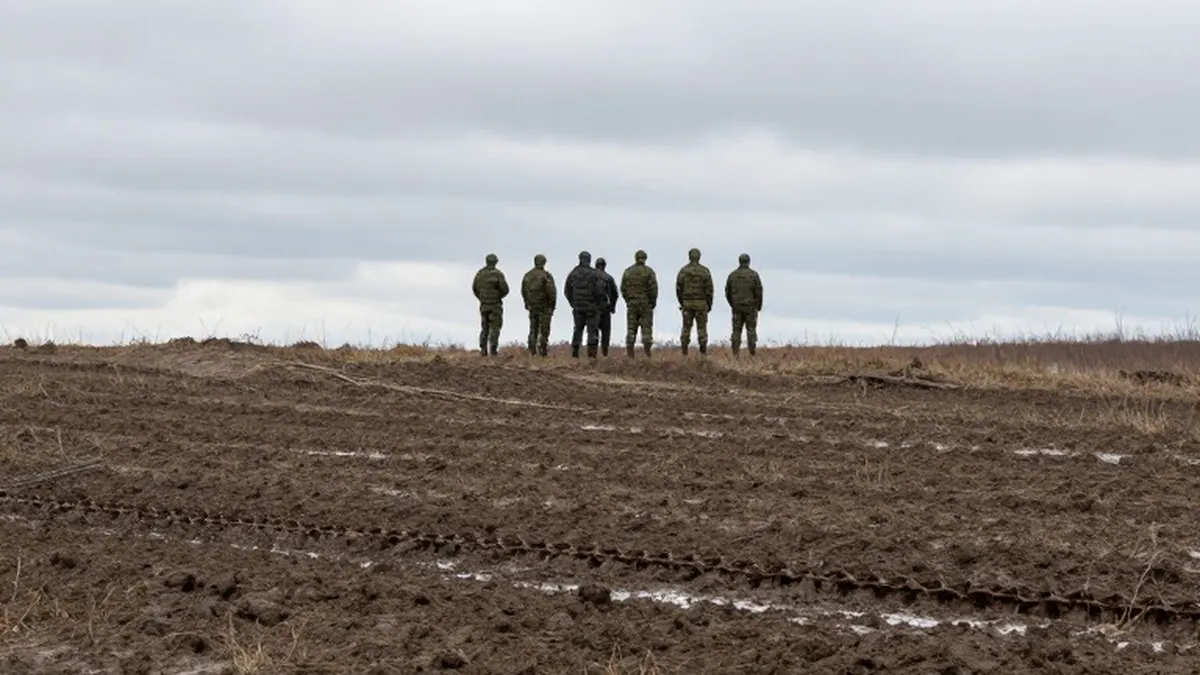
Ukrainian military forces have expanded their control over occupied land following a new offensive that coincided with record-breaking Russian casualties. The operation, identified as the fourth major effort of the year, targeted the northern Kharkiv region. Details of the campaign were released on November 20, revealing that Ukrainian troops successfully cleared Russian forces from hundreds of square kilometres of territory.
The offensive, designated Operation Bear Trap, was launched approximately one month after Russia claimed to have encircled 2,000 Ukrainian soldiers near the town of Velykyi Burluk. Ukrainian commanders, recognizing the threat of a pincer movement, executed a strategy relying on secrecy and deception. By utilizing a Russian T-80 tank and an American Abrams M-1 tank to attack the border town of Vilhuvatka, they created a false impression of their primary attack vector.
While Russian reinforcements moved to shore up defences, Ukrainian forces struck from the rear. Drones were also employed to mine resupply routes remotely. The Ukrainian command reported that the operation has liberated 200 square kilometres and 14 settlements so far. Although the effort is ongoing, it has foiled the Russian plan to seize nearly 500 square kilometres. Russian troops still occupy at least four border villages, including Vovchansk, but the broader encirclement has been broken.
This success mirrors earlier Ukrainian efforts, such as Operation Vivaldi, which prevented an encirclement of the fortress belt in the Donetsk region. However, challenges remain. The Ukrainian General Staff reported active defensive operations in Donetsk to stop assaults, while nationwide power outages continue to strain civilians. Retired colonel Konstantyn Mashovets noted that Ukrainian forces also advanced in southern Zaporizhia, clearing infiltrators near the Solona river.
Russian losses have reached historic levels. On November 24, Ukraine’s military reported that Russian casualties had climbed to a record 432,519. The following day, the monthly total for November hit a new high of 55,629, with five days remaining in the month. Despite these battlefield realities, US mediation efforts have focused on two proposals involving territorial exchanges for peace.
According to reports from The Wall Street Journal, one proposal suggests Ukraine cede the Donetsk fortress belt in exchange for full NATO membership, a concept President Volodymyr Zelenskyy has rejected. The second option, which US negotiator Jared Kushner described at a Berlin news conference, involves freezing the front line in return for NATO-style security guarantees based on Article 5. Kushner stated that President Trump is open to this concept if it serves American interests, implying that broader European security arrangements must be part of the deal.
Zelenskyy expressed skepticism regarding a direct deal between Donald Trump and Russian President Vladimir Putin. He told Bloomberg that the US and Russia seemed aligned in pushing Ukraine toward unfavourable compromises. He also highlighted logistical issues, noting that limitations in the Starshield system and reduced missile deliveries for Patriot systems had hindered Ukraine’s air defence capabilities.
European leaders have also voiced concerns. German Chancellor Friedrich Merz told parliament that Russia is escalating tensions in the Baltic, Poland, the Black Sea, and space. His remarks followed the crash of two Russian missiles and a drone in Poland on November 20. This incident occurred during the first military exercise of a multinational force comprising over 5,000 personnel from ten nations.
Ukraine has responded aggressively to Russian advances. On November 21, it struck the Russian logistics vessel Sparta II. The next day, Ukrainian naval drones sank the Russian corvette Merkury near Benghazi, Libya, an action that has strained relations with Italy. The Security Service of Ukraine stated that seven unmanned boats were launched from a mother ship. On the same day, another Russian logistics ship, the Angara, was hit in the Mediterranean.
Strikes inside Russia have also intensified. Ukrainian forces damaged a Mig-31 and two Sukhoi-24 bombers at the Savasleyka airfield on November 25. They also targeted the Kaleykino pumping station on the Druzhba oil pipeline, destroying three large oil tanks. Attacks on key refineries in Novoshakhtinsk, Permnefteorgsintez, Kuibishevsk, and Sizran have reduced Russia’s refining capacity by an estimated one-third, leading to fuel shortages and increased imports of refined fuels.