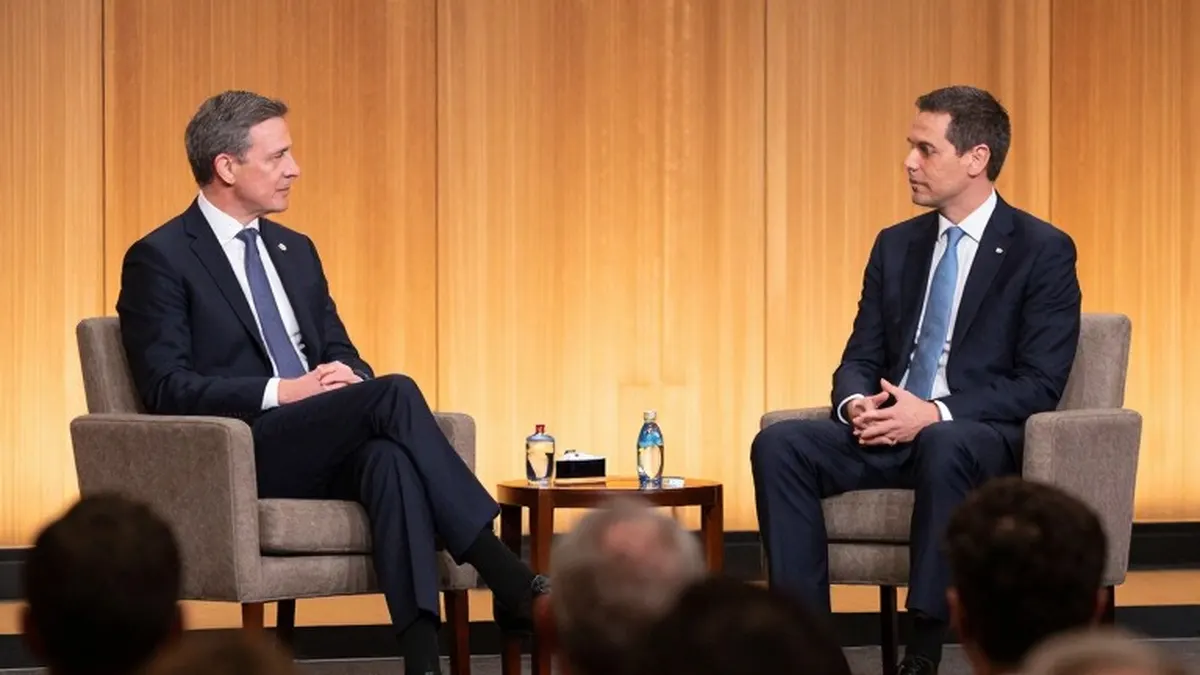
Former US secretaries of state Antony Blinken and Mike Pompeo appeared together in Washington on Sunday and played down the expected end of American military assistance to Israel, saying such a move would not harm the overall relationship between the two countries.
Their remarks came after President Donald Trump declared that the roughly $4 billion the United States provides Israel each year will get "cut off at the end of the year." The two men spoke at the Jewish Federations of North America's annual General Assembly, where they also defended Israel's security and its right to defend itself following the Hamas-led October 7, 2023, attack, and condemned voices that equate Israel's actions with those of Hamas or accuse it of genocide.
The shared ground was striking given that Pompeo, a Republican, served as secretary of state under Trump from 2018 to 2021, while Blinken, a Democrat, held the post under Joe Biden from 2021 to 2025. Still, some differences were visible. Blinken criticized Israel's conduct of the Gaza war, saying that after October 7 the Israelis did "for the most part, the bare minimum" for civilians caught in the crossfire, and that "there was a certain amount of disregard, a certain amount of disdain for the well-being of the Palestinian civilians." He stressed, however, that this was "vastly different" from an intent to harm or eliminate them, saying the target was Hamas even as too many people suffered terribly.
Blinken also warned that American attitudes toward Israel are at "an inflection point." He recalled telling Prime Minister Benjamin Netanyahu during the Gaza war that Israel was "not only losing the Democratic Party" but would also lose young Republicans and young evangelicals.
On the aid question, Pompeo, who previously led the CIA, said he did not "know exactly how this administration will follow through on that," but noted that Jerusalem and Washington have held conversations about "what's the appropriate level of assistance and what [is] the right model" for cooperation, and that calls to change the nature of the aid have become bipartisan. He said he was "very optimistic," arguing that whether the US provides the $4 billion, which mostly goes to buy American weapons systems from contractors such as Lockheed and Raytheon, is "much less material than the nature of the relationship." He said there would still be deep connectivity, assistance and a historically important partnership, adding, "We couldn't do the intelligence work we need to do without them," and "They save American lives all the time." He noted that he still faces a death threat from Iran and that Israeli intelligence has been very helpful in keeping him safe.
Israel's 10-year memorandum of understanding with the United States, which pledges $3.8 billion annually for fiscal years 2019 through 2028 subject to congressional appropriations, has become a political liability for Trump. Last week he questioned why his administration should face Democratic criticism over the issue, and after the GOP's midterm losses, Vice President JD Vance wrote that voters want to "change our relationship to Israel."
Blinken largely echoed Pompeo on aid, saying he sees "a recognition on the part of the Israeli government that this thing is not going to last forever," and an effort to show the Israeli public that "we can pay for our own stuff." He added that this "doesn't change anything.. about the inherent value of the relationship and the partnership."
The two diverged more sharply on Iran. Pompeo said he simply does not think a negotiated settlement is possible with the current regime, even while acknowledging the US cannot now curb Iran's ambitions militarily. He called for continued pressure through the economic blockade and by "going after further assets inside of Iran," and insisted, regarding concessions to keep the Strait of Hormuz open, "We should never give the Iranians a damn thing." Blinken countered that Trump must recognize the war against Tehran "wasn't a real win" even if it "might not be a loss," and said concessions, possibly including sanctions relief, may be needed to bring Iran back to the table, alongside sustained economic pressure. He cited the 2015 nuclear deal and the end of the Iran-Iraq war as evidence that negotiation, not capitulation, serves American interests.
On the Palestinian issue, Blinken argued that part of Hamas's motive for the October 7 attack was to preempt expansion of the Abraham Accords, and that fully realizing that vision "requires a resolution of the Palestinian question." He said he believes "to the bottom of my heart" that the only way forward is "a secure Israel and a sovereign Palestine." Pompeo pushed back, saying a key to the Accords' success was "not letting the conflict between the Palestinians and the Israelis get in the way of what the Gulf Arab states actually know needs to happen."