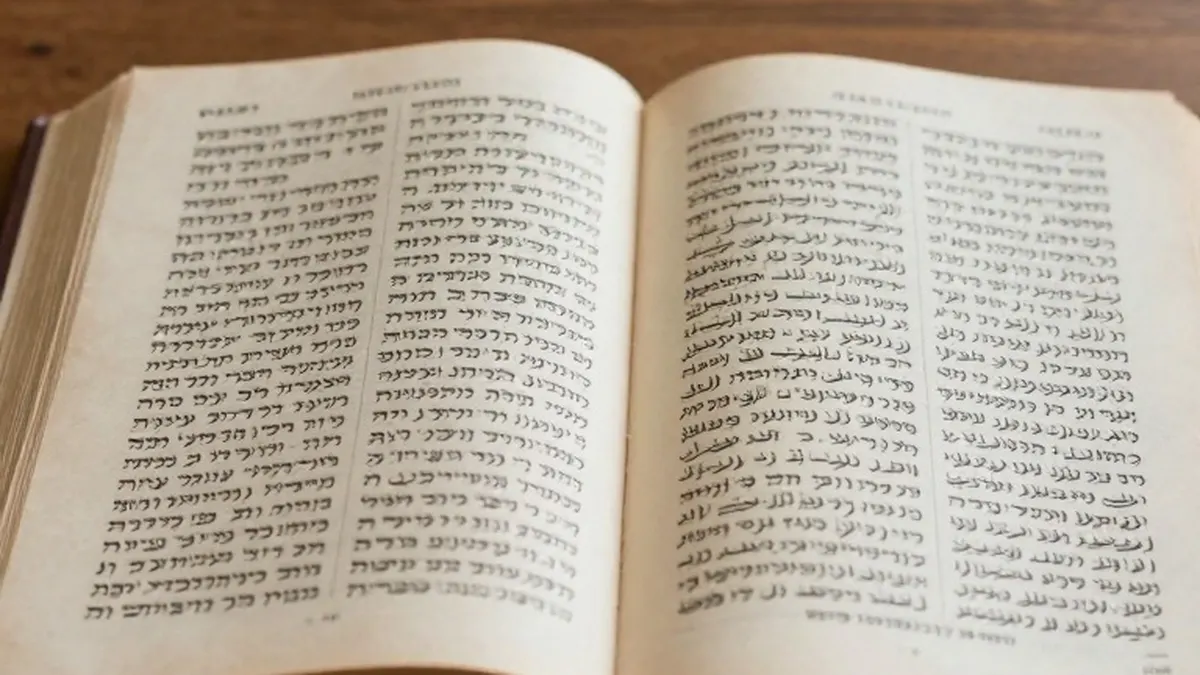
In an era where peace between Muslims and Jews often appears elusive, a new book suggests that the central religious texts of both faiths may offer a path toward mutual understanding. Rick Sopher, a British interfaith activist and senior adviser at Edmond de Rothschild Capital Holdings, believes the Quran was originally designed to confirm the spiritual messages of the Torah rather than replace them. His new work, “Illuminating Scriptural Connections,” co-authored with Emirati scholar Abdulla Galadari and published by the Jewish Publication Society, invites readers into an active dialogue between the two scriptures.
The project has gained urgency following the impact of the October 7, 2023, Hamas attack on Jewish-Muslim relations globally. Sopher, a British Jew of Sephardic descent, noted that his family originated from Baghdad, a Jewish community with a 2,500-year history of peaceful coexistence with Arabs and Muslims. He stated that his final relative left Iraq in 1971, crossing the northern border on a donkey. This history drove his central question: does the Quran make Jewish-Muslim cohabitation impossible?
After a decade of study with scholars worldwide, Sopher concluded that the Quran was not in opposition to the Torah or Judaism. He explained that while the Quran contains negative verses about some Jews, it also includes passages of reverence and praise. Sopher argued that the wars between the two peoples cannot be attributed solely to scriptural differences. He insisted that the Quran, which emerged roughly 2,000 years after the Torah, explicitly states its purpose is to confirm the Torah and designate it as a source of guidance and light.
The book utilizes the Parshat Hashavua, or weekly Torah portion, format to explore 54 different aspects of the Quran. Sopher and Galadari, who both read the texts in their original Hebrew and Arabic, identified remarkable parallels in stories, characters, and messages. Sopher observed that in lectures, very few attendees have actually read the Quran, leading to widespread ignorance about its contents. He pointed out that popular slogans like “Globalize the Intifada” or “From the river to the sea” have no basis in the Quranic text.
While the authors aim to promote understanding, they acknowledge that not all Muslim scholars agree with their conclusions. Sopher noted that the Quran does not present biblical stories in a chronological sequence or as a continuous narrative. Instead, it selects portions useful for conveying its own ethical messages, often omitting historical context, dates, and names. This approach creates differences in detail, such as the Islamic principle of prophetic infallibility, which suppresses narratives of sin found in the Torah, such as Noah’s drunkenness or Moses disobeying God.
The Quran also emphasizes the exaltedness of God, prioritizing submission to divine will over human agency. For instance, while the Torah describes Adam naming the animals, the Quran depicts God performing this act. Sopher explained that these variations do not refute the Torah’s teachings but represent the message presented in a different style for a different audience. He believes readers will be surprised by the similarity in substance at the core of these texts, noting there are no fundamental contradictions between them.
Addressing passages that appear hostile to Jews, Sopher advised readers to consider the context and compare them with Torah parallels. He stated that references to Jews as “apes and pigs” apply specifically to those who transgress God’s will, such as breaking the Sabbath, a violation that carries the death penalty in the Torah. Furthermore, Sopher argued that calls to violence in the Quran are actually milder than the Torah’s instructions regarding the Amalekites or Canaanite nations. He noted there is no verse calling for the complete elimination of all Jews or Christians.
The book also explores the theological implications of the story of Abraham’s nearly sacrificed son. While the Torah identifies the son as Isaac, the Quran leaves the identity ambiguous, referring to him only as “Oh, my son.” Sopher noted that most Muslim scholars in the early centuries identified the son as Isaac, but later figures like Ibn Taymiyyah and Ibn Kathir shifted the interpretation to Ishmael. This shift moved the story’s location from the land of Moriah in Jerusalem to the area near Mecca.
Sopher acknowledged that many Jews and Muslims may not initially be interested in studying the other’s scriptures. However, he believes a substantial audience is willing to look beyond political conflicts to explore their shared religious traditions. He concluded that Jews and Muslims are deeply connected through their foundational texts, a fact that most people have never been told.
The authors’ rigorous research aims to bridge the gap between the two faiths by highlighting shared concepts like ethical monotheism and virtuous behavior. By presenting these parallels, they hope to encourage Jewish readers to become familiar with the Quran and Muslim readers to engage with the Torah, fostering a deeper appreciation for the spiritual bonds between the two communities.