Civilians evacuated from Russian-occupied Oleshky reached Ukrainian-held territory after travelling by bus and aircraft through Russia and Belarus. Their departure was part of a humanitarian operation under a six-day local ceasefire in southern Ukraine’s Kherson region. Ukrainian authorities prohibited disclosure of the number arriving and the crossing’s location. Organizers said the restrictions were partly intended to protect residents staying behind and safeguard possible future missions.
The ceasefire began at 3 a.m. Tuesday and was expected to last until Sunday evening. The White House said U.S. first lady Melania Trump helped broker the arrangement. Pope Leo, the first American pontiff, also urged Russian and Ukrainian leaders to permit aid deliveries and evacuations. The operation represented an unusual instance of humanitarian co-operation between the warring countries.
Bus convoys started leaving Oleshky, on the Dnipro River, on Friday. Its estimated 2,000 remaining residents could choose Ukrainian-held or Russian-held territory, or stay with fresh food and medical supplies. Russia’s Defence Ministry said those heading to Ukrainian-controlled territory travelled to Anapa in Russia before flying to Homel in Belarus, accompanied by Ukrainian human rights commissioner Dmytro Lubinets. Ukrainian lawmaker Davyd Arakhamia reported that four evacuation aircraft had landed in Belarus.
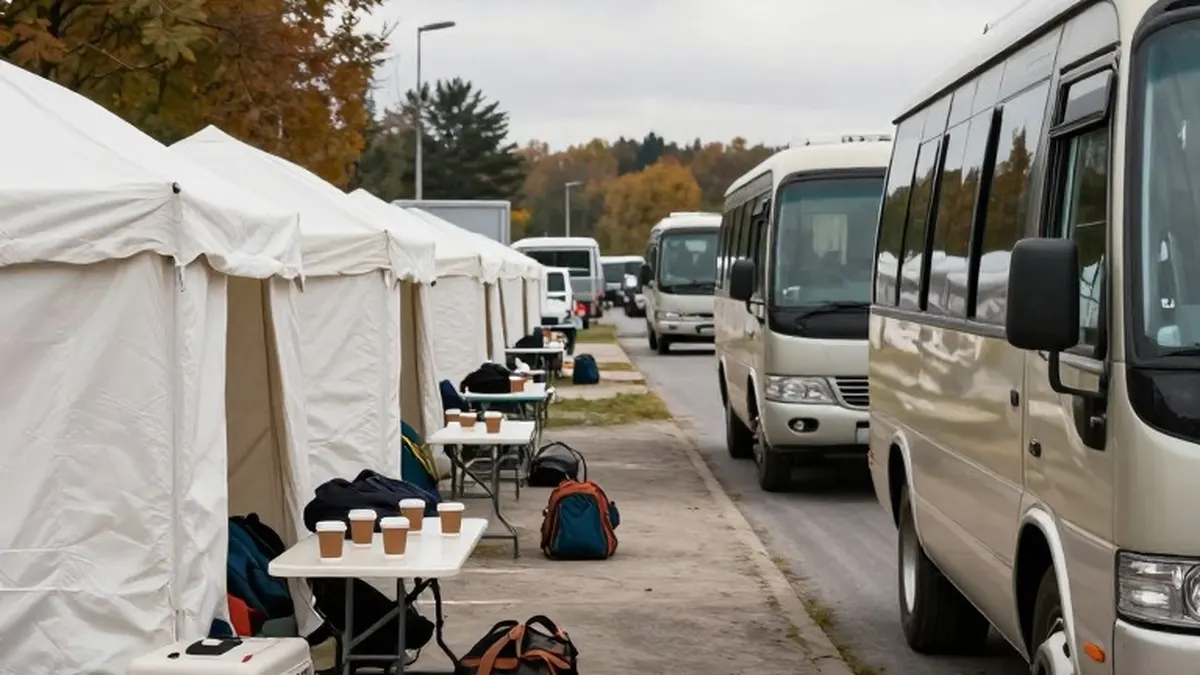
Families gathered at the Ukraine-Belarus border on Saturday, where aid tents, coffee stands and supplies for evacuees’ pets were available. Volunteers included representatives of the Red Cross, Doctors without Borders and World Central Kitchen. Among those waiting was Liza Paliy, 19, who had left occupied territory with her mother and sister more than two years earlier. Her father stayed behind, although the family had initially expected their separation to last no more than two months.
Daria Pavlyn was also hoping to see her father, Mykhailo, after about a month without contact. He had intended to leave with his family after a nearby strike killed two neighbours, but remained when plans for someone to care for their home and animals collapsed. Pavlyn said he subsequently feared the difficult journey, particularly because he lacked Russian documents.
Russia’s lead representative on the mission, ombudsperson Yana Lantratova, said buses also carried residents who wanted to live in Russia. Russian media showed arrivals on Saturday at temporary accommodation in Simferopol, in Crimea, the Ukrainian peninsula Moscow annexed in 2014. Neither side specified how many residents left Oleshky. Melania Trump said Friday that the convoy could safely evacuate more than 750 people.
Separately, Ukrainian President Volodymyr Zelenskyy welcomed U.S. approval of a purchase of 500 PAC-3 Patriot interceptors, while calling for supplies from partners’ existing stocks for winter protection. He warned that delivery under the newly approved sale could take years. The Trump administration announced the proposed $2.1 billion US sale Friday after Kyiv accused the Pentagon of delaying deliveries. The State Department said donations from Canada, Germany and Norway would fund the purchase, with no American money involved.
Fighting continued elsewhere. Bryansk regional Gov. Yegor Kovalchuk said a Ukrainian drone attack killed a woman aged 30 and a man aged 41, and wounded five others. Officials also reported Ukrainian drone attacks in Bashkortostan, while Russian media reported a fire in its capital, Ufa, which has several oil refineries. Russia’s Defence Ministry said it intercepted 433 Ukrainian drones overnight.
Zelenskyy said overnight Russian attacks on energy and railway facilities left 280,000 households without electricity in the Dnipro and Kyiv regions. He listed heat and power plants, substations, a gas distribution facility and railway infrastructure among the targets, and said repairs were underway. Reporting more than 30 Russian strikes on critical power-grid facilities during the preceding two weeks of October, he called for additional sanctions and support from Ukraine’s partners.