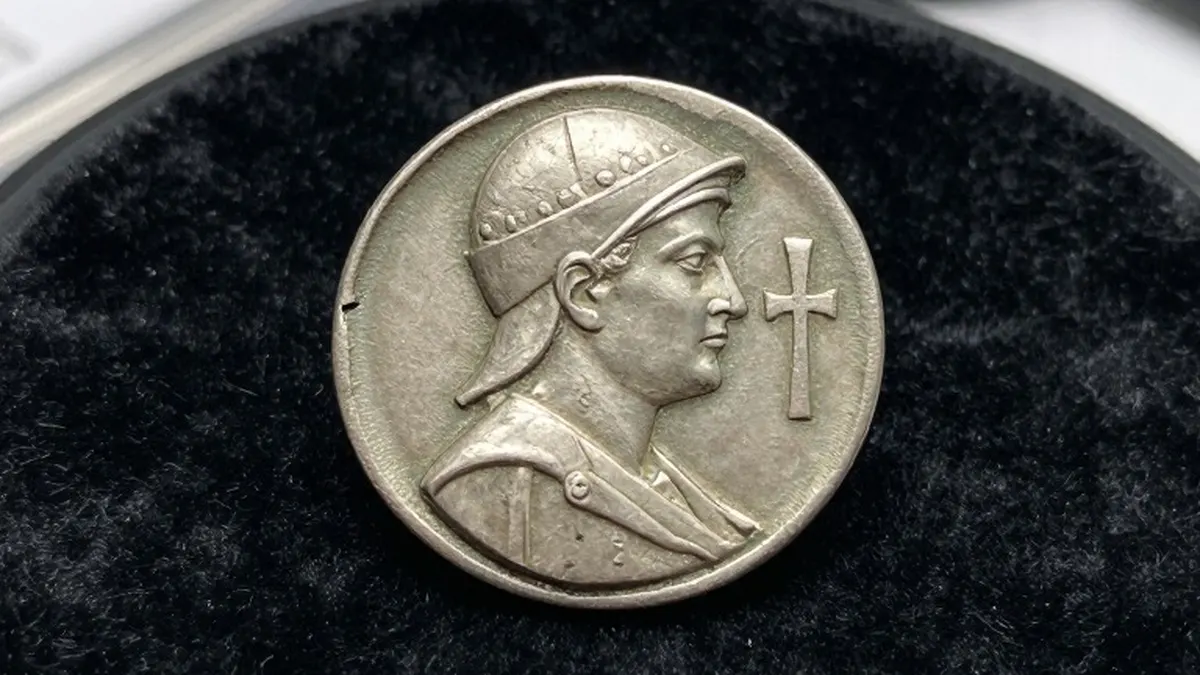
The Museum of Cultural History at the University of Oslo announced in October the identification of a rare coin minted during the reign of Olaf Haraldsson. The artifact was found within the Mørstad Hoard, which is currently the largest collection of Viking Age coins ever uncovered in Norway. This discovery represents a significant milestone in the study of early Norwegian history.
Olaf Haraldsson, widely known as Saint Olaf or Olaf the Holy, ruled Norway from 1015 to 1028. He was canonized in 1030, one year after his death, and was later posthumously honored with the title Eternal King of Norway. His sainthood played a pivotal role in the widespread adoption of Christianity among the Vikings in Scandinavia.
The coin was identified by archaeologist Anne Skogsfjord while she was cataloging items from the hoard. The Mørstad Hoard itself was discovered in April by metal detectorists Vegard Sørlie and Rune Sætre in the village of Rena. Initially, the coin appeared to be of Anglo-Saxon origin and was grouped with pieces issued by King Æthelred II, who ruled the English twice between 978 and 1016.
However, Skogsfjord noticed that the inscription on the coin suggested a later date than the Anglo-Saxon pennies. Upon closer inspection, she recognized the text ONLAF R+ NORMANORV, which translates to Olaf, King of the Norwegians. She described the moment of realization as special, noting that she had found a national treasure.
One side of the coin features a left-facing bust of Haraldsson wearing a conical battle helmet. The other side displays a cross on three steps, a design inspired by Byzantine coinage. Experts believe the coin was modeled on Anglo-Saxon pennies minted during the reign of Cnut the Great around 1024 to 1030. Numismatics Professor Svein H. Gullbekk suggested that Olaf Haraldsson himself may have decided the design and could have even held this specific coin.
Fewer than twenty coins from Haraldsson’s reign have survived to the present day, with most found outside of Norway. Only four coins of this specific type have ever been located. The previous find in Norway occurred in 1924 during the restoration of church ruins at Stein. Gullbekk described the new discovery as a Christianisation coin on a grand scale, illustrating how the king used coinage to legitimize the new faith and establish his status as a European ruler.
The coin is estimated to have been minted between 1024 and 1028, near the end of the Viking Age. Small cuts on both sides of the coin, likely made with a knife, indicate that it was used in commercial transactions. Associate Professor Florent Audy explained that these marks were used to test the silver content during payments. This suggests the coin changed hands multiple times during the roughly two decades between its production and its burial in the hoard.
Hanna Geiran, Director General of Norway’s Cultural Heritage Directorate, praised the find as extraordinary. She noted that the discovery serves as tangible testimony to the period when the foundations of the Norwegian kingdom and its Christianisation were established. The coin is scheduled to be displayed at Norway’s Historical Museum as part of an exhibition on the Mørstad Hoard opening on November 20, 2026.