The University of Sheffield announced last week that a British expert has successfully recreated the color-changing glass effect used in the famous Lycurgus Cup. This artifact dates back 1,600 years to the 4th century CE and is currently housed in the British Museum. Among the 40 surviving glass cage cups from that era, the Lycurgus Cup is considered one of the most complete examples.
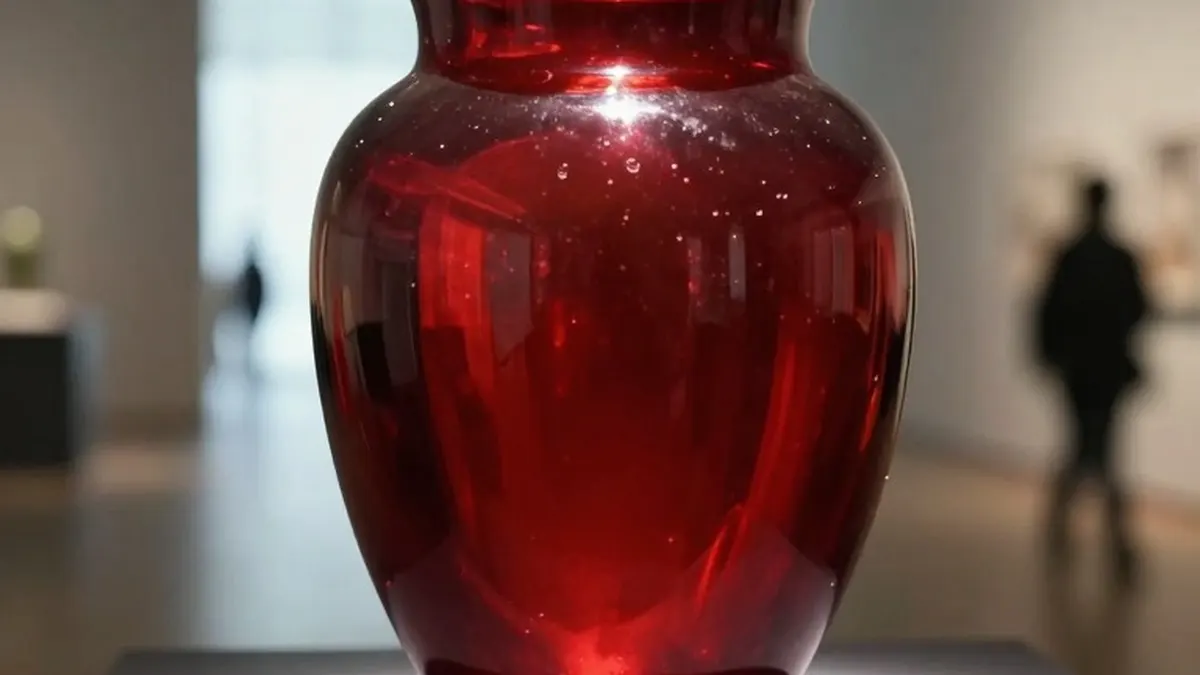
The cup is crafted from dichroic glass, a material that shifts color based on the position of the light source. In reflected light, the glass appears jade green. However, when exposed to transmitted light, the color transforms into a deep ruby red. In 2022, an international panel of artists and conservators recognized the artifact as one of the seven glass wonders of the world.
The recreation project began when the University of Sheffield invited the team to reproduce the glass for its 2025 LightFest. Christina Metcalfe, the Molecular Photonic Breadboards Project Manager, led the challenge. The team developed a recipe derived from a fragment of the original artifact to achieve the desired visual properties.
Dr. Lisa Hollands, a technician at the university’s school of chemical, materials and biological engineering, led the technical effort. With over 25 years of experience studying and working with glass, she noted that the process was complex. It was not simply a matter of adding nanoparticles to standard glass. She combined her practical experience with modern scientific understanding to guide the project.
Hollands collaborated with Professor Caroline Jackson, a leading expert on Roman glass, to research historical knowledge of the material. Together, they developed a base glass using modern materials designed to mimic what the Romans might have used. The most difficult aspect of the process involved introducing small amounts of gold and silver into the glass in the correct form.
Hollands joked that if the Romans had observed her experiments, they might have laughed and asked why she did not know how to make the material. After experimenting with different furnace types, materials, and oxygen levels, she successfully built a recipe that mimicked the appearance of the Lycurgus Cup. The initial piece was exhibited at LightFest in Sheffield.
Following the creation of the glass, the team commissioned a contemporary sculpture to honor the original artifact. Elliot Walker, a UK glass artist and winner of the second season of Netflix’s Blown Away series, was selected for the task. Walker described working with glass developed from ancient mixtures as a rare and exciting opportunity.
Walker aimed to maintain references to the Lycurgus Cup and the history behind the material. He sought to keep the sculpture classical in form while carrying through the original story of Lycurgus. To effectively showcase the dichroic glass, he incorporated a blown element into the design. The final piece blends the Lycurgus story with the Farnese Atlas sculpture, replacing the globe with a cup.
Walker’s sculpture is scheduled to be on display to the public at the Millennium Gallery from November 6 to 15. It will then move to the Turner Museum of Glass at the University of Sheffield. Metcalfe stated that the project aimed to create something tangible to help the public understand the possibilities of embedding tiny nanoparticles in glass.
Metcalfe added that the achievements of Hollands and Walker have surpassed all expectations. She believes the incredible historic narrative will capture people’s imaginations and create something that audiences will marvel at for years to come.