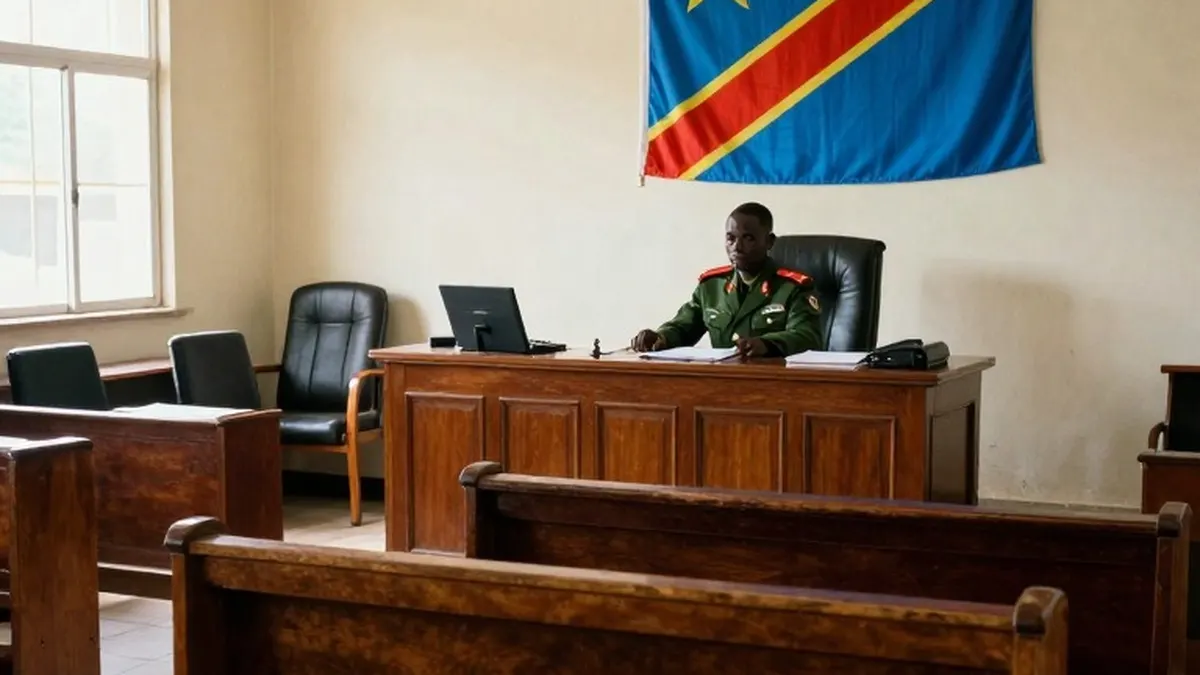
A military tribunal in the Democratic Republic of Congo has pronounced death sentences on 66 soldiers, citing charges of cowardice, mutiny, and the wasteful use of ammunition. The verdicts were delivered following a twelve-day trial held at a military court in Walikale, a town located in the country's eastern North Kivu province. Local media reports indicate that four other defendants in the same case were acquitted, while a single soldier received a ten-year prison term.
The accused troops were arrested on October 20 after facing allegations that they had fled from combat with fighters from the Front for the Refoundation of the Nation, a broad rebel coalition. According to reports from BBC News, a partner network of CBS News, the soldiers were specifically accused of retreating during engagements with these rebel forces. The military authorities stated that the primary objective of the trial was to reinforce discipline within the armed forces, a sentiment echoed by multiple Congolese and international news outlets.
This high-profile case occurs against a backdrop of long-standing conflict in the resource-rich eastern region of the country. Congolese troops have been engaged in battles against various armed groups for decades. The country's military has frequently faced criticism for issues related to discipline, while rank-and-file soldiers have voiced complaints regarding low wages and inadequate equipment. The current legal proceedings are part of a broader trend in the nation's military justice system.
In early October, another group of 27 government soldiers was sentenced to death for similar charges of cowardice, as reported by Radio Okapi. This marks a significant increase in capital punishment within the military. A tally compiled by Radio France Internationale shows that 381 Congolese soldiers have been sentenced to death since the beginning of 2025.
The death penalty was reintroduced in March 2024 as a measure to combat treason within the armed forces. At the time of this legislative change, Amnesty International noted that the country's justice system suffered from numerous problems. The organization highlighted that trials in the region rarely met the standards of a fair trial, as documented in their previous reports.
Tigere Chagutah, the regional director for East and Southern Africa at Amnesty International, commented on the recent wave of sentences. He emphasized that all individuals, whether they serve in the national army, police, or armed groups, or are involved in gang violence, possess a fundamental right to life. Chagutah described the decision as heartless and warned that it endangered the lives of hundreds of people currently on death row, many of whom he said were convicted following unfair trials or politically motivated charges.
The conflict in the east is further complicated by regional dynamics. The United Nations, several Western governments, and the DRC itself have long accused Rwanda, a neighboring country, of supporting the M23 rebel group. Critics argue that this backing is part of an effort to control and exploit the vast mineral resources found in the larger Congolese territory.
Last year, the United Nations issued a warning that M23 fighters were carrying out specific actions as they advanced into the DR Congo. While the provided text cuts off before detailing the exact nature of these actions, the warning underscored the severity of the military situation that has led to the recent string of harsh judicial outcomes for Congolese soldiers.
The outcome of the trial in Walikale highlights the tension between the military's desire for strict order and the human rights concerns raised by international observers. The sentences bring the total number of soldiers facing execution in the current year to a significant figure, reflecting the intense pressure on the armed forces to perform effectively in a volatile region.
As the Congolese government continues to rely on capital punishment to deter dissent and improve performance, the international community watches closely. The case of these 66 soldiers serves as a prominent example of the legal and military strategies being employed in the DRC to manage the ongoing conflict in its eastern provinces.