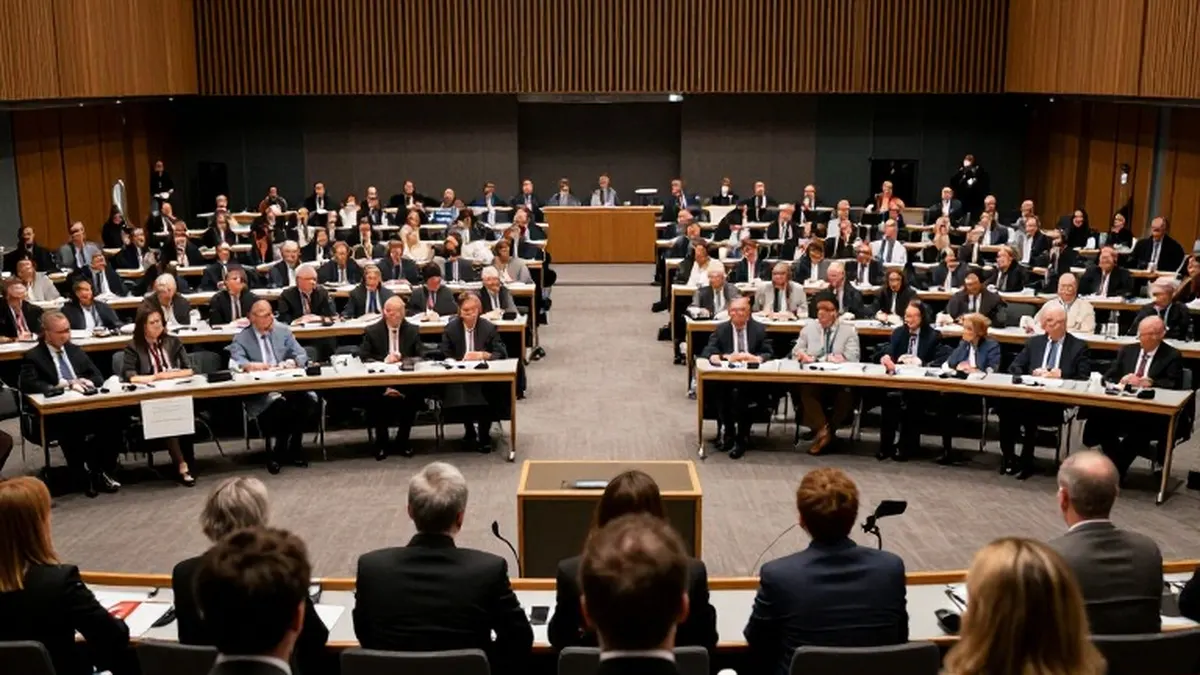
The United Nations climate conference in Turkey concluded without a consensus on its primary draft agreement, marking a significant setback in global efforts to combat warming. The EU, the United Kingdom, and a coalition of developing nations formally rejected the proposed deal, which they argued failed to address the core drivers of the climate crisis. This rejection occurred during a dramatic extension of the talks, which were originally scheduled to end on Friday but continued into Sunday afternoon.
The document in question, known as the Antalya pact, was drafted by the joint Turkish and Australian presidencies of the summit. It proposed that nations electrify their economies and that wealthy countries provide financial support to poorer nations for adaptation. It also called for minimizing the overshoot of the 1.5 degrees Celsius global heating threshold established by the Paris Agreement. However, the text omitted any explicit reference to fossil fuels, a point of contention for many delegates.
Darragh O'Brien, the environment minister of Ireland, spoke on behalf of the EU to announce the bloc's rejection. He stated that the draft failed to meet the moment and did not respond to the scientific evidence. O'Brien emphasized that the EU would not endorse a decision that deepened the gap between global commitments and necessary action, noting that the text did not even mention fossil fuels. His intervention was met with applause from the assembly.
The lack of consensus was further compounded by the inclusion of provisions for carbon capture and storage technology. Many campaigners argued that this inclusion perpetuated the use of fossil fuels. While more than 130 countries demanded language endorsing a transition away from these fuels, the final text did not include such a phrase. This discrepancy led to a breakdown in negotiations among key blocs.
Murat Kurum, Turkey's president of the Cop, acknowledged that there was no agreement on the cover decision text. He explained that the presidencies had not imposed the document on any party nor issued an ultimatum. Kurum recognized that certain parties opposed the text and therefore the decisions were not adopted. This outcome was followed by similar objections from Panama, the Marshall Islands, and Norway.
Bill Hare, chief executive of the advisory group Climate Analytics, described the moment as a significant turning point. He observed that countries were standing up to fossil fuel interests by saying no. In contrast, Saudi Arabia defended the decision to include carbon capture and storage in the text. Other nations, including China, Pakistan, and the Africa group, did not object to the deal, although some expressed reservations.
The two-week summit in Antalya brought together close to 200 countries. The proceedings were marked by long periods of deadlock as delegates struggled to find common ground. For many participants, the talks exposed a lack of collective will, particularly among wealthy nations, to address the urgency of the crisis. Civil society groups, who have a mandated role in the talks, declared it the worst Cop ever.
African ministers made a dramatic intervention on Friday, stating that they had not come to the summit to beg. Mohamed Adow, director of the thinktank Power Shift Africa, echoed this sentiment, calling the event the worst Cop ever. He criticized the EU for rejecting the text while also contributing to the wreckage. Adow argued that for countries facing failed harvests and mounting debt, the outcome amounted to abandonment by the wealthy nations most responsible for the crisis.
The slow pace of the negotiations appalled even veteran participants, especially as extreme weather events worsened globally this year. These events included heatwaves, a glacier collapse in Nepal, and droughts and floods exacerbated by the El Niño phenomenon. Mary Robinson, a former president of Ireland and UN climate envoy, expressed frustration at the lack of urgency. She noted that the co-presidents had not stepped up to provide the necessary leadership as the talks neared their extended close.