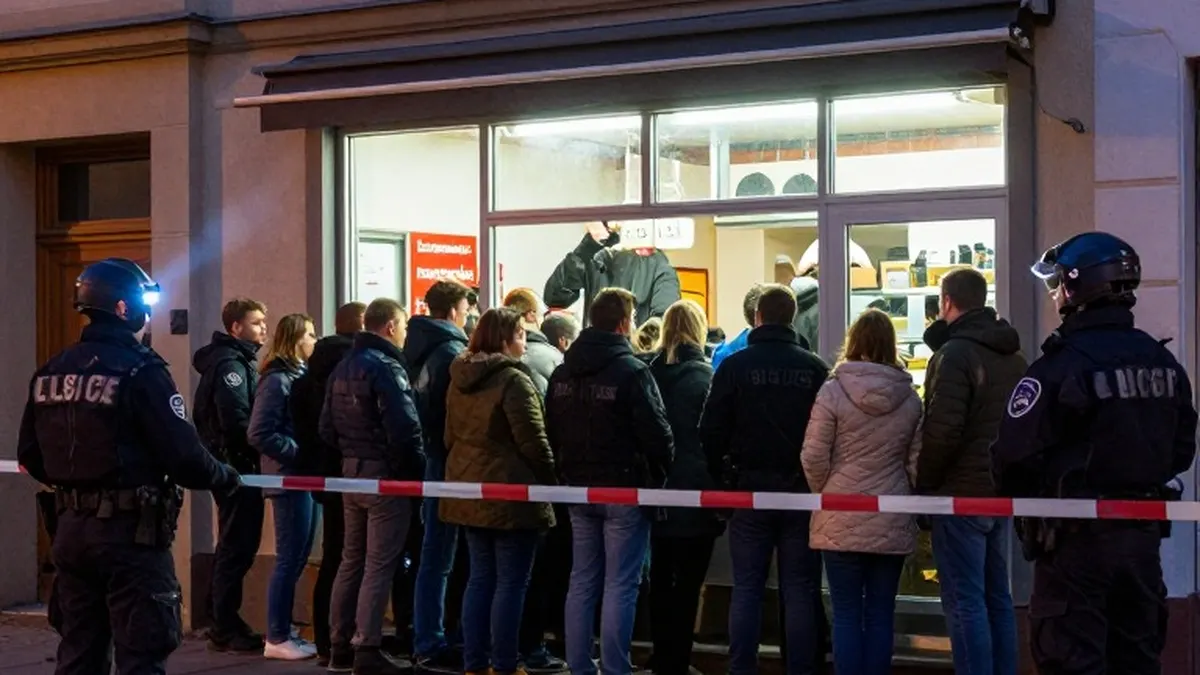
Police in Dortmund, western Germany, were called to a doner kebab shop on Sunday after hundreds of people stormed the premises hoping to buy a portion for a one-off introductory price of one euro.
The owner had advertised the offer in advance, but the turnout for the shop's opening quickly overwhelmed him. According to the owner, about 1,000 people were present, while police estimated the crowd at roughly 300.
The one euro price, equivalent to about 83 pence, stands in sharp contrast to the usual cost of a doner, marinated meat roasted on a rotisserie spit, sliced off and served with salad in pockets of warm flatbread or wraps, which now averages between 7.50 and 9 euros in Germany.
Until about 2020, a doner cost between 3.50 and 4 euros. The steep increase, driven largely by higher energy and food costs, has turned Germany's most popular fast food, served more than 1.3 billion times a year, into a palpable everyday symbol of the effects of inflation.
The owner had hired private security guards to oversee the opening, but they were quickly overwhelmed and he called the police as the situation spiralled out of control.
A police spokesperson said officers were pelted with bottles, stones, fireworks, an electric scooter and a chair. Reinforcements were called in, bringing the deployment to around 100 officers on the ground, supported by a helicopter.
Dortmund's police chief, Tim Frommeyer, condemned the violence in a statement. "Anyone who uses violence, in this case once again against police officers, is not an adventure-seeking youth or a troublemaker, but a criminal," he said. He accused some participants of having set out to attack police from the start, describing it as part of a pattern of behaviour recently seen at rallies and demonstrations.
Several people were arrested, including one found to be carrying a blank-firing pistol. A number of people face charges of breaching the peace, property damage and insult. Police did not say whether the shop owner would face prosecution, and the owner said he would donate the remaining kebabs to a homeless charity in the city.
The doner is widely seen as an immigrant success story, adapted into a flatbread snack by Turkish Gastarbeiter, or guest workers, in West Berlin more than 50 years ago. Two years ago a row erupted between Germany and Turkey when Istanbul applied to the European Commission to have the term recognised as a guaranteed traditional speciality across Europe.
Berlin objected and filed a veto, arguing the application would create large bureaucratic hurdles and fuel further doner inflation by imposing strictly designated production methods and specifications for the meat and spices used, and even the types of knives used to cut it. The Istanbul-based International Doner Federation formally withdrew its application last autumn.