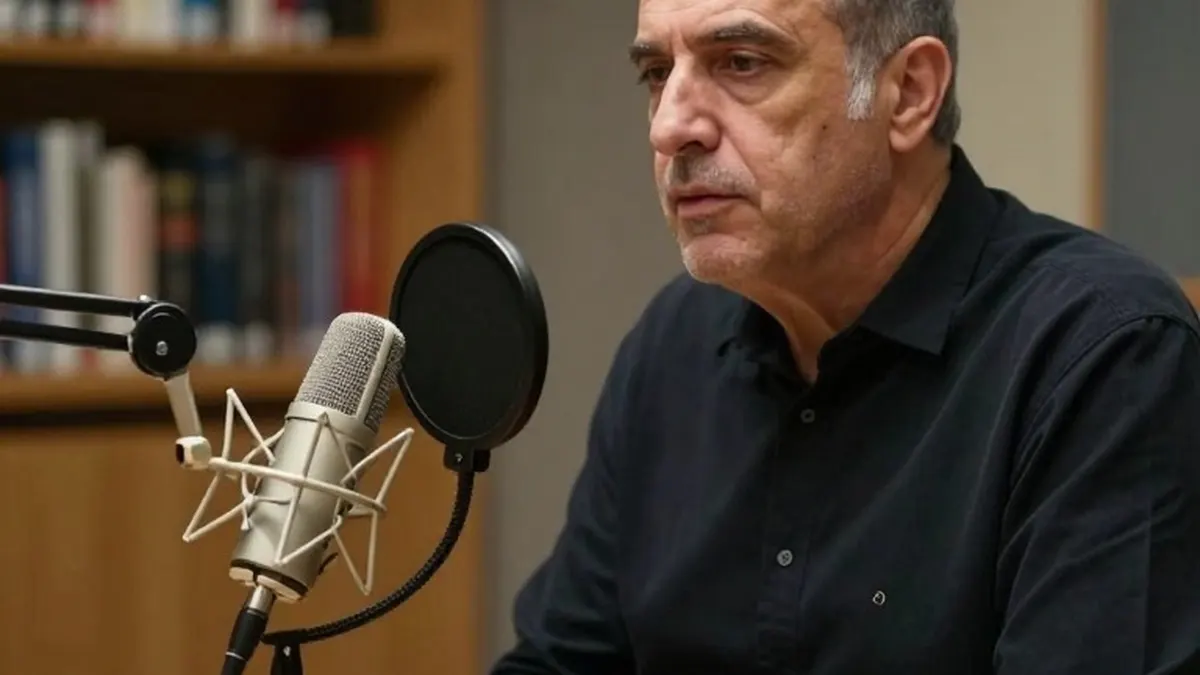
A former Shas spokesperson on Thursday laid out why the Ashkenazi ultra-Orthodox party United Torah Judaism, rather than Shas, is leading negotiations with the bloc headed by Yashar chair Gadi Eisenkot, pointing to fundamental differences between the two haredi movements.
Speaking in an interview on 103FM, Itzik Sudri said UTJ is taking the lead in the talks, assessed that Shas would find it difficult to enter a government led by the change bloc, and noted the bloc's readiness to compromise on the military conscription law.
Sudri said the contrasting characters of Ashkenazi and Sephardi haredi leadership shape the prospects for political cooperation. "There is a fundamental difference between the approaches of the different leaderships, between the Ashkenazi ultra-Orthodox leadership and the Sephardi ultra-Orthodox leadership," he said.
According to Sudri, the Sephardi haredi leadership speaks for a varied public beyond the core ultra-Orthodox community, encompassing wider circles of religious and traditional Jews. He said a Sephardi rabbi's synagogue genuinely includes everyone, from the strictly observant to those who simply come to pray, while an Ashkenazi haredi synagogue includes only Ashkenazim.
Turning to Shas chairman Arye Deri, Sudri said his leadership is unchallenged and stronger than ever, and described a deep alliance between Shas, the Right and traditional Jews, whom he said come from the very flesh of Likud. Asked whether Shas could join a change government, he dismissed the idea. "I do not see such a possibility. Shas's agenda is much broader. It is not only Yavne and its sages, but also Ashkelon and its traditions," he said, adding that UTJ should lead the matter and calling the Ashkenazi party the "Shabbat goy" in this context.
Sudri cautioned that UTJ itself faces internal divisions that must be resolved before any deal with the Eisenkot-led bloc can be reached, saying the party's Hasidic and Lithuanian factions and their rabbinical leaders would all need to be brought on board. "We need to talk about United Torah Judaism before we get to Shas," he said, acknowledging that considerable room to maneuver remains.
Even so, Sudri said the change bloc appears strongly driven to close a deal with UTJ, above all on the conscription law. "There is enormous motivation on the part of the Eisenkot-led bloc to accommodate United Torah Judaism on the issue of the conscription law. United Torah Judaism has a sacred and overriding interest in regularizing the status of those who study Torah," he said.
Sudri said the two sides share overlapping interests centered on removing Prime Minister Benjamin Netanyahu from power, describing that as the overarching goal, and said the bloc is certainly willing to make concessions on other matters to reach an arrangement.
He warned, however, that any agreement must clear two major hurdles: approval from the senior Ashkenazi Torah sages and the ability to hold up under future scrutiny by the High Court of Justice. "It is difficult for me to see right now how the wording being developed and formulated can overcome all these problems," he said.
Sudri concluded by noting that Degel HaTorah, one of UTJ's constituent factions, has steadily raised its demands beyond the legal status of yeshiva students to include preserving the status quo and maintaining independence within the haredi education system.