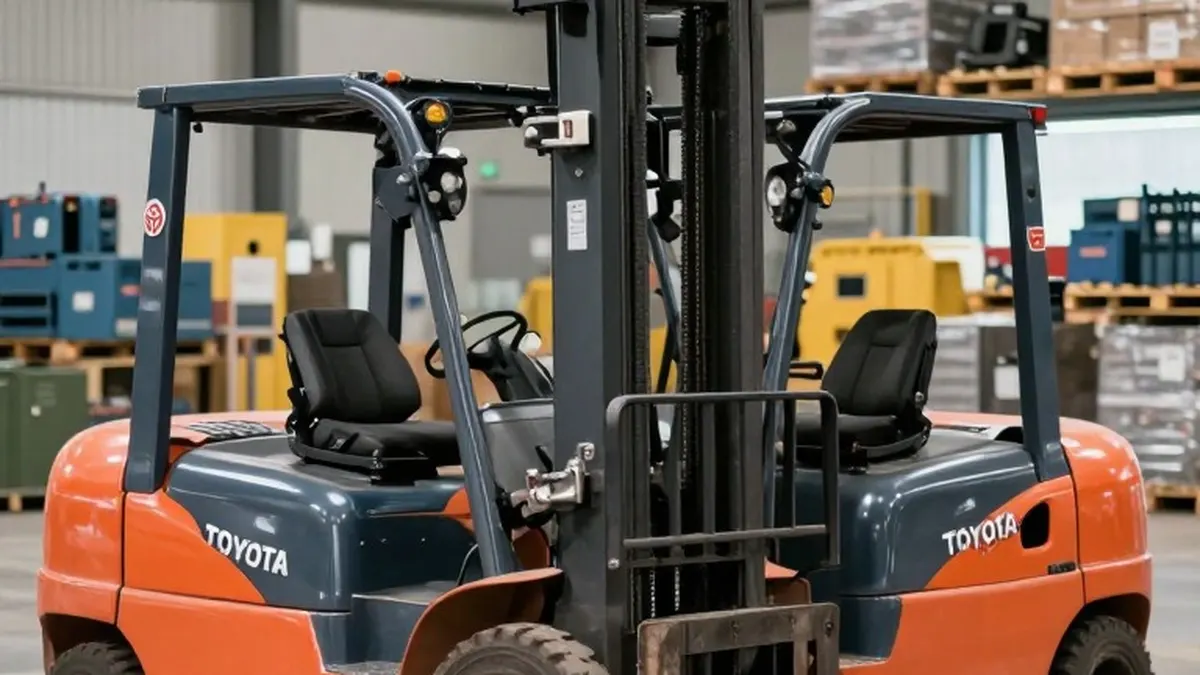
Toyota has announced it is investigating the use of its forklifts by the Israeli military. The review follows findings by Middle East Eye that documented the vehicles at weapons storage sites, supply lines for frontline units, and within the army's Logistics Corps. The company states that its vehicles are designed for civil purposes, not military operations.
The investigation uncovered a previously unreported contract worth 158 million shekels, or approximately $49.8 million, signed in 2024. This agreement between Toyota and Israel’s Ministry of Defense covered the supply of forklifts during the first full year of the Gaza war. Toyota told Middle East Eye that it has commitments with both the defense ministry and its official reseller in Israel to ensure its products are for civil use only.
After sharing footage from official Israeli military social media channels with the company, Toyota said it was investigating whether those agreements had been breached. The footage showed Toyota forklifts at a missile and ammunition depot in northern Israel, a Logistics Corps training base, and inside a munitions factory. A spokesperson for Toyota Material Handling, the division headquartered in the United States, stated that the company is reviewing the images to determine if use agreements were violated.
The contract details were revealed in a 2024 budget report published by the finance ministry’s accountant general in March 2025. The report listed the purchase of heavy-duty forklifts under the category of Land Platforms. The entry noted that the remaining balance as of December 31, 2024, was approximately 158 million shekels, with the engagement expected to conclude in 2026. Given that new heavy forklifts can cost roughly $80,000 or more, the order could encompass hundreds of vehicles.
Arms industry experts have raised questions about the company's due diligence. Noam Perry, a strategic research coordinator at the American Friends Service Committee, noted that while tracking resold vehicles is difficult, a multi-million dollar contract delivered directly to the defense ministry during an active conflict should have prompted heightened scrutiny. He argued that any serious due diligence process should have flagged the potential military use of the equipment.
Visual evidence from official military accounts supports the claim of military use. In July, the Israeli army’s Technology and Maintenance Corps posted an image of a Toyota forklift carrying a pallet of munitions at a missile and ammunition center. Another post from March 2024 by the Logistics Corps showed soldiers gathered around a Toyota forklift during training courses. Additionally, a January 2024 video from the Ministry of Defense showed a Toyota forklift on the production line at Elbit Systems, a major Israeli defense company.
Toyota’s reseller in Israel, Union Industrial Vehicle Ltd, did not respond to requests for comment. The company has not disclosed specific details of the contract or what it considers a violation. However, a spokesperson emphasized that the forklifts are designed for moving merchandise in warehouses or cargo at ports, and the company would not condone use beyond this scope.
Experts suggest that if a clear breach of the civil-use clause is found, Toyota could suspend sales to Israel. Mark Bromley of the Stockholm International Peace Research Institute noted that such an action is possible if the evidence is clear. However, he also pointed out that the contract only binds the specific parties involved. Other forklifts sold to private companies in Israel could still be requisitioned by the military under a 1987 law governing the registration of equipment for operational needs.
Samuel Perlo-Freeman, a researcher at Campaign Against Arms Trade, stated that any sale of equipment to the Israeli military supports its activities. He argued that Toyota should verify that its equipment is not being used in illegal activities, rather than relying solely on assurances. He added that with potential sanctions on West Bank settlements, companies may need to be more cautious about their products' use in the Occupied Palestinian Territories.
Toyota Industries, the parent company, maintains a group human rights policy based on United Nations guiding principles. The policy commits the company to implementing a human rights due-diligence process to identify and mitigate negative impacts. As Toyota continues its review, the outcome may influence how other civilian companies approach sales to military entities in conflict zones.