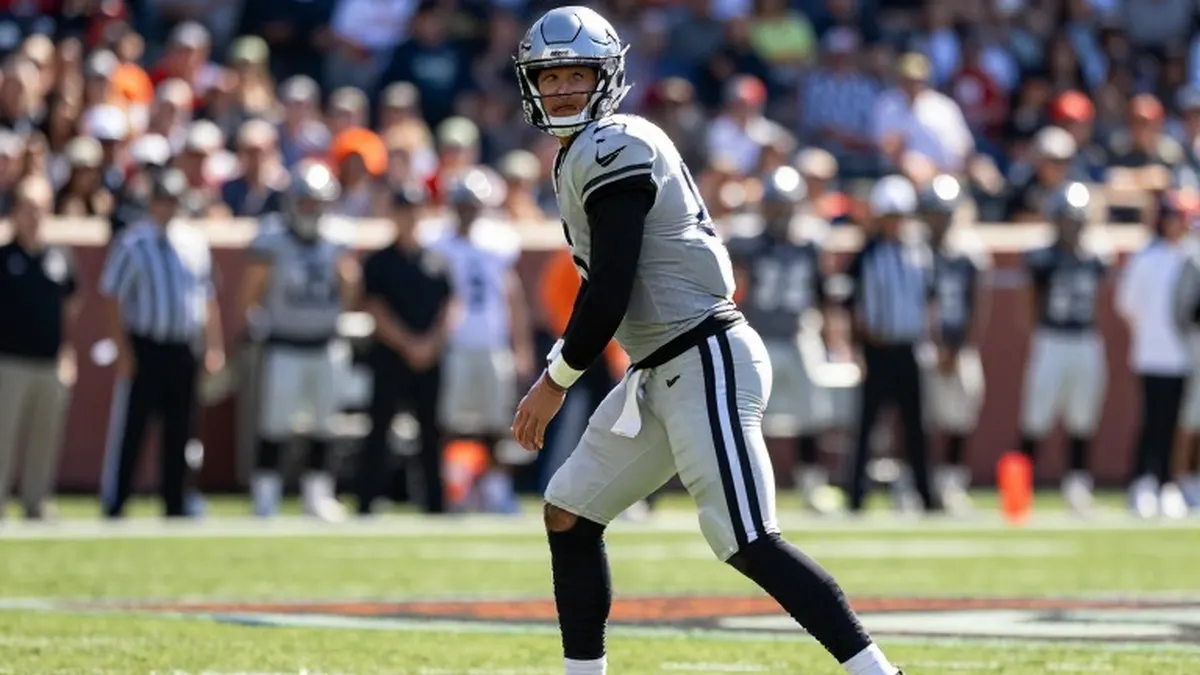
The Las Vegas Raiders have officially moved forward with Fernando Mendoza at quarterback after trading Kirk Cousins to the Minnesota Vikings on Tuesday in exchange for a third-round pick. Mendoza, who was selected as the No. 1 overall pick in April, will make his first career start this Sunday against the Seattle Seahawks. While the move marks a significant shift for the franchise, historical precedents indicate that the path for a rookie stepping in midseason is often fraught with difficulty.
NFL history offers two starkly different examples of quarterbacks who entered the league with similar team records. In 2016, the Los Angeles Rams, sitting at 4-5, replaced Case Keenum with No. 1 overall pick Jared Goff. Goff lost all seven of his starts, throwing five touchdowns and seven interceptions, leading to a 4-12 finish. Conversely, in 2018, the Baltimore Ravens, also at 4-5, turned to Lamar Jackson after Joe Flacco was injured. Jackson won six of his first seven starts, helping Baltimore secure a playoff berth. These contrasting outcomes highlight the unpredictability of rookie midseason debuts.
Statistical analysis from 2000 to 2025 shows that midseason rookie starts are rarely smooth. Among 148 quarterbacks who started as rookies during that period, only 22 made their first start between Weeks 10 and 13. This group completed just 53.8% of their passes and averaged 5.8 yards per attempt. They also threw interceptions on 5.3% of dropbacks, the worst mark among any rookie group. Only five of these 22 quarterbacks won their debut, and their interception rate was significantly higher than that of rookies who started in Week 1.
The impact on team performance further underscores the challenge. Five teams with winning records turned to rookies in Weeks 10 through 13 and went 10-20 afterward. The 17 teams with losing records saw their winning percentage improve slightly from 28.9% to 33.7%, but they still lost twice as often as they won. Only three of the 22 teams involved in such transitions made the playoffs, including the 2011 Texans and the 2017 Bills, though the latter eventually reverted to their veteran starter.
Mendoza faces an immediate gauntlet of difficult opponents. His first three starts are against the Seahawks, Denver Broncos, and Cleveland Browns, all of which possess strong defensive units. After a bye in Week 13, the schedule remains challenging with matchups against the Broncos and Kansas City Chiefs among the final four games. This sequence of tough opponents could make it difficult for the rookie to build momentum early in his tenure.
However, the Raiders' struggles under Cousins were not solely attributable to the quarterback. Cousins had thrown 20 touchdowns and eight interceptions, and the team averaged 25.4 points per game. The passing offense ranked fifth in yards per game and ninth in EPA per play. The more pressing issues for Las Vegas lie in the running game and defense. The team ranks last in yards per carry at 2.9 and 31st in rushing yards per game. Additionally, the defense has allowed 35.7 points per game over the last six weeks, with five of those games resulting in losses.
The lack of a balanced offensive threat places a heavy burden on Mendoza. Even a well-designed system requires a functional run game to provide balance. In June, analysts predicted Mendoza would be the most NFL-ready quarterback in the draft class but noted he had landed in a less than ideal situation. Models projected he would complete 61.4% of his passes with a passer rating of 82.1, suggesting a solid but not elite start.
The Raiders now have their quarterback of the future, and Mendoza has eight games to demonstrate his capabilities. Whether his record ends up being 0-8, 6-2, or somewhere in between, the initial results may not fully define his long-term potential. Previous greats like Goff and Jackson both faced early struggles or unique circumstances before reaching their peak performance. The organization's role is to provide Mendoza with the support and infrastructure necessary to succeed, allowing him to prove he belongs at the top of the depth chart.
As the season progresses, the focus will shift from Mendoza's individual statistics to how the team can adapt around his strengths. The historical data serves as a cautionary tale, but it also reminds fans that early struggles do not necessarily dictate a quarterback's ultimate destiny in the league.