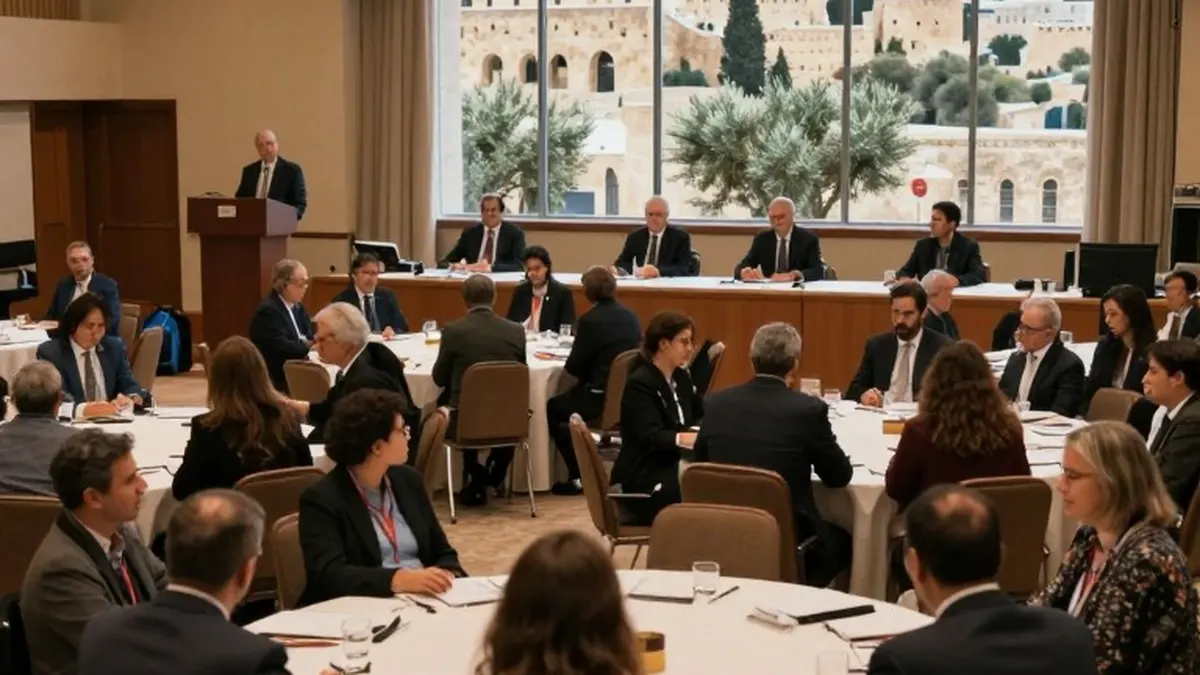
Delegates representing Noahide communities from six continents convened in Jerusalem on Monday for the opening of the First International Congress of Noahides. The five-day event is hosted at the Seven Arches Hotel on the Mount of Olives and organized by the Jerusalem-based Noahide World Center, also known as Brit Olam. The gathering marks the first time that scattered groups adhering to the Seven Laws of Noah have come together to create permanent institutional frameworks and global governing bodies.
Noahides are non-Jews who observe the Seven Laws of Noah, a set of universal moral imperatives derived from the Torah. These laws prohibit idolatry, blasphemy, murder, theft, sexual immorality, and cruelty to animals, while mandating the establishment of a legal system. Unlike proselytizing traditions, Judaism does not seek to convert non-Jews but recognizes this autonomous spiritual path rooted in ancient biblical covenant. While distinct from Judaism, Noahides look to the Torah and traditional rabbinical authorities for guidance on living a righteous life under these covenantal laws.
The congress is structured as a founding assembly rather than a standard conference. Participants are engaged in working sessions led by President Rabbi Oury Cherki, a senior lecturer at Machon Meir and leader of the Bayit Yehuda community in Jerusalem. Key objectives include establishing the first international Beit Din, a rabbinical court of guidance. Rabbi Cherki will serve as Chief Justice alongside senior and regional judges. Additional sessions focus on drafting a unified educational syllabus, organizing six continental regional councils, and creating a three-arm financial funding model under a signed Founding Charter.
The schedule also includes workshops on developing foundational texts. These include the Brit Shalom legal codex, authored by Rabbi Cherki to guide everyday life under the Seven Laws, and the Brit Olam siddur, a universal prayer book adapted for Noahides. Delegates are also participating in guided heritage tours across ancient Jerusalem and Shilo, the site of the historical Mishkan.
Rabbi Tovia Singer, founder of Outreach Judaism, opened the congress. Singer is known for his counter-missionary work aimed at responding to Christian groups that target Jews. His public lectures inadvertently reached a broad non-Jewish audience, leading many to study his material and become Noahides. Reflecting on the location, Singer noted that the hotel was completed in 1964 when Jewish access to East Jerusalem was restricted. He told delegates that the return of these groups fulfills biblical prophecy, welcoming them to the first international congress.
Chabad Rabbi Manis Friedman also addressed the assembly, blessing the gathering. He emphasized that humanity is reaching a tipping point where individuals across cultures are recognizing the reality of God. Friedman stated that serving the Creator through everyday actions makes every human being a universal partner in creation. Rabbi Yehuda HaKohen, head of Brit Olam's English-language division, framed the event as a monumental step following the revival of Jewish sovereignty. He noted that the congress focuses on how non-Jews partner with Israel to fix the world.
In an interview with The Jerusalem Post, HaKohen explained that the group needs to formulate a universalist orientation at a time when liberal ideology is collapsing. He argued that Israel has an opportunity to present a universal vision that can lead humanity into a better future. However, the event has drawn criticism from some conservative evangelical and independent Christian commentators. Online platforms have warned that establishing international rabbinical courts for non-Jews parallels apocalyptic prophecies concerning a single world religion. Critics also point to traditional rulings that classify mainstream Trinitarian Christian worship as idolatry under Noahide law.
The congress will conclude with the signing of a founding document and a formal reception at Beit HaNasi, the residence of the Israeli President. Rabbi Cherki stated that this move will ensure Noahides are no longer alone in their questions, restoring a living connection to Jerusalem. Rabbi Chaim Goldberg, CEO of the Noahide World Center, described the event as a new foundation where nations are received as builders rather than guests. Rod Bryant, a leader from Texas, said the congress has given new life to international Noahide leaders who have previously worked in isolation.