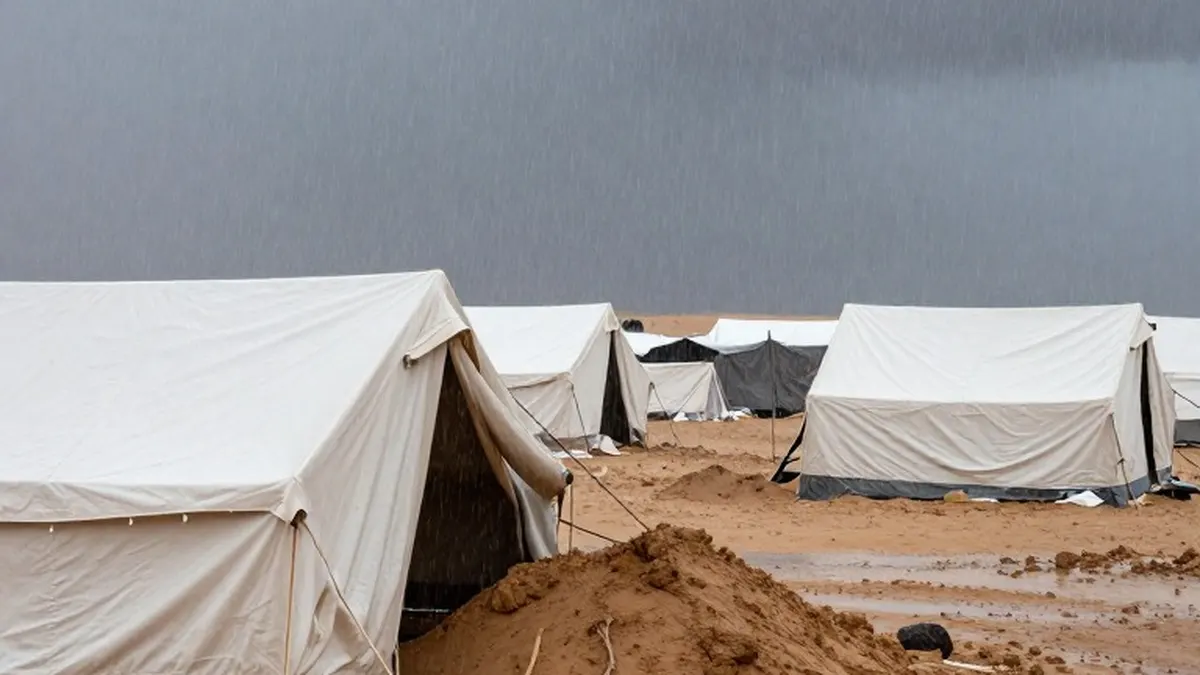
Late on Sunday, a massive sand embankment collapsed onto tents sheltering displaced Palestinians in the Gaza Strip, resulting in the deaths of three children and two women. The incident occurred in the city of Deir al-Balah, where severe weather conditions had already been battering the territory throughout the weekend.
Civil Defence search and rescue teams managed to rescue at least five other individuals with injuries from the debris at the makeshift camp. Operations to locate any remaining missing persons continued in the immediate aftermath of the collapse.
Mahmoud Basal, the spokesperson for the Palestinian Civil Defence in Gaza, explained that the failure of the sandy embankment and surrounding earth mounds was triggered by a low-pressure weather system. This system delivered torrential rain and strong winds to the Strip over the preceding days.
The victims identified in the disaster include Mariam Nabhan and her son, Salah Nabhan. The other three deceased individuals were Reem al-Zain, Habiba al-Zain, and Ibrahim al-Zain.
The weekend downpours caused flooding in an estimated 70,000 temporary tents used by displaced families across Gaza. This left thousands of people exposed to the elements, highlighting the vulnerability of the makeshift shelters.
The Palestinian Ministry of Foreign Affairs stated on Saturday that the worsening conditions are not merely a result of severe weather. The ministry described the situation as a direct consequence of the prolonged Israeli genocide, widespread infrastructure destruction, continued displacement, and the denial of essential humanitarian assistance and adequate shelter.
According to the ministry, nearly two million Palestinians are currently living in approximately 270,000 tents across Gaza under appalling humanitarian conditions. An estimated 60 to 85 percent of these tents are worn out and unfit for use, leaving more than 400,000 people exposed to flooding, rainwater accumulation, and coastal hazards.
Hamas asserted that Israel bears full responsibility for the Sunday disaster. The group cited continued restrictions on the entry of new tents, mobile homes, and other shelter supplies as key factors. It described the tragedy as a direct result of criminal policies imposed by the occupation, which has forced over two million Palestinians to flee their homes and confine them to less than one-third of the territory.
The UN Office for the Coordination of Humanitarian Affairs reported that since the genocide began in October 2023, Israeli forces have destroyed or damaged at least 92 percent of homes in Gaza. During the first two years of the conflict, more than 200,000 tonnes of explosives were dropped, an energy equivalent to approximately 13 Hiroshima-type nuclear bombs.
Although a US-mediated ceasefire agreement was reached in October 2025 to halt the bombardment and lift aid restrictions, Israeli forces have continued near-daily air strikes and demolitions. The Palestinian Health Ministry reported that nearly 1,600 Palestinians have been killed since the ceasefire took effect, bringing the overall death toll since October 2023 to at least 74,600.