The Democrats' sweeping victory in Tuesday's midterm elections has left one critical question unanswered: with the election cycle over, is President Donald Trump more or less likely to resume the war on Iran?
In the weeks before the vote, the United States appeared to be on the verge of launching a new, wide-scale attack. Families of US diplomats were evacuated from the region, additional American military assets flooded into the Middle East, and Arab leaders issued cryptic warnings about a devastating new conflict. The attack that many diplomats and analysts expected around election day never materialised.
Republicans are now blaming the Iran war, and even Israel, for their blistering defeat at the hands of the Democrats. Trump said on Wednesday that it was "largely true" that the war and the high fuel prices tied to it caused his party's historic loss. Vice President JD Vance put it more bluntly, saying: "The reason we lost is the war. The president himself said so last night." He also faulted the administration's ties to Israel. Notably, the president's eldest son, Donald Trump Jr, posted his support for Vance's analysis on X. People familiar with the White House describe him as an ardent anti-interventionist who opposed the war.
Markets reacted swiftly, with oil prices collapsing nine percent on Wednesday in a sign that expectations are shifting. Merissa Khurma, founder and CEO of Amena Strategies and a non-resident fellow at the Baker Institute at Rice University, told Middle East Eye the outcome could see Trump's inner circle and Congress constrain him. "This all depends on how elected members in the House and Senate work together to ensure a change of course with Iran and what Trump is told by his advisors," she said.
There are reasons to doubt that logic. Trump has boasted about his "veto power" over Congress, and while he told Politico during election coverage on Tuesday that he did not want to just "sit around there for two years vetoing everything", the 80-year-old billionaire, who is prohibited from running for a third term, may also feel unconstrained by lawmakers. Under the Constitution, only Congress can declare war, but the last US president to seek congressional approval for the use of military force was George W Bush, in 2001 and 2002.
Even so, experts say the scale of the Democratic victory could hem Trump in. With 54 seats in the Senate and 237 in the House, the party holds a comfortable cushion that gives it subpoena and investigative power. "It is hard to predict what Trump will do, but it matters how Democrats work with Republicans willing to cooperate on stopping further escalation," Khurma said.
Senate Democratic leader Chuck Schumer placed the Iran war at the heart of his party's agenda on Wednesday. "We are going to end the war," he said. "We have some Republicans already who have joined us in ending the war, and the Founding Fathers had the power of the purse as one of the ways of deterring a president who does war without the consent of the American people."
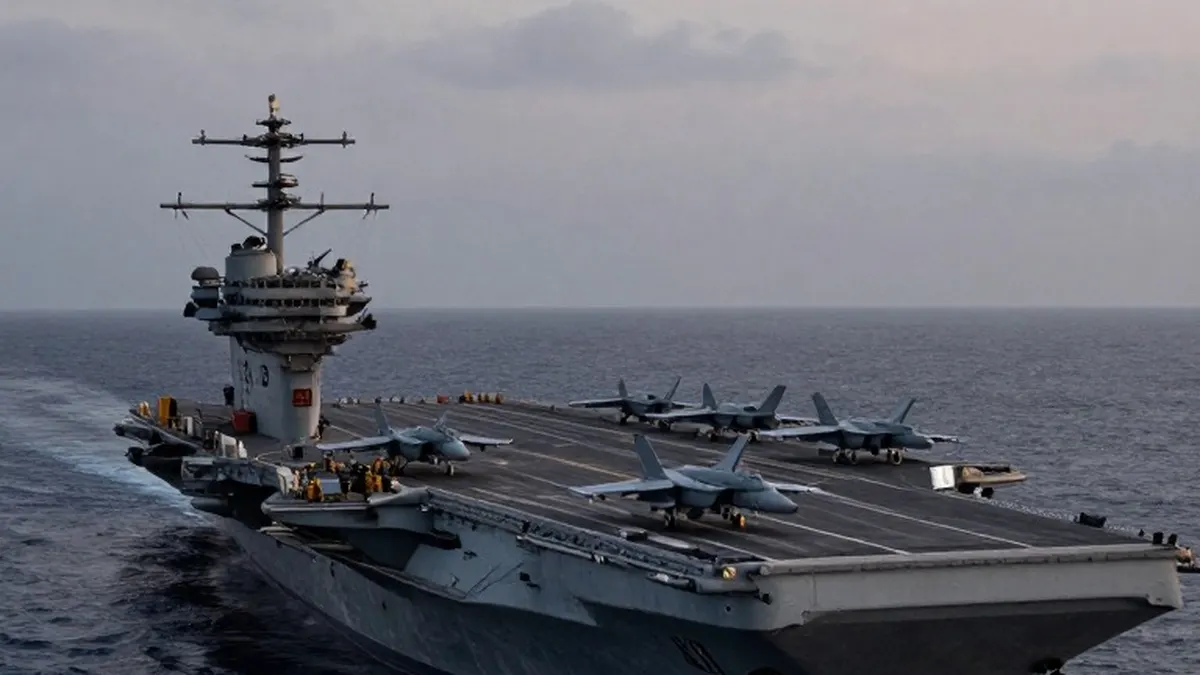
Yet the deployment of US military assets suggests escalation remains likely. The United States has two aircraft carrier groups and an amphibious assault ship in the Arabian Sea, and a third carrier group is arriving in the region. Iran's leadership, meanwhile, appeared to savour Trump's political collapse. Mohsen Rezaei, secretary of Iran's Supreme National Security Council, wrote on X that the Iranian nation had handed Trump "a strategic defeat on the battlefield and in the Hormuz" and "a POLITICAL DEFEAT in Washington."
Even as Trump acknowledged the war played a part in his party's defeat, he expressed no regrets about launching it at the start of the year. "I can tell you that as far as that war is concerned, I would have done nothing different," he said.
Some experts believe a bitter president with no electoral constraints may simply strike again. "If anything, Trump is now freed up for another round of strikes," Alan Eyre, a former senior State Department expert on Iran now at the Middle East Institute, told MEE. "The new Congress won't be seated until January, and even then it is questionable how much real ability they will have to constrain the president, so I don't think it changes much."