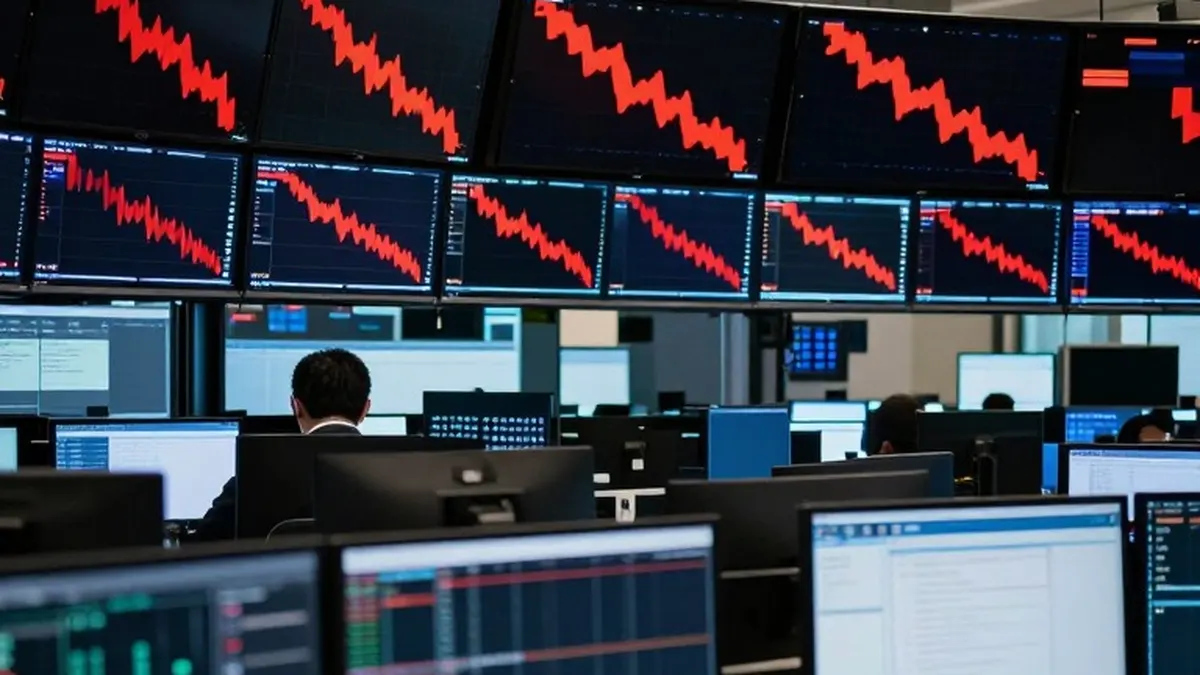
A technology stock rout spread through global markets Friday after Democratic gains in the U.S. midterm elections heightened investor concerns about the future of artificial intelligence development. Asian markets suffered steep declines following Thursday’s Wall Street selloff, while European shares opened lower. Japan’s Nikkei recorded its worst week since 2020.
The Nasdaq 100 fell 6.3% Thursday, losing $2.3 billion in market value, while the S&P 500 dropped 4.4%, erasing $2.8 trillion. Both indexes had their worst day in 18 months, dating back to the market turmoil caused by President Donald Trump’s global tariffs. U.S. stock futures were mixed early Friday as selling continued overseas.
South Korea’s Kospi sank more than 8%, prompting a temporary halt to trading across the market. Samsung and SK Hynix, which supply memory for AI data centers, each lost more than 10% in early trading before partly recovering. Japan’s Nikkei 225 declined as much as 6% and entered bear-market territory. Taiwan’s TAIEX fell 9%. In Europe, Britain’s FTSE 100 slipped nearly 2%, with France’s CAC40 and Germany’s DAX posting similar declines.
The election brought victories for candidates opposed to AI and data center development, including Texas Gov.-elect Gina Hinojosa. Texas is the country’s largest data center market. A Democratic Congress could subject the industry and its infrastructure projects to greater scrutiny, potentially creating delays and raising costs. Those possibilities have compounded existing doubts about whether AI investments will deliver sufficient profits. Investors had anticipated Republican losses, but the scale of the Democratic victory exceeded expectations.
Asian companies are especially exposed because they manufacture much of the hardware used in U.S. AI projects. Charu Chanana, chief investment strategist at Singapore-based SAXO Markets, told NBC News that markets were being hit according to their reliance on American AI infrastructure spending. Tai Hui, J.P. Morgan’s APAC chief market strategist, similarly pointed to the close connections between companies in Taiwan, South Korea and Japan and global AI capital expenditure.
The election uncertainty followed months of sharp swings for Asian investors. AI shares surged in June, but a recent selloff had already raised questions about stretched valuations. Chinese model developer Z.ai, which debuted in January, rose 2,000% in June. It has since fallen more than 80% from its peak and lost another 10% Friday. China’s Star 50, which includes semiconductor and AI leaders, now stands at half its June peak, having lost half a trillion in market value.
The Star 50 and China’s AI Index each declined as much as 5% Friday before recovering some ground. Chanana said parts of China’s AI stock bubble could reasonably be considered to have burst. However, she noted that China views AI and semiconductor self-sufficiency as national strategic priorities, allowing investment to continue for technological independence, industrial competitiveness and national security even when immediate profitability is uncertain.
South Korea’s commercially driven memory suppliers remain particularly vulnerable to a slowdown in U.S. spending. The Kospi more than doubled in market value in June but had surrendered most of this year’s gains by Friday. Taiwan, home to chip supplier TSMC and a major center for advanced semiconductor manufacturing, also faces substantial exposure.
Despite the declines, several Asian benchmarks remained above their levels a year earlier. The Kospi was up 25%, the Nikkei 225 was up 13%, and TSEC Taiwan Technology was up 47%. Hui said continued growth in global computing demand should support demand for semiconductor and memory hardware over the medium term.