Takashi Yamazaki made history just over two years ago when his film 'Godzilla Minus One' won the Academy Award for Best Visual Effects. The writer, director, and VFX supervisor became the first director to receive this specific honor since Stanley Kubrick for '2001: A Space Odyssey'. Speaking through a translator, Yamazaki described the win as a shock, noting that the Academy had been remarkably open to films made for domestic markets far from Hollywood.
The recognition opened new doors for the filmmaker, leading directly to the creation of the sequel, 'Godzilla Minus Zero'. Now in theaters, the film picks up in 1949, two years after the events of the original. It continues the narrative of the Shikishima family as they confront a new and devastating calamity. This installment is the 38th film in the Godzilla franchise and the 34th produced by Toho, the Japanese entertainment company that originated the character.
Yamazaki returned to both the director's chair and the role of VFX supervisor. The cast includes Kamiki Ryunosuke and Hamabe Minami. Notably, this production marks the first time a Japanese feature has been shot specifically for IMAX screens. Yamazaki discussed how he balanced massive action sequences with deeply emotional storytelling, ensuring that the human layer and the kaiju layer were not separate. He emphasized that human actions must affect the monsters and vice versa, creating a tight loop of cause and effect that drives the narrative immersion.
The title of the film carries significant weight for the director. Zero represents neutrality, a state of ordinary life that is difficult to attain in the post-war period depicted in the story. After the family in the first film briefly found stability, the new tragedy pulls them apart. Yamazaki explained that the characters are attempting to claw their way back to a neutral state, a concept he compared to the mathematical idea of approaching zero.
One of the film's most critical sequences involves Godzilla emerging from the ocean to chase a seaplane. Yamazaki noted that the screenplay simply stated that Godzilla would emerge and chase the plane, but the visual realization required careful composition. Because Godzilla is 50.1 meters tall, which is relatively small compared to other iterations in the franchise, Yamazaki used a long-lens visual effect shot. This technique compressed the depth of field to create the illusion of immense size while the waves of the emerging monster threatened the aircraft.
The director stated that this particular scene was crucial for the audience to feel the threat, leading the team to spend significant resources and rendering time on the shot. The final result exceeded his expectations due to the work of the VFX team. It is the first time the audience sees a full frontal view of Godzilla rising from the water in this series.
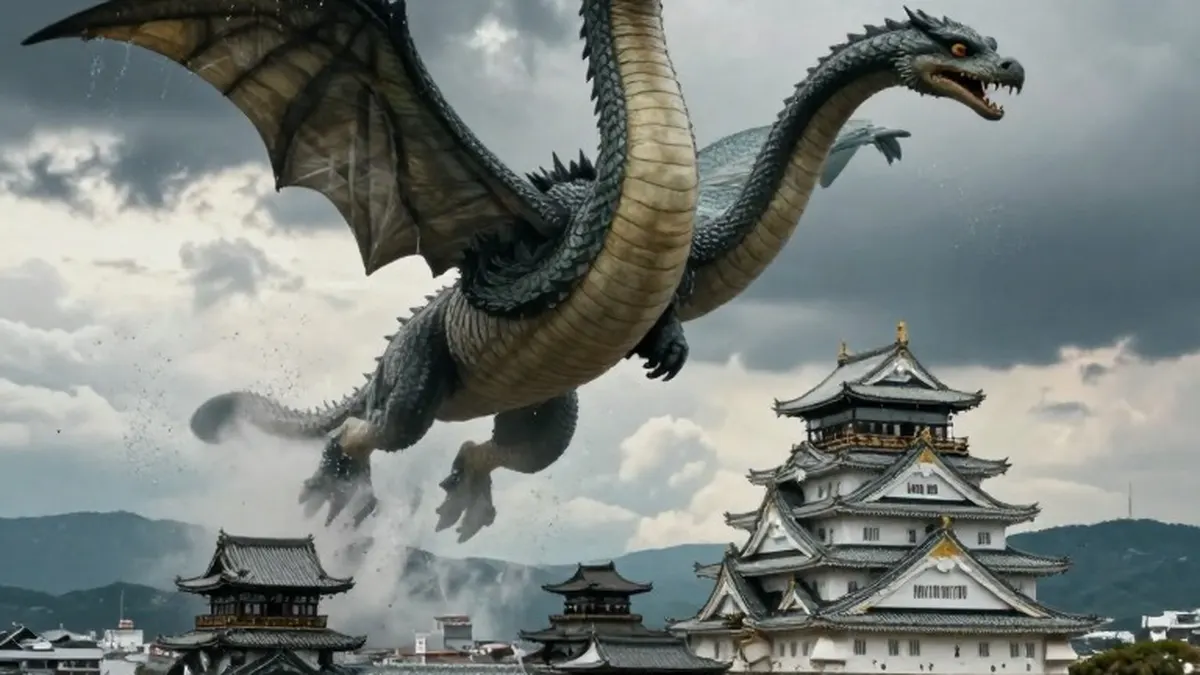
Bringing King Ghidorah to the screen allowed Yamazaki to fulfill a childhood dream. He grew up in Matsumoto City, the same location where Ghidorah made its silver screen debut in 'Ghidorah, the Three-Headed Monster'. As a child, he was disappointed that the original film only showed the monster flying over Matsumoto Castle without destroying the city. In 'Godzilla Minus Zero', Ghidorah appears in Matsumoto City and smashes it up, realizing the vision Yamazaki had wanted to see as a boy.
The film also features a young actress, Sae Nagatani, who plays Akiko. When the first film was shot, she was two years old, and the crew would run in with cameras when she was about to cry. Now five, she has a better understanding of the scenes and provided authentic reactions without extensive direction. Yamazaki cited a scene where a mother and baby are levitated by Ghidorah's gravity beam as one of the most satisfying sequences to pull off, using drones and a tilted set to capture the terror of the moment.
When asked about the future of the franchise, Yamazaki left the door open for a third installment, suggesting that the audience should stay excited for what comes next.