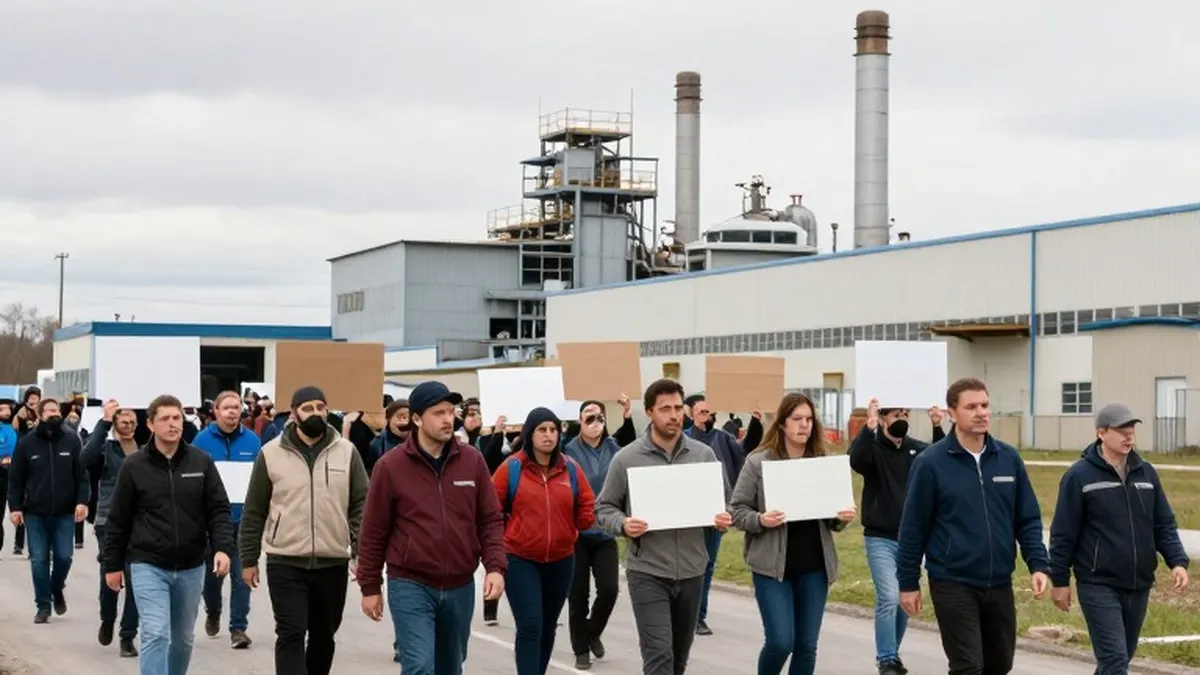
Tens of thousands of garment workers in Bangladesh have staged protests over the past few days, demanding significant increases to their minimum wages. The demonstrations have disrupted operations in the country's ready-made garment sector, which accounts for more than 80 percent of its export earnings. Workers argue that their current pay is no longer sufficient to cover basic living expenses, leading to widespread hardship in their communities.
Laili Begum, a 37-year-old sewing operator in Dhaka, illustrates the severity of the crisis. Earning approximately 15,000 taka per month, with occasional overtime raising that figure to around 20,000 taka, she recently had to pull her two children out of school. Begum described days when her family consumed only puffed rice and snacks for dinner, going without a proper meal for lunch. Her son has become visibly thin due to the lack of adequate nutrition.
The protests began on Saturday, with workers demanding a minimum wage of 30,000 taka, more than double the current rate of 12,500 taka. The Bangladesh Garment Manufacturers and Exporters Association reported that the strikes affected nearly one million workers across 529 factories on Sunday. Police used tear gas and stun grenades to disperse crowds in the Ashulia industrial area, resulting in the arrest of dozens of protesters.
In response to the unrest, the government announced the creation of a six-member wage board to review worker demands. This move follows a recent amendment to labor laws that shortened the wage review cycle from five years to three. Despite this announcement, workers returned to the streets on Monday for a third consecutive day of protests. In the Gazipur area, demonstrators blocked major highways and clashed with police, while some vehicles were vandalized.
Rasel Khan, another worker in Ashulia, highlighted the growing debt burden faced by many employees. With monthly earnings between 18,000 and 20,000 taka, he has accumulated debt of roughly 100,000 taka to support his family amid soaring prices. The last minimum wage revision occurred in December 2023, and annual inflation has since reached 8.34 percent, significantly reducing the purchasing power of low-income earners.
Economic experts note that persistent inflation over the past five years has sharply eroded the real income of garment workers. Zahid Hussain, a former lead economist at the World Bank, explained that workers are forced to cut daily living standards because they lack surplus income. He also suggested that a recent salary hike for government employees created a demonstration effect, encouraging private sector workers to seek similar relief.
Industry leaders acknowledge the need for fair wages but warn that significant increases could pressure factories if global brands do not adjust their purchasing prices. Sheikh Hossain Muhammad Mustafiz, an official at the Bangladesh Garment Manufacturers and Exporters Association, stated that international brands must share the responsibility of sustainable wage growth through fair pricing practices.
Critics argue that Western fashion brands, which hold a large share of the value generated by Bangladeshi garments, have been slow to address workers' rights. Taqbir Huda, a senior fellow at the University of Oxford, noted that the wage board was only formed after protests began. He emphasized that without addressing the cost-of-living crisis, the new board may not meet workers' expectations.
Political leaders have moved quickly to manage the situation. Prime Minister Tarique Rahman convened an emergency meeting of top officials on Sunday, while Home Minister Salahuddin Ahmed met with factory owners on Monday to assure them that negotiations would determine the new wage. Labor Minister Ariful Haque Choudhury urged workers to return to their jobs, stating that the wage board would begin deliberations shortly.
A workers' representative on the board, Babul Akhter, has called for the new wages to take effect with January 2027 salaries. He also demanded the release of arrested workers and the withdrawal of cases against them. For many workers like Begum, the ongoing uncertainty means another month of struggle to feed their families, with the hope that food prices will also decrease alongside rising wages.