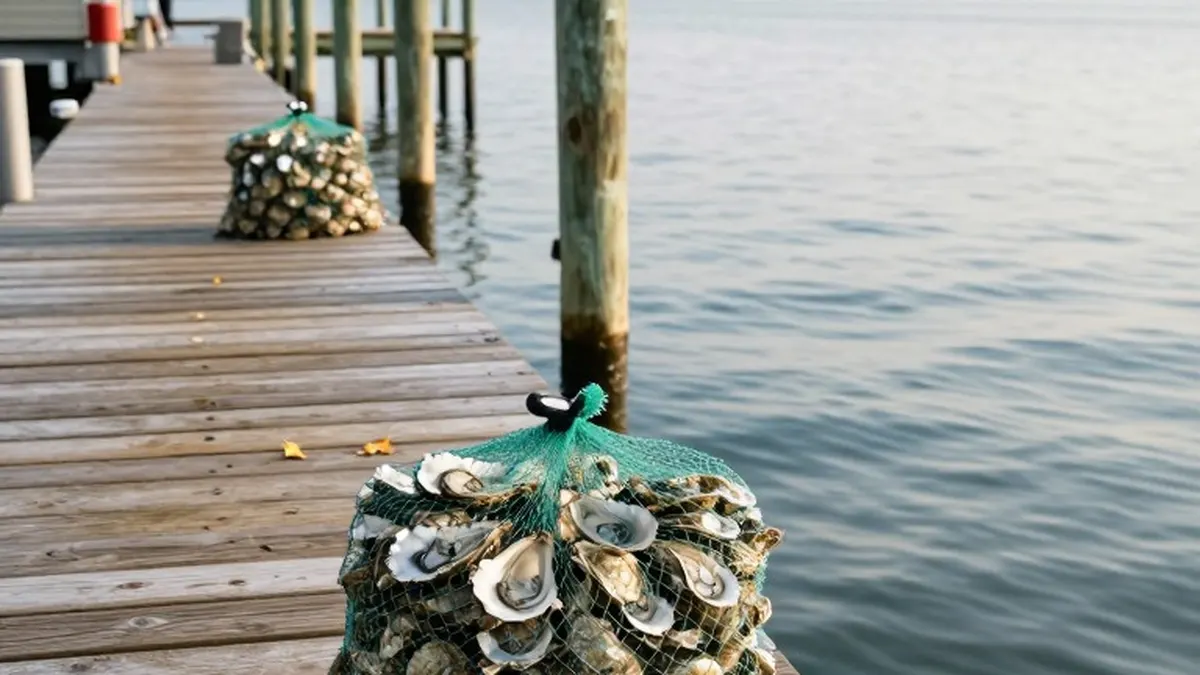
From his pier at the southern end of Maryland's Kent Island, John Consoli is helping replenish the Chesapeake Bay's oysters, one mesh bag at a time. After three months in the water, one batch of young oysters had grown so heavy that he struggled to lift it onto the dock. His conservation effort now extends beyond his waterfront, drawing neighbors and a local restaurant into raising oysters.
The animals play several roles in the bay's ecosystem. An adult oyster can filter as much as 50 gallons of water daily, improving conditions for sea grass and other marine life. Their shells also provide places where small fish and crabs can feed and shelter. Consoli says he has even discovered a seahorse among his oysters.
Overharvesting devastated the Chesapeake's once-abundant oysters, with one estimate putting the decline at more than 99% by 2011. The losses contributed to deteriorating water quality and reduced habitat. Ryan Carnegie, a biologist at the Virginia Institute of Marine Science, says oyster farming has expanded in recent years despite disease and environmental challenges. Improved management and restoration investments have also helped wild populations recover partially. Still, Elizabeth North, a fisheries oceanographer at the University of Maryland Center for Environmental Science, says their numbers likely remain a fraction of historical levels.
Consoli, a professional photographer at the University of Maryland, became interested in restoration while photographing oyster research on campus. He keeps his oysters just beneath the surface, where he says concentrated nutrients encourage rapid growth. He does not raise them for food, although improving the bay's water also benefits habitat for oysters harvested commercially.
Among the researchers who inspired him was University of Maryland mechanical engineer Miao Yu. Her team is developing robotic tools to address two problems made difficult by murky water: identifying suitable places to plant young oysters and determining where and when adults should be harvested. Young oysters need a hard surface to settle on and can suffocate in mud. Harvesting through dredging can damage the seabed or remove oysters before they are ready.
At the university's Neutral Buoyancy Research Facility, Yu's team tests Oysterbot, a robot built in-house with electronics mounted above pontoons and sonar underneath. Doctoral student Michael Xu uses it to scan broad underwater areas. A smaller, commercially available robot called BlueROV supplies live video for closer inspection. The researchers use artificial intelligence to combine and analyze the imagery, assessing oyster presence, size and whether the animals are alive or dead.
The algorithms are still being refined. Yu hopes the work will eventually give farmers detailed information to guide planting and harvesting. Her team has also conducted fieldwork along Washington state's shoreline and the Gulf Coast. She hopes the technology can be adapted and expanded to coastlines nationwide within a decade.
Meanwhile, Consoli has built what he calls the Peer to Pier Network by encouraging people with access to the bay to grow oysters. Participants include neighbors and his dental hygienist. Neighbor John Patrick says he has observed more marine life around his pier since adding oysters, including croaker, crabs and eels.
A couple of months before the October 31 report, Consoli worked with Libbey's Coastal Kitchen to install a million baby oysters around its dock pilings. Eight people worked in wetsuits and life jackets amid jellyfish. Restaurant operator Andrew Westlin welcomed the effort as a way to contribute to the community. Consoli's wife, Kathy, estimates his network may now include 80 people, a growing group united by his aim of restoring as many oysters as possible.