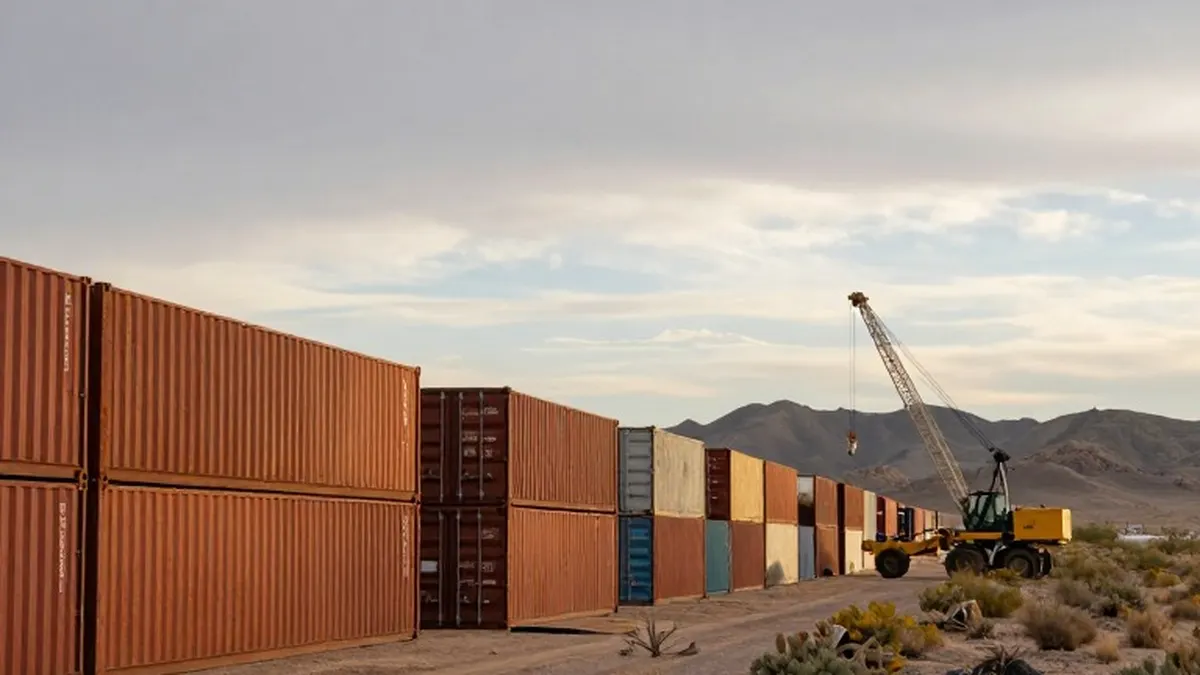
Gov. Doug Ducey has agreed to take down the shipping containers he placed along the Arizona border, ending his refusal to comply with a demand from the Biden administration.
In a stipulation filed in federal court on Wednesday, Ducey committed to removing the containers near Yuma, along with all "associated equipment, materials, vehicles and other objects" from United States property by Jan. 4. The filing says the work will be done "to the extent feasible and so as not to cause damage to United States' land, properties and natural resources." Separately, the governor agreed to begin talks with the U.S. Forest Service on removing the containers already placed in Cochise County, on a schedule acceptable to all sides.
The agreement settles part of a lawsuit the federal government filed earlier this month. It asked a judge to force removal of the hundreds of double-stacked containers, or to let federal authorities take them out and send the state the bill. Until Wednesday, Ducey had held his ground.
His spokesperson, C.J. Karamargin, rejected the idea that the governor was backing down. He described the deal as a win because it secures what Ducey wanted from the start: a federal pledge to begin closing gaps in the existing border wall, with construction starting before the end of the year. Karamargin said conditions at the border have worsened and that the White House "has apparently realized it." He pointed to cities such as El Paso and Yuma being overwhelmed by migrants, and noted that the U.S. Supreme Court is weighing whether to lift Title 42, the Trump-era rule that let the federal government quickly expel asylum seekers on the stated grounds of limiting COVID-19 spread.
Any federal move to fill wall gaps would be a notable shift. On his first day in office, President Biden halted further work on the wall begun under his predecessor. The administration had spoken before about closing some gaps, but Karamargin said this is the first clear sign of immediate action. "Better late than never," he said.
It remains unclear whether the commitment, which appears to bind Katie Hobbs when she takes office on Jan. 2, ends the broader legal fight. In an earlier suit, Ducey argued Arizona had the right to put up the barriers and asked a judge to declare that the "Roosevelt Reservation," a 60-foot-wide strip along the border set aside as federal land by President Theodore Roosevelt, was illegally enacted. The new filing states it "is not a waiver of any rights, claims, liabilities, or defenses," which could let that case and the land ownership dispute continue. Karamargin said no decision has been made on whether Ducey will drop the state's ownership claim before leaving office.
The question may be moot. Work on the planned 10 miles in Cochise County has effectively stopped after protesters blocked crews. Hobbs also told Capitol Media Services she intends to halt further installation once she is sworn in, saying she believes the decision to place the containers was wrong. "It's not our land to put things on," she said, calling the effort "a political stunt" and "a waste of taxpayer dollars."
The governor's office put a $6 million price tag on filling a 3,820-foot gap near Yuma, while the 10-mile Cochise County stretch under construction will cost taxpayers another $95 million. The money came from a $335 million appropriation by the Republican-controlled Legislature.
A complication remains. The rules on that account, the Arizona Border Security Fund, allow the money to be spent only on building a barrier. Paying for removal would therefore require lawmakers, who will still be under Republican control next year, to approve a new appropriation or rewrite the existing law.