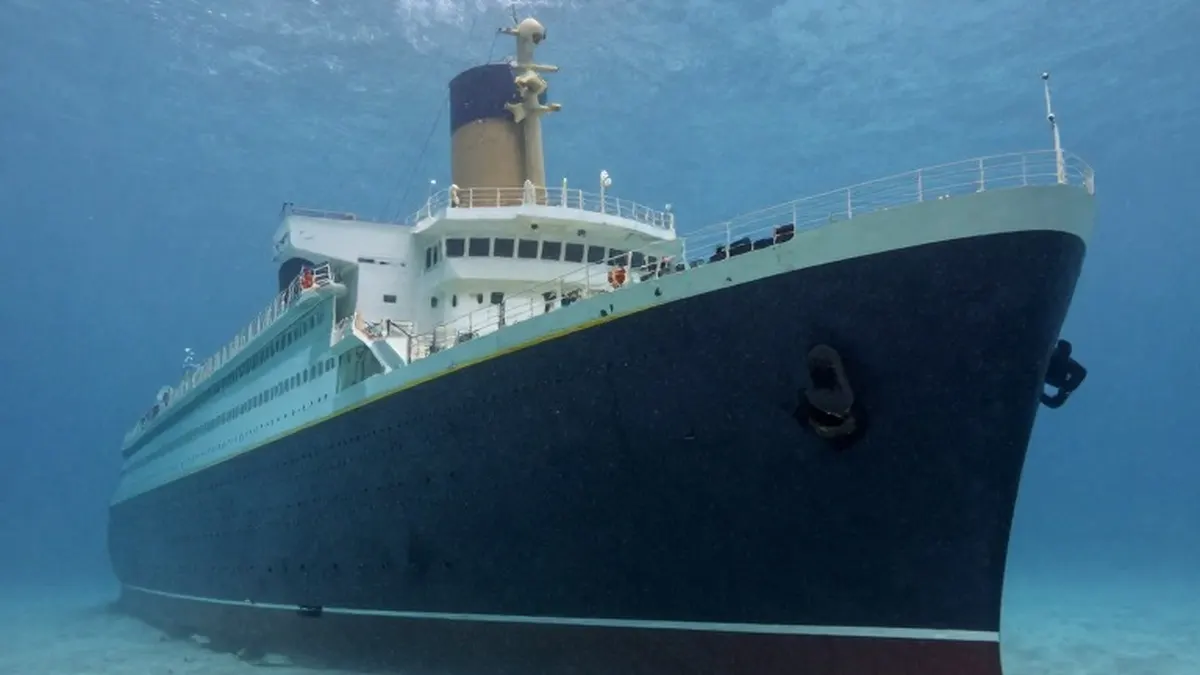
The SS United States sank off Destin, Florida, on Wednesday, November 11, ending its final journey and beginning a new role as the world’s largest artificial reef. The nearly 1,000ft vessel reached the bottom of the Gulf of Mexico at about 10pm after gradually taking on water over several hours.
Deployment began at approximately 2.40pm ET, followed by the start of the sinking process shortly before 5pm. Preparations included hollowing out the ship and cutting openings in its hull so water could enter, helping the liner descend upright to the ocean floor.
The ship’s resting place is approximately 180ft below the surface, with its upper decks about 55ft underwater. The site is expected to draw divers from around the world. Officials also anticipate that the structure will become habitat for marine life, including red snapper, grouper, amberjack, mackerel and tuna.
Launched in 1952, the American-made liner established a transatlantic speed record on its maiden voyage and was once the fastest ocean liner in the world. It transported thousands of passengers across the Atlantic during a 17-year operating career that ended with its retirement in 1969.
The vessel subsequently spent years docked in Philadelphia while a succession of owners pursued efforts to preserve and restore it. Those attempts became increasingly difficult as maintenance expenses rose. In 2021, port authorities increased the daily dockage charge to $1,700, an amount the nonprofit SS United States Conservancy could no longer afford.
Florida’s Okaloosa county bought the ship for $1m in 2024, intending to turn it into the world’s largest artificial reef. The purchase set the former passenger liner on a course toward an underwater future after years of efforts to secure its preservation.
Before the sinking, conservancy president and co-founder Susan Gibbs said the vessel would remain intact as a reef and develop into a thriving marine habitat. She said that future, together with a land-based museum and visitor experience, would provide a moving way to honor the ship’s history.
Gibbs also described the attachment of her grandfather, ship designer William Francis Gibbs, to the liner, calling it a “full-bore obsession”. He joked that he loved the vessel a thousand times more than her grandmother, she recalled. He watched it depart on every voyage to Europe and was among the first to welcome it back.