Artificial intelligence has become a major topic at universities over the past year. Generative tools that can write articles and produce images have left some professors worried about cheating. At Arizona's two largest universities, however, a number of people are working to ease those fears by showing staff and students how the technology can be used constructively.
The Arizona Board of Regents has not issued a policy or guidance on AI, so each school has been left to decide what counts as acceptable use. Both Arizona State University and the University of Arizona have introduced new syllabus guidelines. Under them, instructors can state whether students may use AI heavily, lightly, or not at all in a given class.
Mina Johnson-Glenberg directs the Embodied Games XR Lab at ASU, which creates STEM learning content for students from fourth grade through adulthood. She said the university's general aim is for graduates to be AI literate. "AI is going to be around for a long time," she said. "It's not going to go away. So we want our students to have some experience working with it."
Instructors are encouraged to treat AI as a collaborator and never put it in the driver's seat. That means students should not hand in an entire assignment, such as a paper, produced by AI. Where AI is used in other ways, students must cite it in the final product, using APA style or another appropriate format.
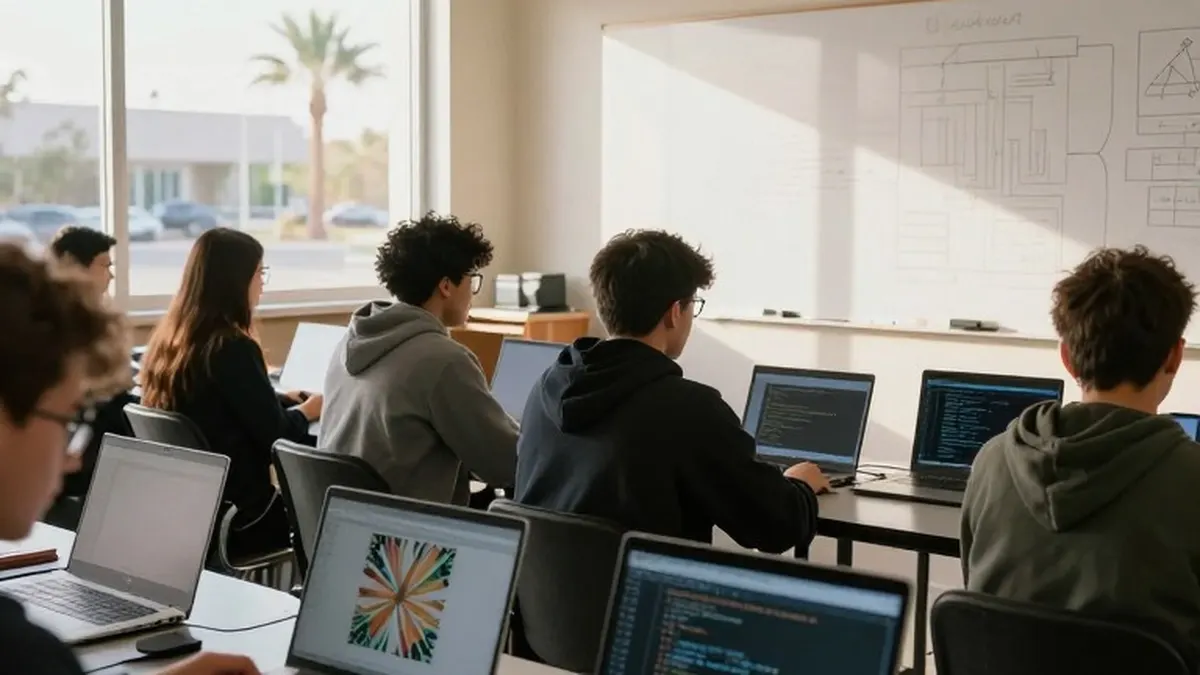
In Johnson-Glenberg's class, students use AI to strengthen work they are already doing. One student building a game for Parkinson's disease rehabilitation used a text-to-image generator to produce a polished interface, replacing the stick-figure sketches students once submitted. Another student used AI to help code a new keyboard for people with cerebral palsy, and said it made him 50% faster. She noted that the tool makes errors, so users must know how to correct them.
She stressed that the tools are far from perfect. One guest speaker asked an image generator for a photo of "frozen pears." The result showed baskets of pears that were not quite frozen, topped with odd heads resembling Elsa. The generator had latched onto the Disney film Frozen instead of reading the word as an adjective.
ASU has formed student and staff committees to lead discussions on AI. Frank Liu, a Ph.D. student in computer engineering, heads the student group, which takes up topics from faculty and aims to inform the university's generative AI policy decisions. The group also wants to address professors' concerns and show them positive uses. Liu said he uses ChatGPT to catch small grammar issues and to suggest ways to make a sentence stronger.
At the University of Arizona, Barney Maccabe directs the Institute for Computation and Data Enabled Insight. He said a new working group of about 150 faculty, staff and students is holding an ongoing conversation about AI. One reason for it is that last fall, the university's plagiarism checkers began looking for AI use in student work. Maccabe said the school did not understand how the software determined what was inappropriate, and the vendor provided no information. The recommendation was to turn the feature off quickly, since it was producing false positives.
Like ASU, UA wants students to learn these tools because they are already used in the professional world. "At the end of the day, it's your responsibility to make sure that what you turn in, what you have written, you can stand behind and you have to be part of that creative process," Maccabe said. All three experts agree that generative AI will ultimately prove to be more friend than foe.