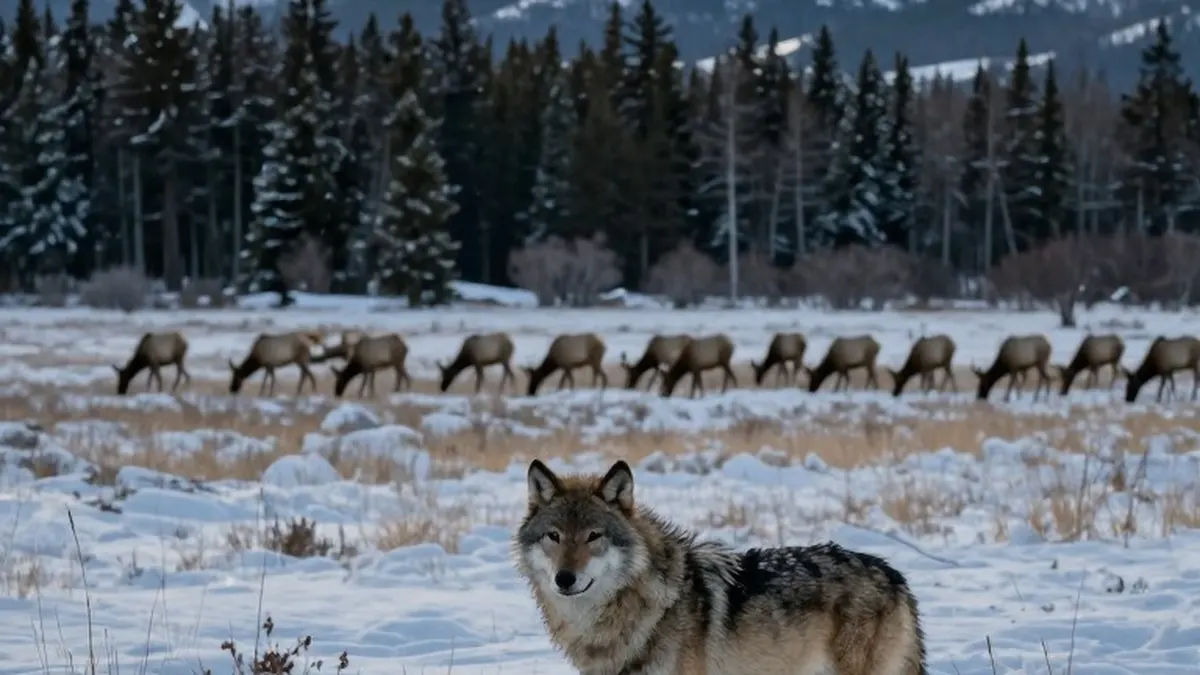
Gray wolves are set to return to the Colorado Rockies, with state wildlife managers working to meet a deadline to begin releasing the animals by the end of December. Humans eradicated wolves from the state in the 1940s.
The effort follows Proposition 114, which Colorado voters approved in 2020. The measure required wolf reintroduction within three years. State officials have since held public forums and assembled a large stakeholder group that included rural county leaders, environmentalists, outfitters and ranchers, many of whom opposed the idea. The group helped write a management plan widely viewed as a compromise. If everything goes as planned, reintroduction will start by New Year's Eve.
"We know that wolves will do well here," said Reid DeWalt, an assistant director with Colorado Parks and Wildlife. He said the aim was for the process to be done "with the citizens of Colorado and not done to the citizens of Colorado." The effort is considered historic because voters mandated it. Earlier reintroductions, in states from North Carolina to Wyoming, were carried out by the federal government. Political analysts largely credit the yes vote to the state's growing urban population, which has helped turn Colorado from red to blue in recent elections.
Some wonder whether that growth could undermine the wolves' chances. Colorado had barely two million residents in the 1970s and is now approaching 6 million. It grew at twice the national rate over the last decade, and some of the best wolf habitat is broken up by luxury homes, ski resorts and other development. Perry Will, a Republican state senator and retired game warden of 40 years, said, "We're not Wyoming. We're not Idaho. We're not Montana." He expects the animals to be "in constant conflict in this state," noting that wolves can travel up to thirty miles a day in search of food.
Joanna Lambert, a University of Colorado environmental studies professor and wildlife biologist who helped write the ballot measure, disagrees. She called wolves "superb dispersers" that are intelligent and adaptable. Lambert, an expert on wolves in the Greater Yellowstone ecosystem, said the human population there has also grown significantly since wolves were reintroduced in the 1990s. Studies show livestock losses there have been far lower than expected, she said, and wolves tend to avoid people. She does not expect them in neighborhoods or on the streets of Aspen.
Food should not be scarce. Colorado has more elk than any other western state, averaging around 300,000, roughly twice the size of Montana's herd. The first wolves will come from Oregon, partly because they are adapted to hunting elk. Colorado had initially struggled to find wolves, as wildlife agencies in Wyoming, Montana and Idaho turned down some transfer requests, in some cases because of politics. Wolves outside the Northern Rockies remain protected by the federal Endangered Species Act, but under the compromise Colorado's will be an "experimental population." That means they could be harassed or killed if they cause problems for livestock producers.
Fear persists among some residents. Orion Viertel, a realtor in Summit County, said it is frightening to consider taking children and pets on a day hike. He believes voters were ill informed and said he would think twice about backpacking with his young son. No attack on a human has been documented in the thirty years since wolves were reintroduced to Yellowstone and central Idaho.
Francie Jacober, a rancher who chairs the Pitkin County Commission, believes people and wolves can share the landscape. She supported reintroduction, which makes her an outlier among ranchers, and served on the stakeholder group. Flying over the western slope, she said, reveals "a lot of untouched wilderness," and "that's where the wolves will be." She hopes wolves will scatter the elk herds that have grown used to grazing leisurely and restore their migratory habits.
Wolves have already begun arriving on their own from the Yellowstone area, and one was recently spotted just over the New Mexico border. The state plans to start formally releasing several more by December 31, with possibly dozens to follow in the years ahead.