Remedy Entertainment has provided insight into the development of one of Control Resonant's most complex missions, titled Recursions and Iterations. The level centers on time travel and intersecting timelines, presenting players with a narrative that is deliberately difficult to parse. As the protagonist, Dylan Faden, players encounter researchers who appear to be trapped in timeline anomalies. The encounter is unsettling because Dylan's first meeting with them is not their first meeting with him, leading to a glitch that leaves the researchers dead in every observed timeline.
The ambiguity of the story is a central feature rather than a bug. Lead level designer Anne-Marie Grönroos admitted that even the development team struggled to keep track of the narrative outcomes. She noted that she did not actually remember where the writing landed regarding the researchers' fate after the mission concludes. Senior level designer Admir Burnic agreed that the uncertainty is part of the design, stating that time travel stories are inherently illogical and therefore anything can go. The goal was to capture the unease of knowing something is wrong without necessarily understanding why.
A major highlight of the mission is a late-game combat sequence where multiple versions of Dylan glitch into the fight. Burnic revealed that this idea was inspired by the mission Effect and Cause from Titanfall 2. He wanted to create a Remedy-style interpretation of that concept. Because it was added late in production, Burnic looked for a way to reuse existing animations to make the implementation feasible. He approached an animator to request specific clips, allowing the team to execute the risky idea without overhauling the entire system.
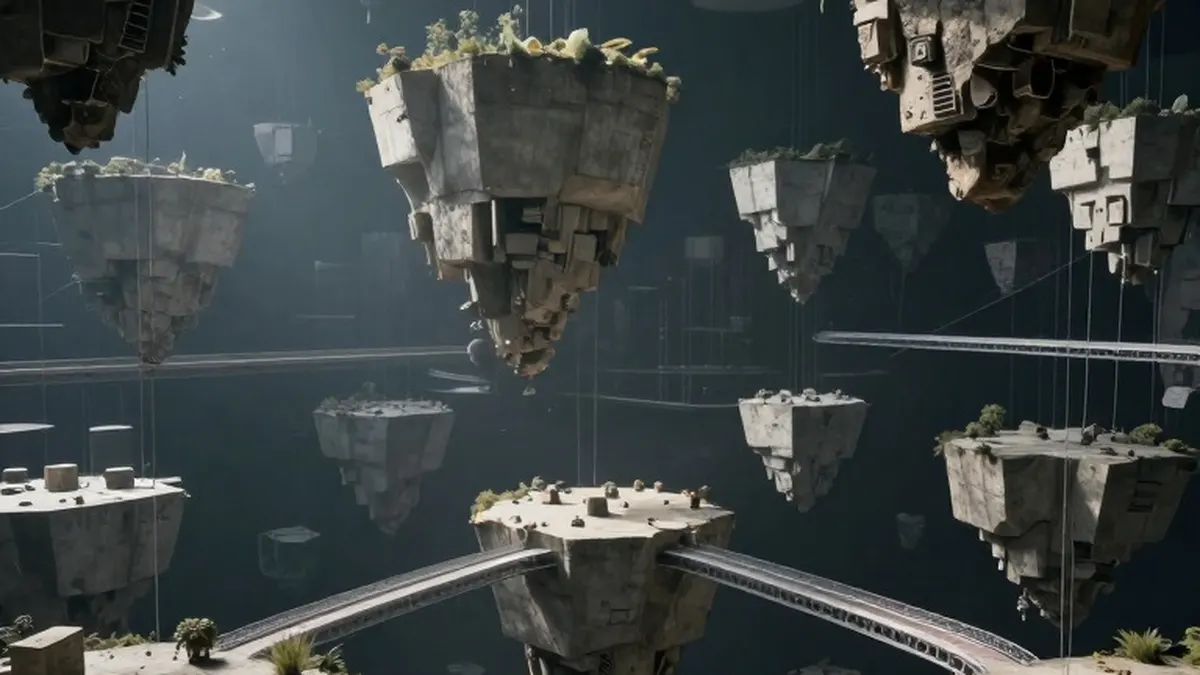
While the narrative was a standout for playtesters, the physical design required significant iteration. Players must navigate between three research stations located in the Underpass, an area characterized by floating concrete islands. In early versions, the stations were nearly identical, relying on internal content to distinguish them. This caused confusion, with some testers unable to determine how many stations existed or how to tell them apart. To solve this, the team introduced a visual language based on the state of disrepair. Each station now reflects a different amount of time spent there, ranging from two weeks to ten years.
Navigation was another critical area of focus. The developers made the Reach ability, which allows Dylan to grapple over long distances, a requirement for accessing the Underpass. This change addressed navigation issues that had been holding the mission back during development. The ability makes the floating islands much easier to traverse, ensuring that the environmental complexity does not become an obstacle to progress.
The immense power of Dylan Faden presented its own design challenges. Burnic explained that the character's abilities allow him to close gaps quickly, which could easily break the intended flow of narrative moments. The team realized that trying to guarantee a specific order of events would result in overly hand-holdy design. Instead, they treated narrative beats as pieces of a puzzle. The order in which players discover them is less important than ensuring they eventually have all the pieces to understand the story.
The development team aimed for a fragile balance between providing enough guidance for players to understand their objectives and trusting them to explore. Grönroos emphasized that the goal was to allow players to know where they are going without holding their hand. This approach is described as being in the DNA of the entire game. Despite the potential for confusion, the final result successfully conveys the unsettling, otherworldly mood of the mission while remaining accessible to players.
The mission serves as a testament to Remedy's willingness to experiment with complex mechanics and narrative structures. By leaning into the power of the protagonist and the illogical nature of time travel, the developers created an experience that is both challenging and memorable. The iterative process, involving changes to art, mechanics, and narrative, resulted in a level that stands out in the broader context of the game.