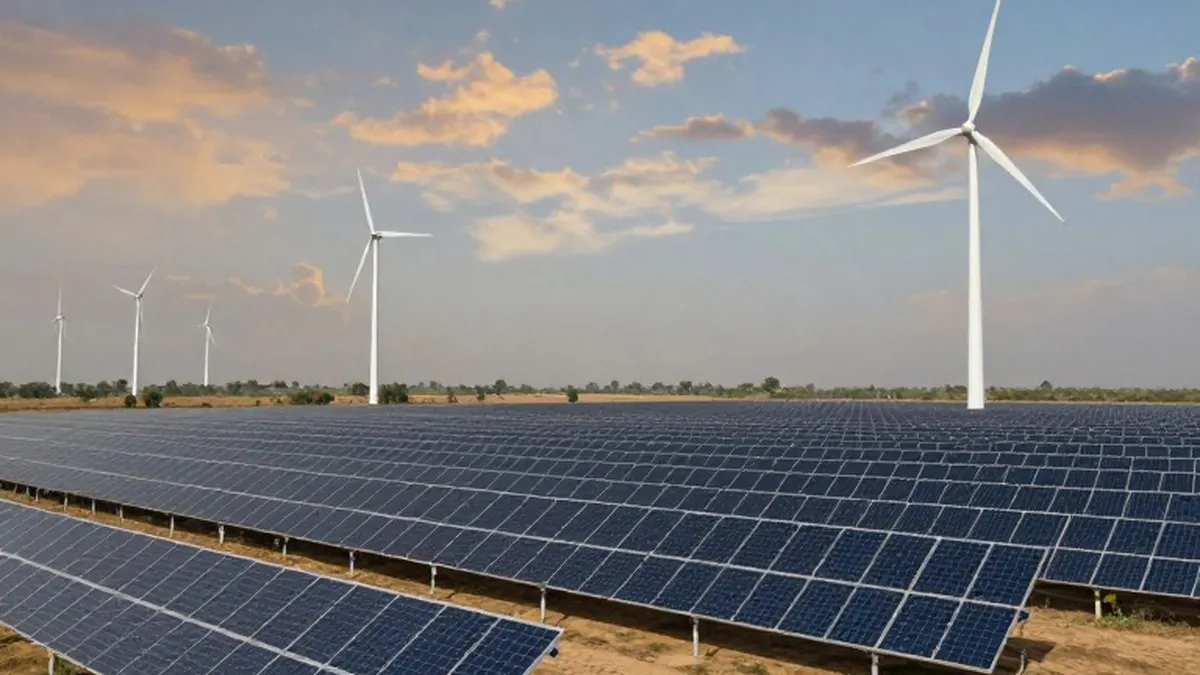
India has outlined an aggressive plan to expand its nonfossil fuel power capacity to 900 gigawatts by 2035. This new objective, announced in late September, is nearly double the country's previous target of 500 gigawatts for 2030. The goal includes solar, wind, hydropower, and nuclear energy sources. Currently, India holds the third largest clean power capacity in the world, trailing only China and the United States.
The announcement coincides with the ongoing United Nations climate conference in Turkey, known as COP31. As one of the fastest growing economies and a major carbon emitter, India aims to accelerate its shift away from fossil fuels. The government has also approved nearly $20 billion in funding for power grid upgrades and battery storage under its Green Energy Corridor initiative.
Experts indicate that achieving this target could reduce electricity costs and limit the construction of new coal plants. However, significant hurdles remain, primarily related to transmission infrastructure. India currently generates more renewable electricity than its grid can handle. Nikit Abhyankar of the India Energy and Climate Center at the University of California, Berkeley, stated that a robust transmission grid is essential to meet the new goals.
Ajay Shah, an economist based in Mumbai, described the ongoing transition as the rise of an Indian electrostate. In this scenario, electricity increasingly replaces coal and petroleum products. Shah noted that India now possesses two major economic assets: cheap labor and cheap energy. This shift mirrors global trends toward cleaner power, although fossil fuels remain a critical source of energy worldwide due to rising demand.
Despite these developments, coal continues to play a dominant role in the Indian power sector. According to the energy think tank Ember, coal generated approximately 71 percent of the country's electricity in 2025. Power planners remain concerned about maintaining reliable supply as renewable output fluctuates. Ghanshyam Prasad, chair of the Central Electricity Authority, suggested that India may require up to 150 gigawatts of additional coal-fired capacity by 2035.
Researchers at Berkeley estimate that beyond the coal capacity already under construction, new plants may not be economically necessary if the country meets its clean energy targets. Abhyankar warned that newly built coal facilities could become stranded assets in the long term. Existing coal plants also face operational difficulties, as many cannot quickly reduce output when renewable energy sources are available.
The current grid is already under strain. While clean power accounted for 55 percent of installed capacity by September, it generated only about one-third of the country's electricity in the preceding three months. Over the past 16 months, India curtailed enough solar generation to power roughly 10 million homes because the infrastructure could not accommodate the supply.
The Green Energy Corridor plan aims to help states integrate up to 135 gigawatts of renewable energy by 2033. This involves adding thousands of kilometers of transmission lines and expanding battery storage. However, analysts question whether this is sufficient. Berkeley researchers suggest India may need as much as 250 gigawatts of energy storage to properly integrate renewable electricity over the next decade.
Policy barriers also pose risks to investment. Shah argued that regulations requiring businesses to pay higher rates to subsidize other consumers can discourage renewable energy projects. He advocated for market-driven pricing and easier access for foreign investors. Additionally, India's reliance on imported battery cells, primarily from China, presents a supply chain challenge that domestic manufacturing could help address.
Despite these obstacles, India has overtaken the United States in annual renewable energy growth. Abhyankar believes the country's experience could serve as a model for other developing nations in the Global South, demonstrating that the energy transition can be achieved in an economically affordable manner.