In the lobby of a three story building in Wuhan, China, a child-size yellow robot welcomes guests by dancing to traditional Chinese music, flanked by two larger robots pounding drums in time with the beat. The performance is a prelude to the more serious work happening upstairs at the Hubei Humanoid Robotics Innovation Center.
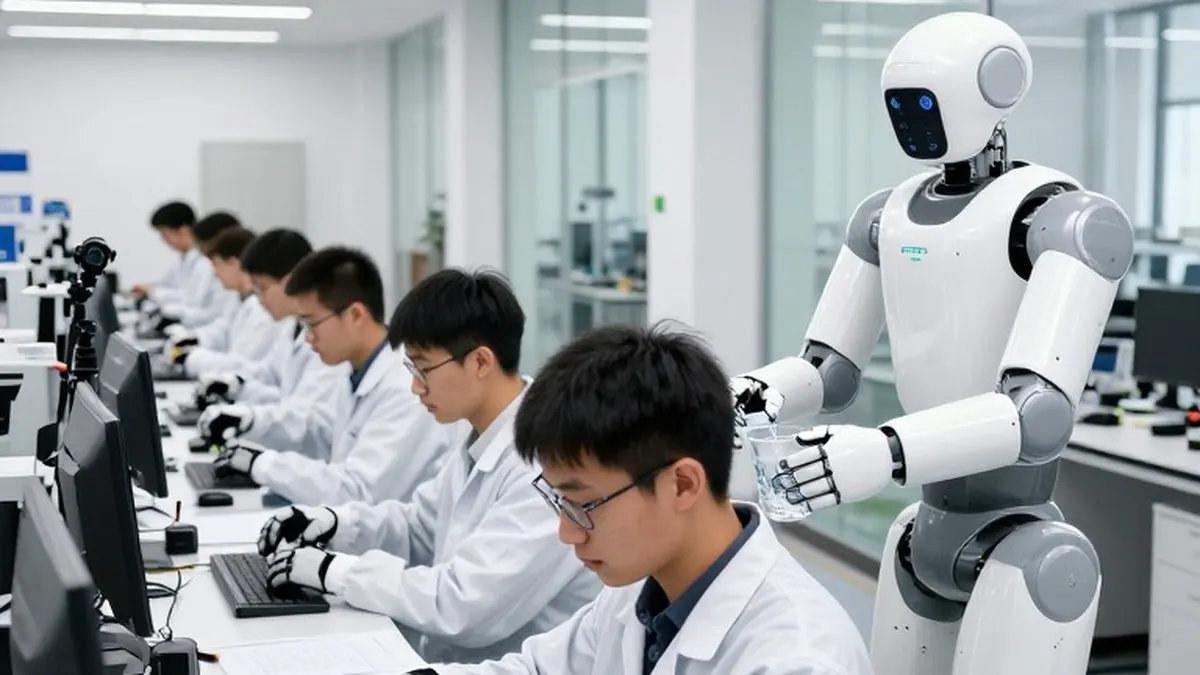
On the top floor, more than 100 computer science and engineering graduates work at individual stations, wearing gloves and suits fitted with motion and tactile sensors while cameras track their every move. One pours water into a jug. Another sorts cutlery and chopsticks into a container. A third unscrews a flashlight, takes out the battery and puts it back in.
Each action is performed slowly, carefully and repeatedly, because every recording becomes training data for the company's humanoid robots. "It was fun at first," said 22-year-old intern Mei. "It gets a little boring in the middle. But it's such a proud moment when we get the model trained."
Mei is among the nearly 1 million engineering graduates China's universities are estimated to produce each year, a figure that dwarfs the roughly 140,000 young engineers entering the job market annually in the United States. Nearby, another graduate uses a hand controller to make a humanoid robot mirror his movements, teaching it to pour water into a cup. "We need to run this hundreds or thousands of times. We have only completed 500 iterations so far," he explained.
At the G20 summit in September, Elon Musk predicted that within 10 years "there will be well over a billion humanoid robots, and productivity of a robot will be five-times that of a human." Many in China, however, frame the goal differently.
"Our main goal is for these robots to serve humans in household and industrial settings," Prof. Jiyin Cao, who runs the Hubei center, told CBS News. "We train them to carry out tasks for industrial applications. This is why we train these robots: to help them integrate better into human life."
The effort carries real urgency for China, which faces an aging and shrinking population, one of the fastest demographic shifts anywhere in the world. That pressure is driving attempts to place humanoid robots in labor-intensive fields such as manufacturing, logistics, retail and healthcare. "I believe future robots will be deployed across all industries," Cao said. "They will work in factory workshops, homes, nuclear energy sites, provide elderly care services, and serve as our personal assistants."
Cao dismissed the idea that household robot helpers are just around the corner. "Home environments are unstructured, far from simple," he said, noting that early robots mostly operate in fixed, structured settings while every home is different. "It could be three to five years away before one is in our home. But it could also take 10 years."
Whatever the timeline, China is betting on its industrial might to lead the sector. "China has the world's strongest industrial manufacturing system and a full supply chain for upstream and downstream robotics products," Cao said. "That is our greatest edge globally."