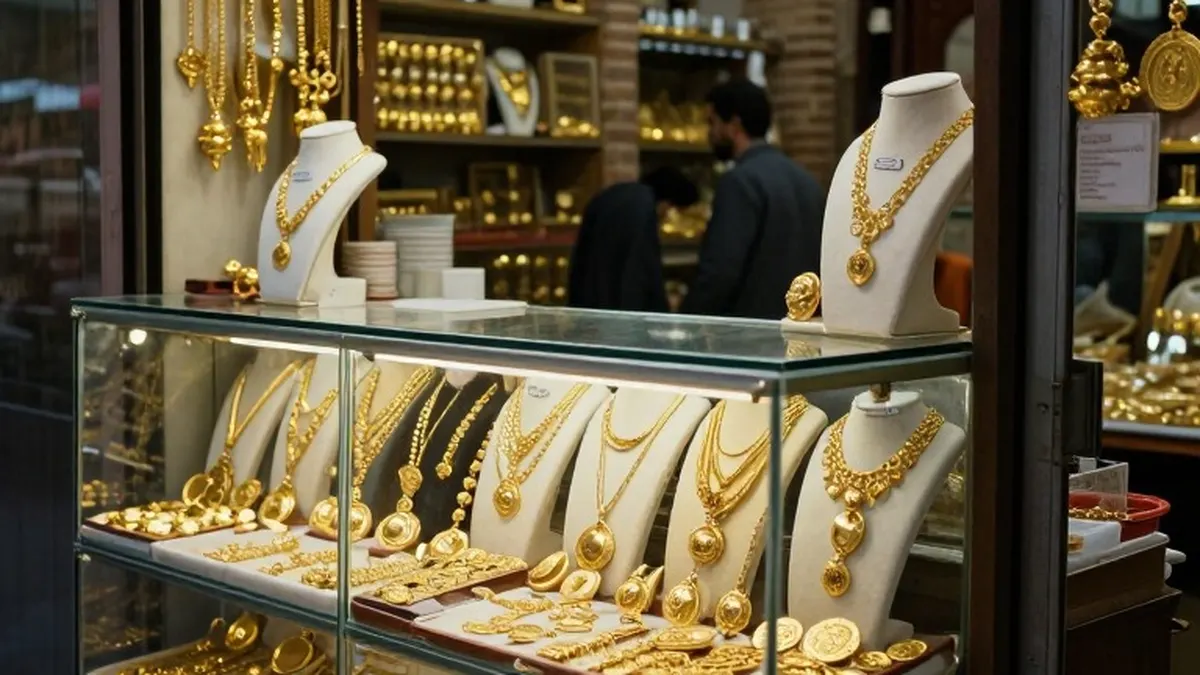
Authorities in Iran have ordered gold traders in Mashhad to stop displaying or selling jewelry and coins bearing the Lion and Sun, the emblem that appeared on the country's national flag for generations and has reemerged as a prominent symbol of protest against the Islamic Republic.
The directive was issued on Monday by the Mashhad Gold, Jewelry, Silver and Coin Dealers' Union, acting on instructions from the police department responsible for supervising public establishments. It covers items ranging from bracelets and pendants to commemorative coins carrying the historic symbol or imagery associated with the Pahlavi monarchy. Shopkeepers have been told to inspect their inventories and displays, and the union warned that violations would be dealt with under existing regulations.
Mashhad is Iran's second-largest city and one of the most important religious centers in Shi'ite Islam. The prohibition arrives after a year of extraordinary upheaval in the country, during which the Lion and Sun reappeared prominently at protests against the Islamic Republic, showing up on flags carried by demonstrators worldwide, on clothing and on jewelry. The emblem has become closely associated with supporters of exiled Crown Prince Reza Pahlavi, although its appeal extends beyond those advocating a restoration of the monarchy.
The Lion and Sun became a major symbol in Persia by the Safavid period, appearing on banners, coins and artworks. The Safavids, who ruled from the early 16th century, also established Twelver Shi'ism as Iran's dominant state religion. Under the Qajar dynasty the emblem became more standardized and eventually appeared on the national flag. It survived the transition to Pahlavi rule in 1925 and remained a familiar symbol of the Iranian state until the Islamic Revolution in 1979.
That long history did not protect it after Ayatollah Ruhollah Khomeini returned to Iran in February 1979. Speaking in Qom on March 1 of that year, Khomeini demanded the removal of royal insignia from government institutions and described the Lion and Sun as manhus, or accursed. "The accursed Lion and Sun must be removed from all ministries and offices," he declared, insisting the country's official emblems should be Islamic. The symbol was subsequently dropped from the national flag, and in 1980 Iran abandoned the Red Lion and Sun as the emblem of its national humanitarian society in favor of the Red Crescent, although it retained the right to use the former emblem under international law.
Despite that official hostility, Iranians continued to find the emblem for sale in bazaars and jewelry shops throughout much of the past 47 years. Such selective enforcement has long characterized the authorities' approach to public expression: certain displays of attachment to the pre-revolutionary past were tolerated, helping sustain the appearance of a system permitting some opposition, but that tolerance could be withdrawn as soon as an expression of national identity was regarded as a political threat.
During the nationwide protests that began in December 2025, many demonstrators called for the return of the Pahlavi family, and imagery associated with pre-revolutionary Iran returned to the streets. The Lion and Sun became a particularly prominent symbol at opposition demonstrations abroad, including large gatherings organized in support of the crown prince. In January, one protester climbed onto the balcony of the Iranian Embassy in London and briefly replaced the Islamic Republic's flag with the Lion and Sun.
Hostility toward the symbol has also surfaced in the treatment of protesters. In September, Iran International published an investigation documenting allegations that security forces tortured protesters bearing nationalist tattoos, including Majidreza Rahnavard, who was executed in Mashhad in December 2022 and whose arm, bearing a Lion and Sun tattoo, was allegedly beaten repeatedly by security personnel. The investigation also detailed allegations that security forces mutilated the tattooed skin of protesters detained during this year's crackdown.
In February, Ali-Akbar Salehi, Iran's former foreign minister and head of the Foundation for Iranology, argued at a conference on Iranian foreign policy and history that the emblem actually belonged to the Islamic Republic, saying it was rooted in Iran's Islamic heritage, including associations with Imam Ali, whom Shi'ite Muslims regard as their first Imam. "The Lion and Sun symbol belongs to the Islamic Republic, but others are using it," he said, according to Iranian media. Nine months later, authorities in Mashhad have prohibited the sale of jewelry bearing the same emblem.
How strictly the Mashhad directive will be enforced, and whether similar instructions will be issued elsewhere in Iran, remains uncertain. Nearly 47 years after Khomeini ordered the Lion and Sun removed from public institutions, his successors are still contending with the same symbol, which has vanished from the country's official flag but proved far harder to erase from Iranian society.