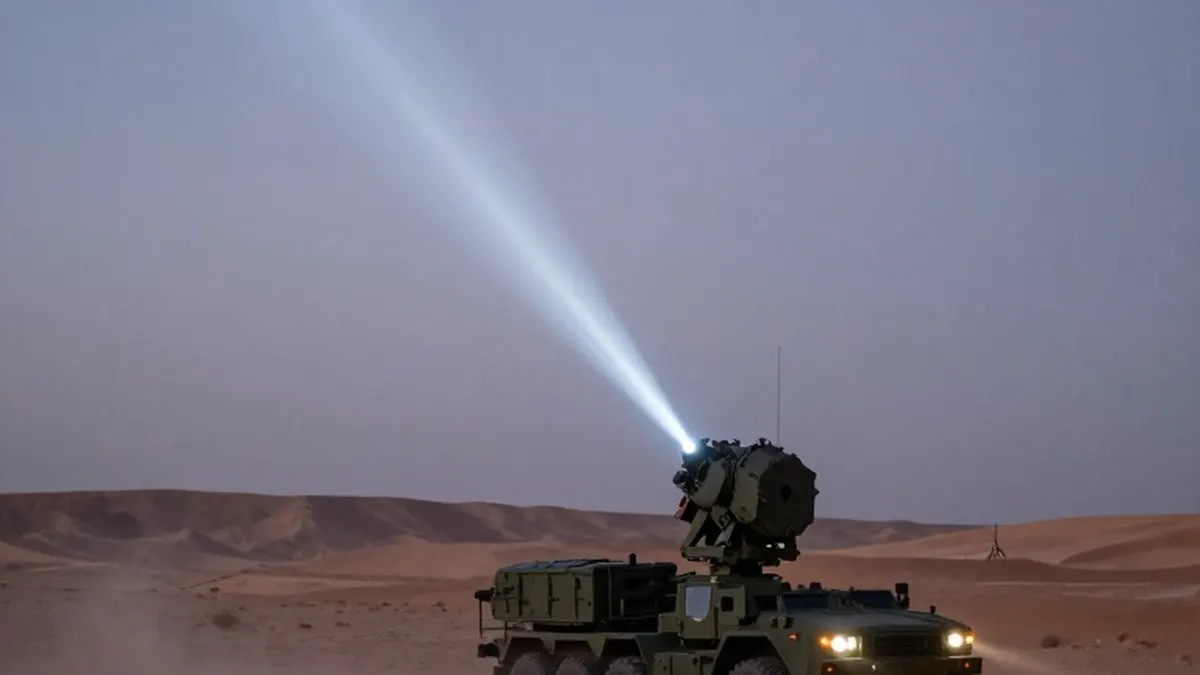
Israeli defense officials are preparing to expand the operational role of the Iron Beam laser defense system, with sources telling The Jerusalem Post that the technology will be more deeply integrated into war scenarios by the end of 2026. This shift aims to address public questions regarding why the system did not play a more prominent part in protecting the country during the early 2026 war with Iran.
During the conflict, the air force explained in May that Iron Beam was used sparingly because the military requires 14 batteries to achieve a significant defensive impact. This statement followed an earlier admission by the Israel Defense Forces in March that the laser system was not being used for regular operations during the ongoing hostilities. The limited deployment came despite evidence from the previous year, where various forms of Iron Beam were credited with downing approximately 40 Hezbollah drones in the fall of 2024.
According to The Post, Israel is making substantial progress in constructing additional Iron Beam platforms. This expansion represents a significant increase from the number of units deployed in December 2025, which marked the system's first announced operational deployment. The new capacity is expected to allow for more active use in future conflicts with Iran or Hezbollah, although the laser will continue to operate in tandem with the existing Iron Dome system.
In 2025, Defense Ministry Director-General Amir Baram described the deployment of Iron Beam as a historic milestone, stating that it marked the completion of high-power laser system development. He noted that Israel was the first nation to bring a high-power laser interception system to full operational maturity, having completed numerous interceptions in simulated scenarios. Danny Gold, head of the Directorate of Defense Research and Development, added that the system is expected to fundamentally change battlefield rules of engagement while next-generation systems are already in development.
The Iron Beam system offers greater power and range than its smaller counterpart, Lite Beam, which became operational in June 2025. While Lite Beam is designed for shorter-range threats, Iron Beam is capable of intercepting a wide array of aerial targets, including drones, missiles, rockets, and mortars. This versatility makes it a formidable addition to the defense network, particularly against fast-moving threats that are difficult to intercept with traditional means.
A primary advantage of the laser system is its cost efficiency. The ministry and the IDF indicated in 2025 that Iron Beam would help reduce the expense of shooting down aerial threats, a critical concern during a war where tens of thousands of projectiles were launched from six fronts. While firing Arrow interceptors can cost millions of shekels and Iron Dome interceptors tens of thousands, using Iron Beam is described as being as inexpensive as turning on a light.
Despite these advantages, some sources suggest that Iron Beam may take several years to surpass Iron Dome as the lead short-range air defense system. The application of lasers against long-range threats, such as Iranian ballistic missiles, is projected to take even longer, potentially five to ten years or more. This timeline is due to the requirement for air-based or space-based laser platforms to effectively engage such distant targets.
In parallel developments, Israel is enhancing its capabilities to counter the Hezbollah FPV drone threat, an area where the IDF faced significant challenges in early 2026. Sources indicate that the military has deployed specialized short-range guns, nets, kamikaze drones, and electromagnetic warfare tools. Additionally, detection methods for FPV drones have been improved, and work is underway on direct-energy microwave weapons designed to neutralize drone machinery.
The Defense Ministry recently held a series of trials in the South, resulting in two companies winning competitions for new drone combat techniques. Meanwhile, Israel continues to work on defenses against Iranian cluster munitions. However, due to the sheer volume of larger threats like ballistic missiles and drones, cluster munitions have received less immediate attention, though they remain a focus for medium-term defense improvements.