
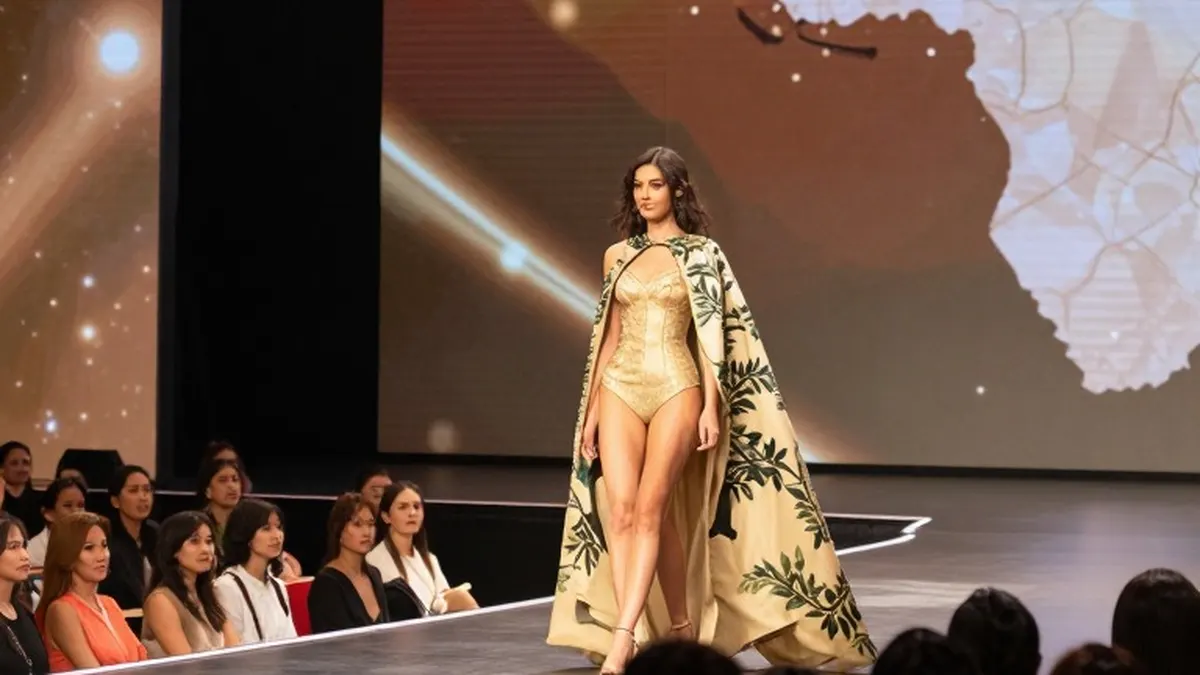
Danielle Yablonka, the 25-year-old model representing Israel, was met with loud boos during the national costume segment of the Miss Universe 2026 pageant in Puerto Rico this weekend. As she took the stage in a gold jeweled bodice, boots, and crown, she spread her arms to reveal a cape featuring olive trees and Jaffa oranges. The word peace was printed along the bottom of the garment in English, Hebrew, and Arabic. The reaction from the audience was immediate and loud, with the boos overpowering the background music as she posed for the judges.
Yablonka turned to display the back of the costume, which depicted a warm-toned, glossy illustration of East Jerusalem. The design featured the Al-Aqsa Mosque complex in gold and blue at the center, surrounded by the Old City. The image included the word Jerusalem in three languages. While East Jerusalem is considered occupied under international law and is envisioned as the capital of an independent Palestinian state, the artistic rendering did not reflect the ongoing demolitions of Palestinian homes in the area.
The costume choice sparked fierce criticism on social media platforms. Users pointed out the irony of the peace message given the ongoing ethnic cleansing in the occupied West Bank and the genocide in Gaza. One user on X noted that the contestant was rightfully booed for wearing a costume that said peace while her country prevented it through occupation and conflict. Others highlighted that olive and orange motifs are defining symbols of Palestinian national identity, making the choice particularly contentious.
The timing of the pageant added to the sentiment, as it coincided with the olive harvest season. This year, Palestinians in the West Bank reported a sharp rise in attacks by Israeli settlers, with 1,369 incidents recorded in October alone. The Israeli military has also been known to demolish olive groves and uproot thousands of trees across occupied Palestine, further contextualizing the backlash against the olive imagery on the dress.
Criticism also targeted the introduction given by the pageant host. As Yablonka walked on stage, the host described Israel as a land where history lives and the desert blooms, suggesting that the country turned arid landscapes into thriving agricultural communities. These phrases are often repeated by Israel and its supporters but have long been criticized by Palestinians as a colonial talking point that erases their history. Historians have refuted the idea that the land was neglected before the arrival of Jewish settlers, citing records of agricultural development and trade in Ottoman Palestine, including the production of the famous Jaffa orange.
Many online commentators drew parallels between Yablonka's costume and the dress worn by Nada Ayoub, Miss Palestine 2025. Ayoub's outfit, designed by Palestinian artist Neven Elkady, featured the Dome of the Rock and the Church of the Holy Sepulchre. Ayoub acknowledged the similarities in a video shared on Instagram, asking where the Palestinian voice was on a stage where Jerusalem was prominently displayed. She highlighted the irony of the Dome of the Rock being featured while Israeli attacks on the Al-Aqsa Mosque increase.
The absence of a Palestinian representative at this year's competition was a significant point of discussion. Ayoub, who became the first Palestinian woman to represent her country in the global pageant in 2025 and placed in the top 30, explained that plans for a new Miss Palestine fell through before the deadline. She stated that the project requires vast resources for local and national competitions, which often lack structural and financial backing in Palestine.
The ongoing conflict in Gaza and the West Bank has made it difficult to create spaces for new talent to emerge. Ayoub explained that she has largely financed the project herself, which contributed to the difficulty in realizing her ambition to select a successor. She appealed to Palestinian businessmen, women, and institutions to support the next Miss Palestine, emphasizing the importance of representation in international competitions.
The incident has reignited debates about the symbolism of national costumes in global pageants and the broader political narratives they convey. For many observers, the boos were not just a reaction to a single contestant but a reflection of wider sentiments regarding the region's ongoing conflicts and the visibility of Palestinian identity on the world stage.





