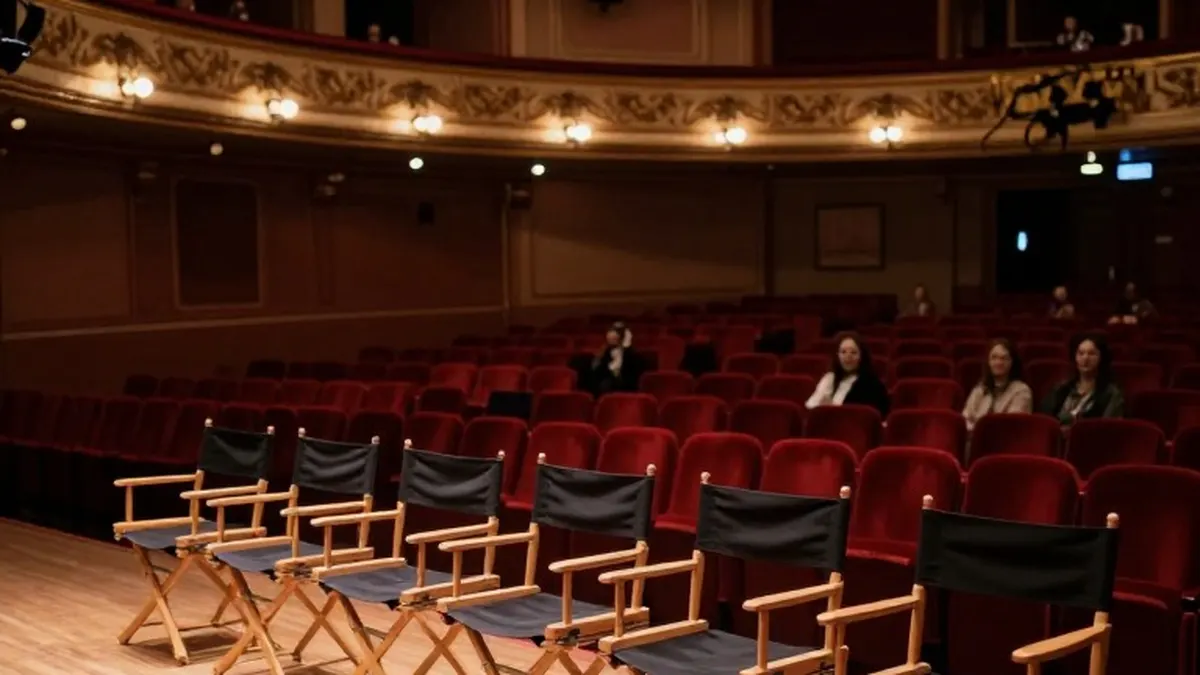
The directors of 10 of 2026's most talked about documentary features came together in late October at the SCAD Savannah Film Festival for the event's 13th annual Docs to Watch panel. Presented by The Hollywood Reporter and held before a capacity crowd at the 1,237-seat Lucas Theatre, the conversation covered how each film originated, how its makers weighed which risks were acceptable, and how they navigated complicated people and topics.
The lineup spanned an unusual range of subjects. Elizabeth Chai Vasarhelyi, representing co-director Jimmy Chin, discussed Nat Geo's Everest: The Other Side, about a couple who share a dream of climbing up and then skiing down the mountain's north face. Jack MacInnes, appearing for himself and co-director Itab Azzam, represented Frontline's One in a Million, which chronicles a tumultuous decade in the life of a Syrian girl who fled her war-torn country. Alysa Nahmias brought Roadside's Cookie Queens, about four young girls pursuing their goals during Girl Scouts cookie-selling season, while Ron Howard represented Netflix's Avedon, an exploration of portrait photographer Richard Avedon's life and legacy.
Also on stage were Julia Loktev with MUBI's My Undesirable Friends: Part II, Exile; Amir Bar-Lev with Apple's The Last First: Winter K2; Poh Si Teng with Watermelon's American Doctor; Rory Kennedy with Abramorama's The Trial of Alec Baldwin; David Greaves with Neon's Once Upon a Time in Harlem; and Nathan Fielder, representing himself and co-director Lance Oppenheim, with A24's You Can See Everything, which looks inside the mind of Theranos founder Elizabeth Holmes and her partner Billy Evans over the 34 days before Holmes began serving her prison sentence. The film's huge success was a running theme of the afternoon.
The panel has become a reliable awards season indicator. Over the 12 previous years it was held, 27 featured films went on to receive best documentary feature Oscar nominations, and eight won: Amy, O.J.: Made in America, Icarus, Free Solo, American Factory, Summer of Soul, Navalny and 20 Days in Mariupol.
Greaves, a veteran journalist who had never directed a film before, explained that Once Upon a Time in Harlem began with his late father William Greaves, who in 1972 gathered Harlem Renaissance luminaries at Duke Ellington's apartment and filmed the reunion with four cameras, one operated by a 26-year-old David Greaves. The footage sat in storage for more than half a century as his parents kept shooting additional material. After they died, his stepmother having had the footage restored, Greaves and his daughter decided, "This has to happen." He said he took the director's chair because he could not imagine turning the material over to anybody else.
Poh Si Teng, also a first-time director after years of producing, commissioning and grant-making for documentaries, said American Doctor grew out of a personal search. "In these very dark times, I was looking for the light," she said, describing the three American physicians, one Jewish, one Palestinian and one Zoroastrian, whose friendship and volunteer work at Gaza hospitals convinced her to finally direct after, as she put it, waiting 22 years.
Loktev, who was born in the former Soviet Union and had planned to keep making narrative films, offered a blunt explanation for how she ended up spending years on a two-part epic about independent Russian journalists: "Well, one answer: Putin." She went to Russia in the fall of 2021 to film young journalists newly labeled "foreign agents," only for Russia's full-scale war in Ukraine to begin four and a half months later, shuttering independent media and forcing her subjects to flee within hours. Exile follows them from their first disoriented days in Turkey as they rebuilt their newsrooms abroad, even as most have since been declared "extremist terrorists" with prison sentences awaiting them.
Bar-Lev said he initially resisted The Last First: Winter K2 because he knew nothing about mountaineering. The story of the COVID-era winter ascent attempt, in which five people died while 10 summited, was pitched to him as an alpine whodunit with finger-pointing along racial lines. His reporting found most of those allegations inaccurate, he said, and the real drivers were commercialization, social media and class issues, which he described as more his speed.
Fielder, known for blurring documentary and narrative on television in Nathan for You and The Rehearsal, said he never intended to appear in You Can See Everything but was drawn in because Holmes and Evans kept acknowledging his presence in their home. He recalled sensing that Holmes seemed sincere and trusting while thinking, "You can't trust this," a tension that became the project's starting point. He said the pair had originally approached A24 themselves because they wanted their lives documented before prison.
Kennedy said she knew Baldwin casually through his support of documentaries, including the Hamptons Film Festival and its SummerDocs series, before filming The Trial of Alec Baldwin in the aftermath of the 2021 accidental shooting that killed cinematographer Halyna Hutchins. She said she and her husband were heartbroken first and foremost for Hutchins and her family, then struck by the intensity of the judgment directed at Baldwin, raising the question of how much the public convicts people in the court of public opinion rather than the court of law.