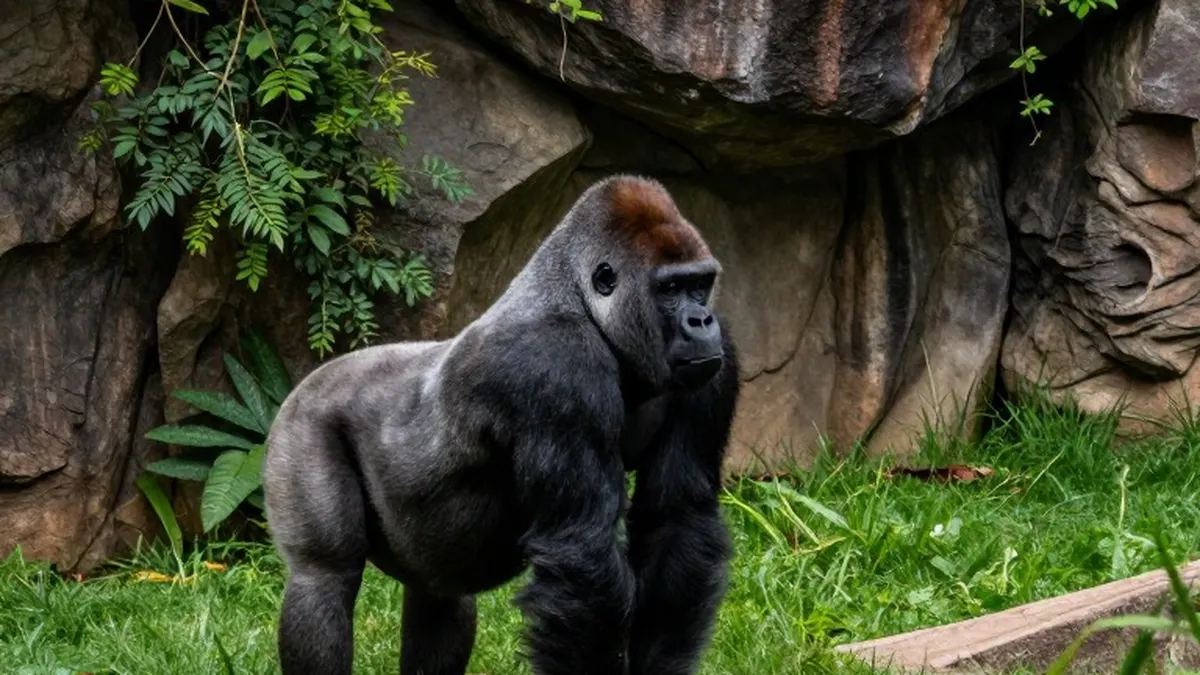
Jojo, a male gorilla who has spent nearly his entire existence in solitary confinement, is now the focus of an effort to find him a social companion. The 11-year-old ape took his first steps onto grass in 2015 after being held in a tiny cage at a private zoo in Gabon. He was captured from the wild as an infant after poachers killed his family, leaving him without a peer or family member for more than a decade.
Today, Jojo resides at the Lekedi Foundation in Gabon, where his caretakers hope to introduce him to another gorilla. Prof Gillian Forrester of the University of Sussex describes Jojo as an extreme case of isolation among great apes. Her research into ape psychology aims to understand how rescued animals recover from such profound trauma. The goal is to find a suitable friend, potentially a rescued or zoo-bred individual, with whom Jojo can bond.
Caretakers observe clear signs that Jojo craves connection. Maxe Anaclet Makaba, the head keeper at Lekedi, notes that the gorilla gathers leaves to trade for treats in order to interact with humans. Jojo also emits specific calls when familiar women leave his enclosure, mimicking the sounds silverback males use to summon females in the wild. Eric Willaume, who runs the sanctuary, states that these behaviors confirm the gorilla feels lonely.
Jojo is part of a larger population of African primates involved in the global trade. Estimates suggest that over 6,000 apes were bought or sold between 2000 and 2023. Many more are trafficked illegally for the pet trade, meat, or traditional medicine. Experts believe that removing infant great apes from their groups causes severe trauma. Tony King of the Aspinall Foundation explains that young apes who understand their family has been killed often lose the will to live, a change visible in their eyes.
Rehabilitation for such animals is challenging. The Grace Center in Africa uses a gorilla-led approach, integrating rescued infants into groups quickly so they can learn social norms. However, Jojo is fully mature and exhibits signs of chronic stress. Forrester has used thermal cameras to monitor his facial blood flow, discovering a condition known as a nasal dip. This persistent cold nose indicates a malfunctioning stress response, where blood flow does not return to normal levels after an initial stress reaction.
Social bonds are critical for great ape psychology. Dr Robin Morrison from the University of Zurich notes that female mountain gorillas actively seek out long-lost acquaintances when joining new groups. She emphasizes that simply sharing quiet space is a fundamental part of gorilla social life. For Jojo, who has never had this opportunity, forming these relationships could be essential for his healing and potential future release into the wild.
Despite the desire to help, finding a companion is procedurally difficult. Moving an animal from an accredited zoo requires approval from an international committee based on genetics, health, and personality compatibility. Introductions must be slow, often starting with scent exchange before visual contact. Forrester has contacted several zoos, but discussions have stalled due to a lack of clear processes for such translocations, which are typically designed for breeding rather than social pairing.
There is also the question of whether it is too late for Jojo, who is likely in his 20s. King suggests that introducing another animal could ironically increase his stress. Morrison points out that solitary life is common for adult male gorillas, with about one-third living alone after dispersing from their family groups in adolescence. While some solo males feel lonely, this state is part of their evolutionary drive to attract females.
However, Jojo's solitude was forced upon him during his most vulnerable developmental years. Morrison believes he is both lonely and traumatized by the loss of group dynamics, such as moving and sleeping together. His keepers and researchers remain hopeful that a compatible companion, whether male or female, would provide significant healing. Makaba describes solitary confinement as akin to prison, stating that another gorilla's presence would be a vital improvement for Jojo's well-being.