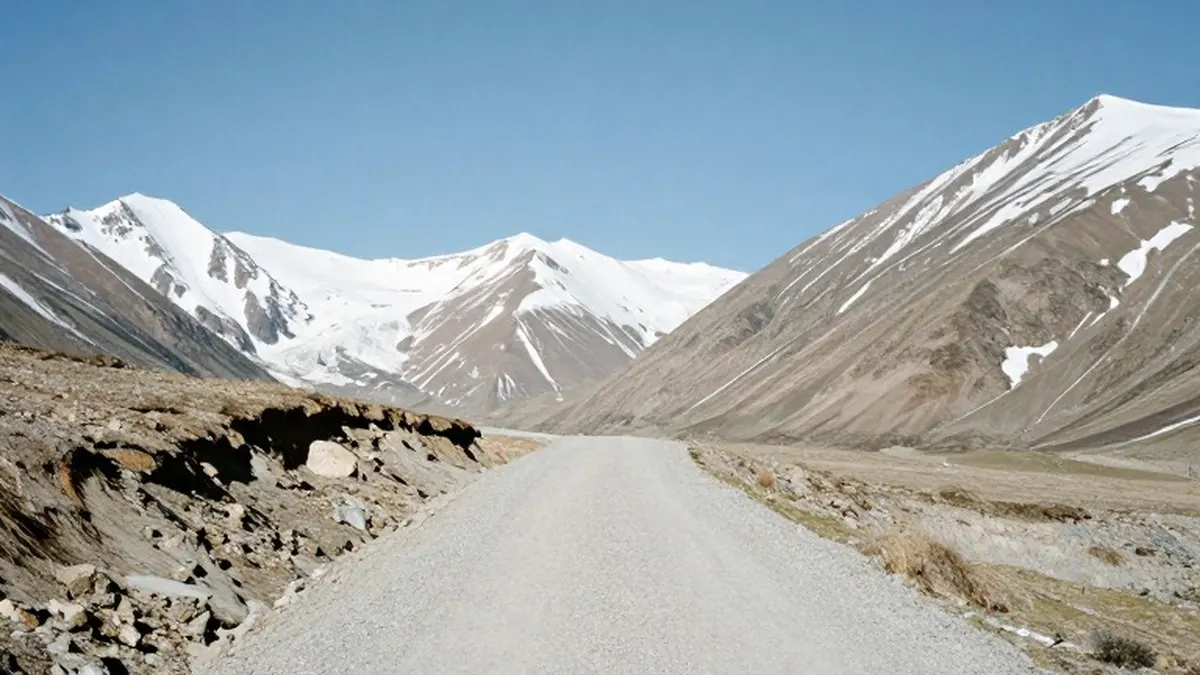
At an altitude of nearly 4,900 meters, the Wakhjir Pass marks the point where Afghanistan ends and China begins. Snow typically seals this high-altitude route for at least five months of the year, allowing only sporadic crossings during the passable seasons. On October 4, the Taliban-led government in Afghanistan marked a milestone by celebrating the opening of a road leading to this frontier. However, the achievement comes with a significant caveat, as the new route stops short of the actual border crossing.
The Ministry of Rural Rehabilitation and Development stated that the road, which traverses the Wakhan Corridor in Badakhshan province, was constructed in two phases at a cost of 365 million afghanis, or approximately $5.5 million. The infrastructure remains basic, consisting of an unpaved track covered in gravel. On the Chinese side of the border, there is currently no customs facility, and China’s Ministry of Foreign Affairs has not issued a public comment regarding the opening. For now, the road leads to a closed border with no clear timeline for when Beijing might allow commercial traffic.
The Wakhan Corridor is a narrow, 350-kilometer stretch of Afghan territory that separates Tajikistan to the north from Pakistan to the south. Its unique shape was established in 1895 through an agreement between Britain and Russia, designed to keep their respective territories apart. Although China was not part of that 19th-century dispute, it did not finalize its border with Kabul until 1963. In recent years, this remote area has emerged as a sensitive geopolitical crossroads where the interests of China, Afghanistan, Pakistan, Iran, and Central Asian nations intersect.
Plans for a road through the corridor date back to 2009, but rugged terrain and security concerns delayed the project. Construction began in 2019, with 60 kilometers completed before the Taliban takeover in August 2021 halted progress. Former Afghan ambassador to China Javid Qaem noted that the Taliban resumed work in September 2023. By January 2024, the road reached the Chinese border, and in March 2025, a contract was signed for a second 71-kilometer phase funded by Afghan government resources.
Beijing views the corridor primarily as a security issue rather than an economic opportunity. In August 2025, Chinese Foreign Minister Wang Yi visited Kabul, urging Afghanistan to maintain border patrols and crack down on Uighur separatist groups. An anonymous Afghan government source explained that China links the opening of the border to effective security guarantees, particularly regarding the protection of its western frontier and the Xinjiang region.
For Kabul, the road is a strategic move to diversify trade routes and reduce dependence on Pakistan and Iran. Mohammad Ismail Ghaznawi, the deputy minister for road maintenance, described the project as part of a plan to create a gateway to Chinese and Central Asian markets. He emphasized that the corridor should be viewed as a strategic link between South and Central Asia, potentially connecting Afghanistan to China’s Belt and Road Initiative in the future.
However, challenges remain. The province of Badakhshan has seen recent security tensions, including attacks claimed by the National Resistance Front. Former acting defence minister Shah Mahmoud Miakhel suggested that regional and international actors may be attempting to obstruct the project. While China shares borders with 14 countries, Afghanistan and Bhutan are the only two without a direct overland trade crossing. The future of the Wakhan Corridor will depend on whether security concerns can be reconciled with the economic potential of this mountainous link.