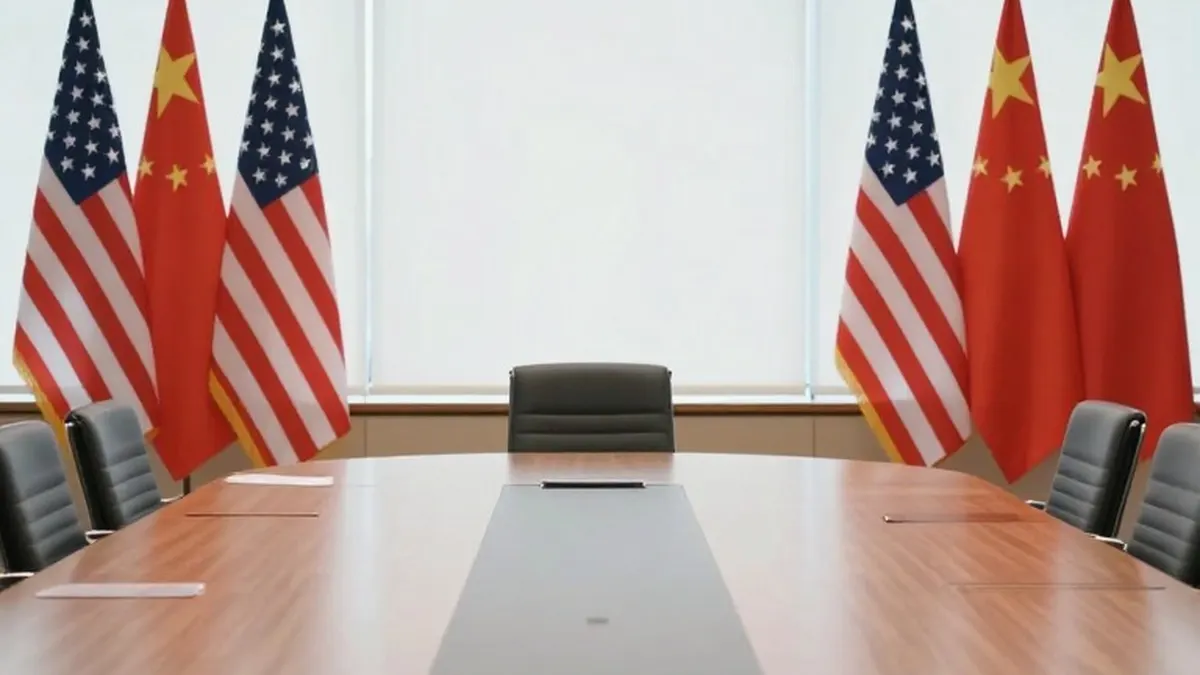
The United States and China reached a consensus on the necessity of high-level dialogue to foster peace and denuclearization, according to a statement released by the US State Department on Wednesday. Secretary of State Marco Rubio and Chinese Foreign Minister Wang Yi held a telephone conversation to address these strategic goals, emphasizing the value of meaningful exchanges between heads of state.
The State Department noted that the two officials discussed the upcoming travel schedules for their respective leaders. This includes US President Donald Trump's planned attendance at the APEC summit in China next week, as well as Chinese President Xi Jinping's visit to Florida for the G20 summit scheduled for next month. These engagements are seen as critical opportunities to maintain momentum in bilateral relations.
During the call, Rubio and Wang Yi recalled the leaders' shared commitment to building a constructive relationship. They cited the principles of strategic stability, respect, fairness, and reciprocity as the foundation for this engagement. The US statement highlighted that both sides agreed on the importance of leader-level conversations to advance specific objectives, including peace and denuclearization efforts.
A notable point of agreement was the potential for a trilateral leaders meeting that would include Russia. The State Department indicated that such a gathering could serve as a platform to discuss these broader geopolitical goals. However, an earlier readout from China regarding the same call did not mention denuclearization or the possibility of a trilateral summit with Russia, suggesting a slight divergence in the initial public messaging.
The potential for a three-way meeting has gained traction in recent weeks. On Tuesday, Secretary Rubio told reporters that preparations are underway to arrange such a meeting on the sidelines of the APEC summit. He indicated that the gathering could involve President Trump, President Xi, and Russian President Vladimir Putin. This follows comments from Trump on Sunday, where he suggested he might meet with both leaders in Shenzhen to discuss ending the war in Iran and addressing denuclearization.
In October, President Trump expressed openness to three-way arms control talks focused on nuclear weapons. However, China has shown less enthusiasm for such discussions. The Chinese Foreign Ministry stated last month that its nuclear capabilities are not on par with those of the US and Russia. Beijing argued that it would not be fair, reasonable, or realistic to ask China to join trilateral nuclear disarmament negotiations at the current stage.
Chinese state news agency Xinhua described the call as positive and constructive. It reported that Wang Yi expressed Beijing's willingness to strengthen communication and cooperation with Washington. Wang noted that the current stability in China-US relations was a rational choice made by both major powers based on their respective and shared interests.
While the summits between Trump and Xi this year have helped stabilize relations, fundamental differences between the two strategic rivals remain. In September, the leaders agreed to extend a trade truce for two months, which was originally set to expire in November. Despite this progress, disputes over tariffs, Chinese purchases of US goods, rare earth exports, and technology restrictions have yet to be resolved.
US Treasury Secretary Scott Bessent commented on Tuesday that the two sides would advance a new dialogue on artificial intelligence. He cautioned that while the nations seek to manage the risks of this technology, they should not ignore their differences as they compete for supremacy in the AI sector. The upcoming summits will likely serve as key venues to address these complex economic and strategic issues.