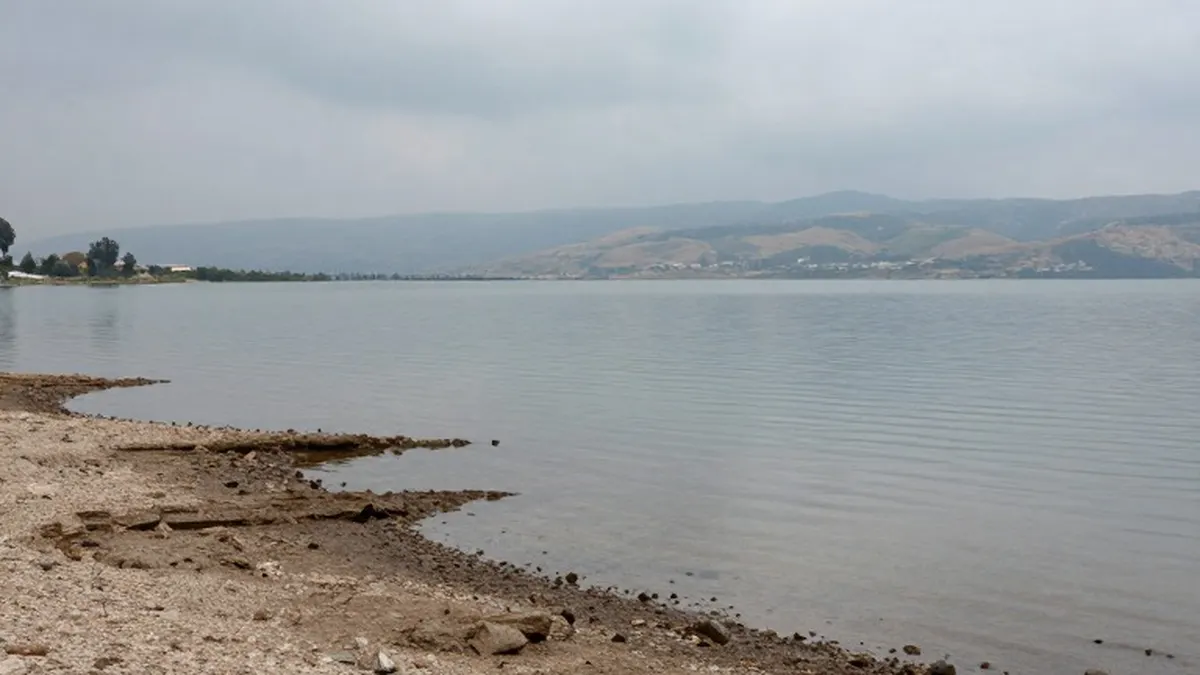
The Sea of Galilee, known in Israel as the Kinneret, rose by just one centimeter over the weekend even as record rainfall swept across central and northern Israel, the Water Authority announced on Sunday. The lake reached 213.70 meters below sea level, leaving it 39 centimeters lower than at the same point last year.
Water Authority spokesperson Itay Dudi said approximately 20 millimeters of rain fell directly over the lake during the weekend, while the flow of the Jordan River stood at six cubic meters per second.
"The effect of the rain on the river is still small to negligible," Dudi said, explaining that most of the precipitation from the current weather system was concentrated along Israel's coastal plain, particularly in the south.
Dudi noted that the past decade saw only three winters with worse figures for the lake. "Exactly one decade ago, the water level was 3 cm higher than it is today," he said.
Additional figures released by the Water Authority show the lake's current level is among the lowest recorded for November 8 over the past decade. In 2017, the water level was 58 centimeters lower than it is now, while in 2018 it was 94 centimeters lower.
The latest measurements follow a decline in the Kinneret in September, when disruptions at Israel's desalination plants forced authorities to pump more water from the lake to maintain the country's supply. An algal bloom crisis forced desalination plants in southern Israel to shut down for nearly two weeks, prompting authorities to draw about 3.3 million cubic meters of water from the lake over the course of 10 days.
During that period, the Kinneret's water level dropped by 10 centimeters, reaching 213.50 meters below sea level on September 9, its lowest level for that date since 2018.
The disruptions also temporarily reversed Israel's recent approach to managing the lake. In recent years, the Reverse National Water Carrier project has transferred desalinated water into the Kinneret to replenish the reservoir.
By September 10, all six desalination plants had resumed operations, although only the Hadera facility was operating at full capacity. The remaining plants reportedly ran at about half capacity.