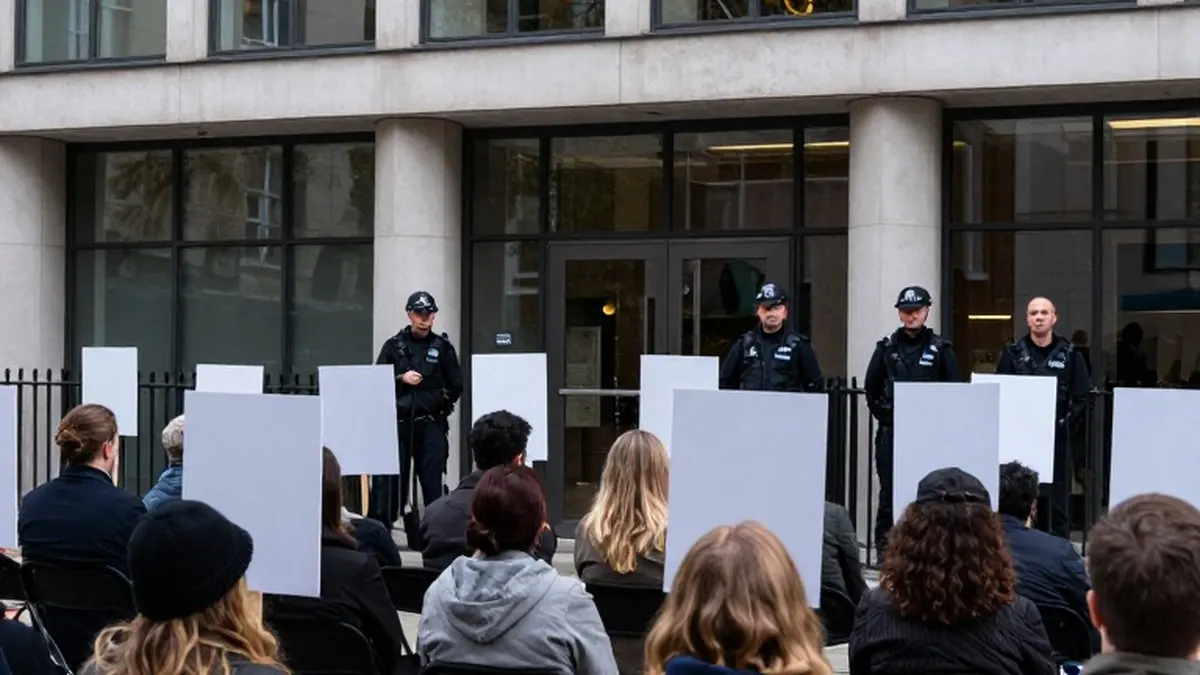
Police arrested protesters outside the US embassy in London on 31 October during the first mass demonstrations against the ban on Palestine Action under Andy Burnham’s premiership. Hundreds assembled in Battersea, south London, carrying placards opposing genocide and expressing support for the proscribed organisation. A supporting vigil also took place outside the US consulate in Edinburgh.
Defend Our Juries, which organised the demonstrations, estimated attendance in London at around 400. Before the gathering, the Metropolitan police warned participants that they risked arrest. The force said people taking a leading role in organising the protest, directing others or supplying logistical assistance would also probably be committing an offence.
Commander Adam Slonecki, who led the policing operation, said those attending knew that supporting a banned organisation was unlawful. He described the gathering as a deliberate attempt to commit an offence and warned that officers could take enforcement action against those they considered central to its organisation.
Among the seated demonstrators was Sue Morhall, a 79-year-old retiree carrying a sign supporting Palestine Action. She said she regarded the United States as complicit in many wars and wanted world leaders, including Trump, to understand the strength of opposition to events in Gaza. Morhall remained hopeful that Burnham might reverse the ban, although she suggested he could wait until after the American midterm elections.
Morhall said she had been arrested five or six times at earlier protests and was prepared to face arrest again because of her commitment to the issue. Another participant, the Rev Bill White, 72, said he believed Britain was facilitating genocide in Palestine by supplying weapons used against Palestinians. He said he had expected more from Burnham and had left the Labour party after Palestine Action was designated a terrorist organisation.
White described participation as an obligation arising from his faith and argued that criminalising people seeking to prevent genocide was wrong. Defend Our Juries also criticised the police response, accusing British authorities of acting to appease American interests. The group argued that US approval enabled Israel’s war crimes.
The demonstrations preceded a Supreme Court appeal against Palestine Action’s terrorist designation scheduled for 4 November. In September, a similar protest outside the Labour party conference in Liverpool resulted in more than 160 people being arrested or reported for summons.
Burnham’s government has faced calls to lift the ban. Shabana Mahmood, who has maintained her support for proscription, has remained home secretary. During the Liverpool conference, two activists also challenged foreign secretary Ed Miliband about the arrests while he was eating at Pizza Express. One urged him to declare a genocide in Gaza and remove Palestine Action’s designation. Miliband offered to discuss the matter at another time before the protesters were escorted out.