Jerusalem-based filmmaker Muayad Alayan is taking his drama 'Conversation With the Sea' to Arab audiences for the first time, with a Middle East premiere set for the Doha Film Festival, running Nov. 19 to 27 and organized by the Doha Film Institute. The film previously screened to a positive response in Venice and Toronto.
Alayan praised the festival's organizer, calling the Doha Film Institute 'one of the most supportive institutions for Palestinian films.'
The film stars veteran Palestinian actor Kamel El Basha, who won the best actor prize in Venice in 2017 for 'The Insult.' He plays Kamal, an elderly widowed baker living in Jerusalem's Old City, who receives what the director describes as a Kafkaesque notice from an Israeli court. The court demands payment of a large social security debt allegedly owed by his son Wael, who drowned in the Red Sea decades earlier, even though no official record of the son's death exists.
The premise is rooted in Alayan's own family history. Years ago, his father-in-law and his wife received an injunction from the Israeli social security service claiming a large sum was owed by his late brother-in-law, who had died by drowning more than 20 years earlier. Because the man still appeared as alive in the system, he was treated as taxable, and the family was forced to prove his death. Alayan said his father-in-law had to travel to collect hospital documents confirming his son had died, an experience he called a shock that was deeply emotional for the whole family.
Alayan said he initially stayed silent, lacking the courage to ask permission to build a story around the incident, but did so a year later. He promised his family the event would be fictionalized and dramatized enough that it would not clearly depict them. For him, the story reflects what he called the subtle yet tormenting pressure placed on Palestinian Jerusalemites, where 'you encounter soldiers and armed settlers on a daily basis.' He described a system of taxation and laws he said is designed to push Palestinians out of the city, adding that such incidents, which he said are on the rise, get sidelined amid larger-scale violence.
The director has known El Basha for more than 20 years, having first seen him perform at the Palestinian Theater in Jerusalem as a teenager, when the actor was already, in his words, an icon and a star. After film school, Alayan cast him in a secondary role in his first short and has used him in almost all of his features since. This time, he wrote the part with El Basha in mind and discussed the script with him over breakfast at the actor's home between the second and third drafts.
Alayan said El Basha immediately recognized the world of the film, having grown up in and around the Old City, with family members who faced evacuation from their homes. The actor was also a political prisoner as a teenager, which Alayan said gives him deep knowledge of life under occupation in Jerusalem.
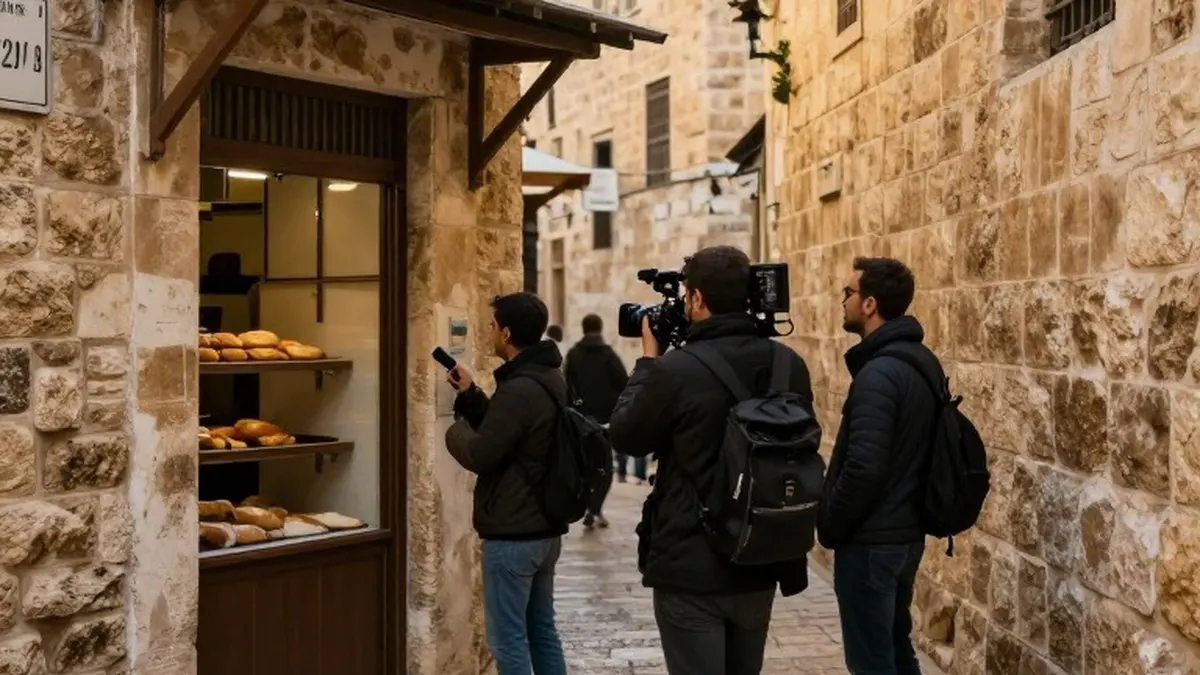
Shooting in the city required an extremely small crew, the director said, because filming in or around the Old City is otherwise impossible. The production was designed to look like a documentary crew so that permits would not be needed, since, Alayan said, a Palestinian production applying for them would not have been realistic. Filming took place at a sensitive moment, shortly after what he called the so-called ceasefire.
Alayan also addressed the film's political relevance following Israel's recent elections, in which Gadi Eisenkot, the leading rival of Prime Minister Benjamin Netanyahu, has a chance to form a governing coalition with support from Arab parties that would not be formal coalition members. 'You cannot avoid the almost two million Palestinians living in Israel who have Israeli citizenships,' Alayan said, arguing that no government can now be formed without the Arab Palestinian parties. He noted that those parties refuse to join a government they see as occupying fellow Palestinians' land and committing crimes, creating a possible dead end, but said the prevailing hope in the anti-Netanyahu camp is that the sides cooperate at least long enough to guarantee Netanyahu is out.