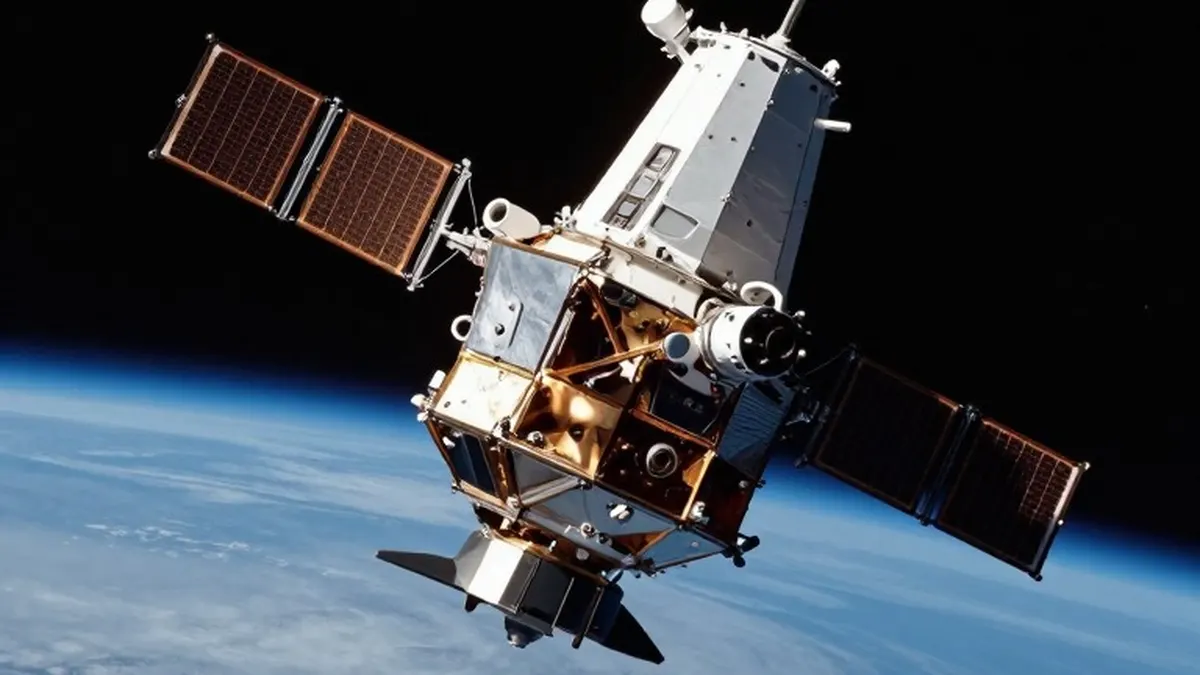
NASA’s Swift Observatory is nearing the end of its time in orbit after an unsuccessful effort to save the aging telescope. The U.S. Space Force predicted that the spacecraft would re-enter Earth’s atmosphere on or around Friday, bringing to a close a mission that spent nearly 22 years observing powerful explosions and other events across the universe.
Most of the 1.5-ton observatory is expected to burn up during re-entry, according to Brad Cenko, NASA’s chief scientist for the mission. Some mirror components and a small number of parts made from tungsten, which is denser than lead, could reach the surface. Surviving debris would most likely fall into the ocean, although the re-entry zone also includes parts of Africa, Australia, India, Southeast Asia, and Central and South America. The Space Force is monitoring Swift’s declining orbit.
Strong solar activity over the past several years caused Swift to lose altitude more quickly than usual. NASA hired Katalyst Space a year ago for an urgent rescue effort, but the company’s three-armed robotic spacecraft, Link, encountered problems after its July launch. It came no nearer than 12 to 15 kilometres from Swift before falling back to Earth in September.
With the rescue effort abandoned, Swift returned to scientific observations and detected additional gamma ray bursts and other extremely high-energy events. By late October, however, its altitude had become too low for the telescope to hold steady enough to continue observing. Its systems were then shut down.
Launched on Nov. 20, 2004, Swift was designed to seek out gamma ray bursts and supernovas, among the universe’s largest explosions. Over its mission, it recorded more than 2,000 gamma ray bursts and 1,400 exploding stars. Its observations also encompassed comets, asteroids and black holes tearing apart stars.
Swift took its name from its ability to turn rapidly toward celestial eruptions. NASA regarded it as a first responder whose alerts allowed observatories including the Hubble and Webb space telescopes to conduct more detailed investigations. Scientists are still considering how to replace that capability.
For the mission team, the approaching loss brings sadness alongside appreciation for Swift’s scientific contributions. Pennsylvania State University astronomer John Nousek, who led its control team, said the spacecraft’s eventual fall had been understood before launch. In an email, he expressed hope that lessons from Swift’s achievements would help future space missions advance discoveries about the universe.