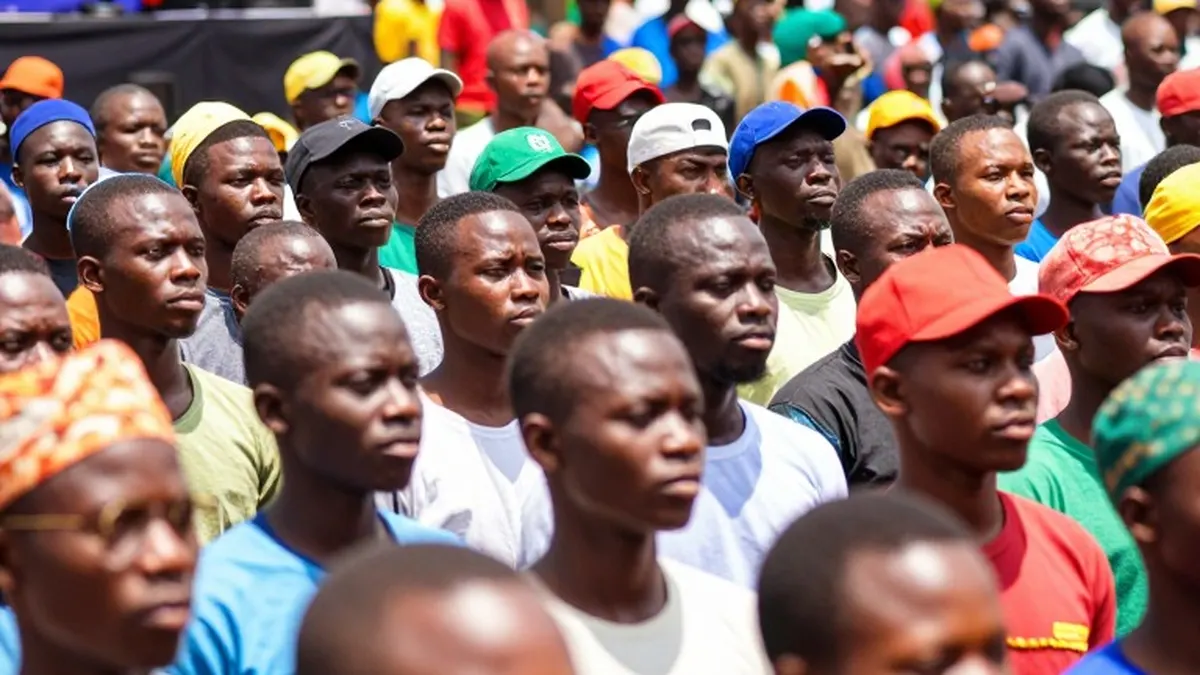
Nigeria is preparing for its general elections in January, a period that typically sees intense political activity. However, a striking demographic contrast defines the current political scene. Approximately 80% of the country's population is under the age of 40, yet the political establishment is predominantly composed of older individuals. This disconnect is evident among the current leadership, where President Bola Tinubu, who is 74, could reach the age of 79 by the end of a potential second term.
The age of presidential candidates highlights this trend. Of the 18 individuals seeking the highest office, only one is under 40. Moses Olusoji Adebisi, a 35-year-old businessman representing the Democratic Leadership Alliance, stands out as a rarity. His main rivals include Atiku Abubakar, who is 79 and seeking the presidency for the seventh time, and Peter Obi, who is 65. Since the return to civilian rule in 1999, Goodluck Jonathan remains the youngest person elected to the presidency, having taken office at age 53.
Young people in Nigeria have a history of shaping political discourse through mass movements. The EndSars protests in 2020 began as a response to police brutality but evolved into a broader demand for accountability and youth participation. Although the movement was eventually suppressed, with reports of about 56 deaths and hundreds of arrests, it demonstrated the capacity of young citizens to mobilize. This energy carried over into the 2023 election cycle, where Peter Obi's campaign, driven by a social media movement known as the Obedients, successfully engaged millions of young voters.
Despite this past enthusiasm, many young Nigerians now feel disillusioned. Nonso Chukwudi, a former member of the Obedients, noted that the failure of the 2023 campaign led many to lose hope in the system. This sentiment is reflected in the electoral data. While the total number of registered voters has increased by 10 million to over 103 million since the last election, the number of registered voters under 35 has dropped by approximately seven million. Young people now account for just 29% of the registered electorate, down from 40% in 2023.
The Independent National Electoral Commission, or INEC, has attempted to reverse this trend by appointing nine ambassadors from the entertainment industry to encourage registration. However, the statistics suggest these efforts have not yet yielded significant results. Many young citizens, such as Hajara Musa, a 33-year-old who has no plans to register, believe the outcome is already determined and that their votes would not change the status quo.
Financial barriers also play a critical role in excluding young candidates. Running for office in Nigeria is expensive, with the spending limit for presidential campaigns doubled since the 2023 election. Major parties, including the ruling All Progressive Congress, the Peoples Democratic Party, and the African Democratic Congress, have set nomination fees at 100 million naira. This cost is prohibitive for many aspiring young leaders, making it difficult for them to compete in internal party contests.
The lack of youth representation is also visible in the National Assembly. None of the 109 senators is under 40, and only 14 of the 360 members of the House of Representatives fall into that age group. Abdulhadi Dalhatu, a 38-year-old candidate in Kano state, argues that while young people are frustrated, they must participate rather than just engaging on social media. He notes that he has previously abandoned campaigns due to a lack of funds.
Political analysts suggest that the issue extends beyond money. Seun Ajayi, a political analyst, observes that while Nigeria has brilliant young minds, they often lack the zeal to fight for top positions or accept only minor roles. Fatima Zahra Umar, a young politician in the APC, adds that cultural attitudes also hinder progress, as society is not yet primed to trust the leadership of younger individuals. She states that older politicians are still firmly holding onto the system.
Some Nigerians are drawing inspiration from recent midterm elections in the United States, where several young candidates succeeded. Entertainer Charly Boy shared a post on X, noting that the US results serve as a warning that voters can change the direction of government. He urged young Nigerians to actively interrogate candidates on their track records regarding jobs, security, and cost of living, emphasizing that democracy requires active participation rather than passive observation.