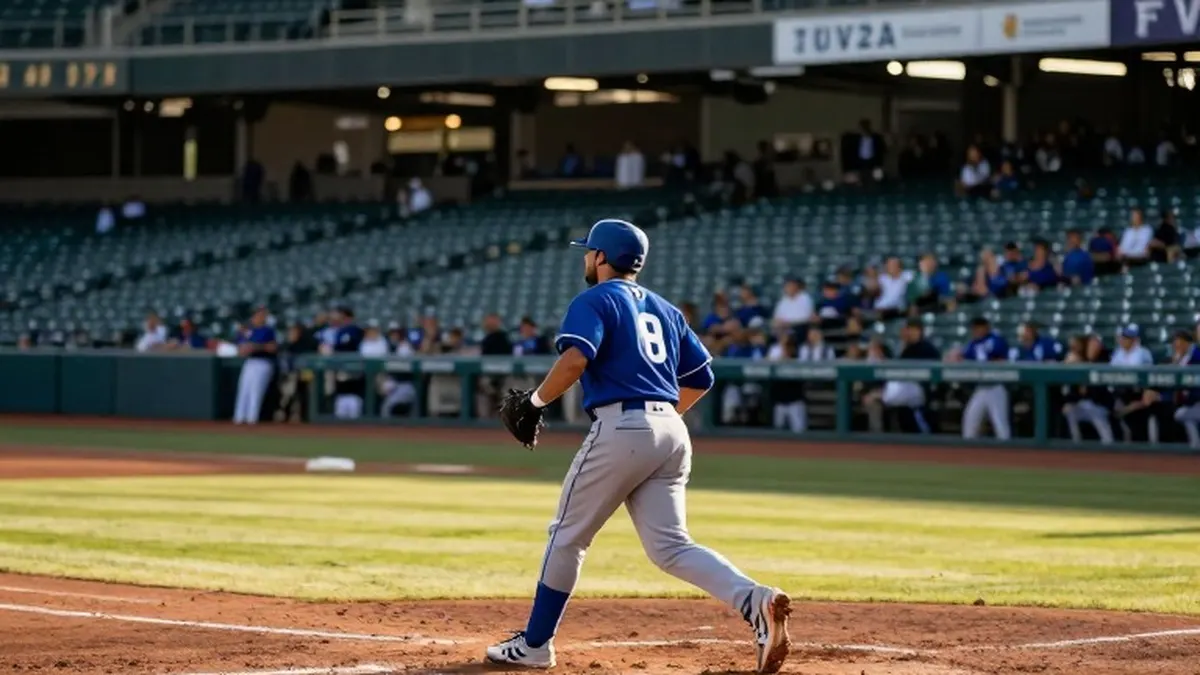
Pete Crow-Armstrong's remarkable 2026 campaign received its ultimate validation Thursday evening, when the Cubs center fielder was named the National League's Most Valuable Player by the Baseball Writers' Association of America.
Crow-Armstrong hit .280/.372/.570 while playing stellar defense, led the league in home runs in a tie with Kyle Schwarber and made a massive leap in his on-base skills. Still a few months shy of his 25th birthday, he already has an MVP award to his name, which raises a natural question about what comes next.
The historical company is striking. Since integration, only eight center fielders have produced a season of at least 8.0 WAR at age 25 or younger: Willie Mays, Mickey Mantle, Willie Davis, César Cedeño, Ken Griffey Jr., Andruw Jones, Mike Trout and Crow-Armstrong. Only Mays, Mantle and Trout topped his 9.8 figure, and going back before integration, just Tris Speaker and Ty Cobb did the same.
One possible career map is the Willie Davis route. Davis posted 8.4 WAR in 1964, a number driven largely by monster defensive metrics, as he hit .294/.316/.413 with 12 home runs and 42 stolen bases. Crow-Armstrong's 2026 season dwarfed that one overall, and Davis trailed Mays badly for the league WAR lead. Davis averaged 3.1 WAR per season the rest of his career and never reached 6.0 again, though he finished with more than 60 career WAR thanks to a decent average, excellent defense and baserunning. That profile resembled Crow-Armstrong's apparent upside before his power surge, but with 30-30 last year and 40-40 this year, the bar has been raised.
The Cedeño and Andruw Jones route offers a cautionary tale. Cedeño followed his 8.0 WAR season with 7.4 at age 22 and 5.8 at 23, and the most statistically similar player to him through ages 27 and 28 was Hall of Famer Carl Yastrzemski. He accumulated 49.4 WAR through his age-29 season, then managed only 3.6 over his final six years.
Jones followed a similar arc more recently. In 12 seasons with the Braves, he piled up 368 home runs, 1,117 RBI and 61 WAR while widely being considered the best defensive center fielder in baseball. After leaving Atlanta in time for his age-31 season, he produced just 1.7 WAR across his final five years, then needed nine turns on the ballot before finally reaching the Hall of Fame. Through his age-28 season, his most statistically similar players were Bryce Harper and Frank Robinson. Applied to Crow-Armstrong, this scenario would mean several more years among the game's best before a decline around age 30.
That outcome is certainly possible, but Crow-Armstrong has shown not only a willingness but an eagerness to make adjustments at the plate, which makes a sudden offensive wall hard to envision. At some point he will lose speed, affecting his defensive range and baserunning, yet it is worth remembering that few saw the collapse coming with Jones either.
Then there is the Mantle, Trout and Griffey route: players on a trajectory to be argued as the greatest ever before injuries in their 30s reduced them to mere all-time greats. Mantle had 90.7 WAR through his age-30 season, then averaged 121 games and 19.5 WAR over his final six years. Griffey had 76.2 WAR through age 30 and added only 7.6 more across 10 further seasons. Trout reached 72.1 WAR through age 27, when his top statistical comparisons were Mantle, Robinson and Griffey, but setting aside 2020, he has since averaged 90 games and 3.0 WAR per season. Even with those drop-offs, all three rank among the top six center fielders ever in career WAR, behind only Ty Cobb, Tris Speaker and Mays, with Joe DiMaggio seventh.
The final route belongs to Mays, and matching it would be jaw-dropping. From ages 23 to 35, Mays led the majors in WAR eight times and the NL two more times, with his worst seasons in that span still worth 7.6 and 7.8 WAR. He posted 5.2 WAR at age 39 and 6.3 at age 40, when he led the NL with a .425 on-base percentage. His 156.2 career WAR ranks third among position players all-time, behind only Barry Bonds at 162.8 and Babe Ruth at 162.3.
The realistic long-term range for the 2026 National League MVP appears to sit somewhere between Cedeño and Mantle, a wide spread of outcomes that is entirely appropriate for a player who is only 24 years old. That Crow-Armstrong's name belongs in this conversation at all is a testament to the season he just delivered.