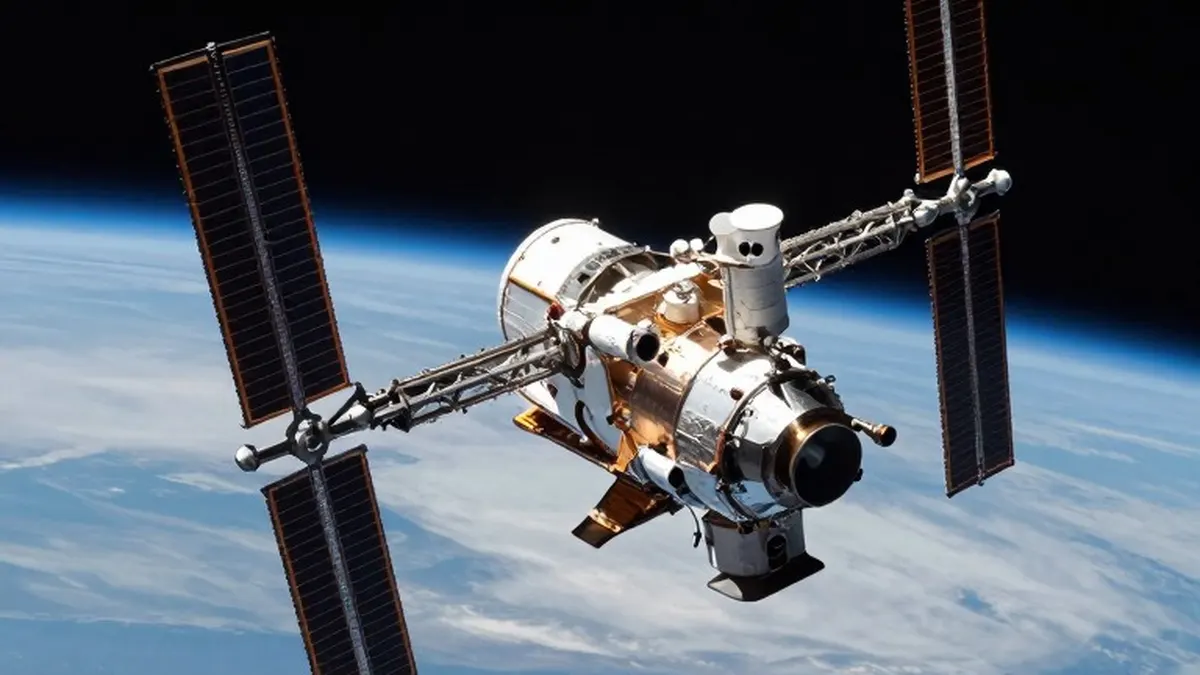
NASA is again seeking ideas from commercial companies to help determine the future of the Hubble Space Telescope, which has spent 36 years in orbit. Without intervention, the observatory is expected to fall back into Earth’s atmosphere in the early-to-mid-2030s, ending its time as one of astronomy’s most prominent scientific instruments.
In a Request for Information released Thursday, the agency asked businesses to describe their current and near-term ability to capture Hubble and raise its orbit, improve its performance through servicing, or arrange a controlled disposal. Companies have until November 30 to respond. The request seeks information about possible missions rather than committing NASA to purchase one.
For an orbit-raising mission, NASA wants Hubble taken to an altitude of at least 373 miles, or 600 kilometers. Any mission to boost or service the telescope would have to avoid harming it and would be expected to take place by 2032. The selected contractor would supply the launch vehicle, servicing spacecraft and mission operations, as well as a crew if the mission required one.
NASA wants to establish which companies are interested, what their proposed missions would cost and whether they could realistically reach the telescope before it reenters the atmosphere. Specialists in orbital dynamics currently expect an uncontrolled reentry in 2033 or 2034. That forecast is not fixed, however, because solar activity can change predictions about when the telescope will descend.
Hubble has no propulsion system of its own, leaving it unable to counter its gradual loss of altitude. Its orbit was last raised in 2002, when the Space Shuttle Columbia visited for a servicing mission. At that point, the telescope was orbiting about 362 miles, or 583 kilometers, above Earth.
The final shuttle servicing mission, in 2009, did not raise Hubble’s orbit. The shuttle fleet was retired two years later, and the telescope has continued to lose altitude without a way to prevent its eventual atmospheric reentry.
Over the 24 years since the 2002 boost, Hubble has descended to roughly 292 miles, or 470 kilometers, above Earth. Raising it to the altitude specified in NASA’s latest request would likely allow the observatory to remain in orbit for at least another 25 years.