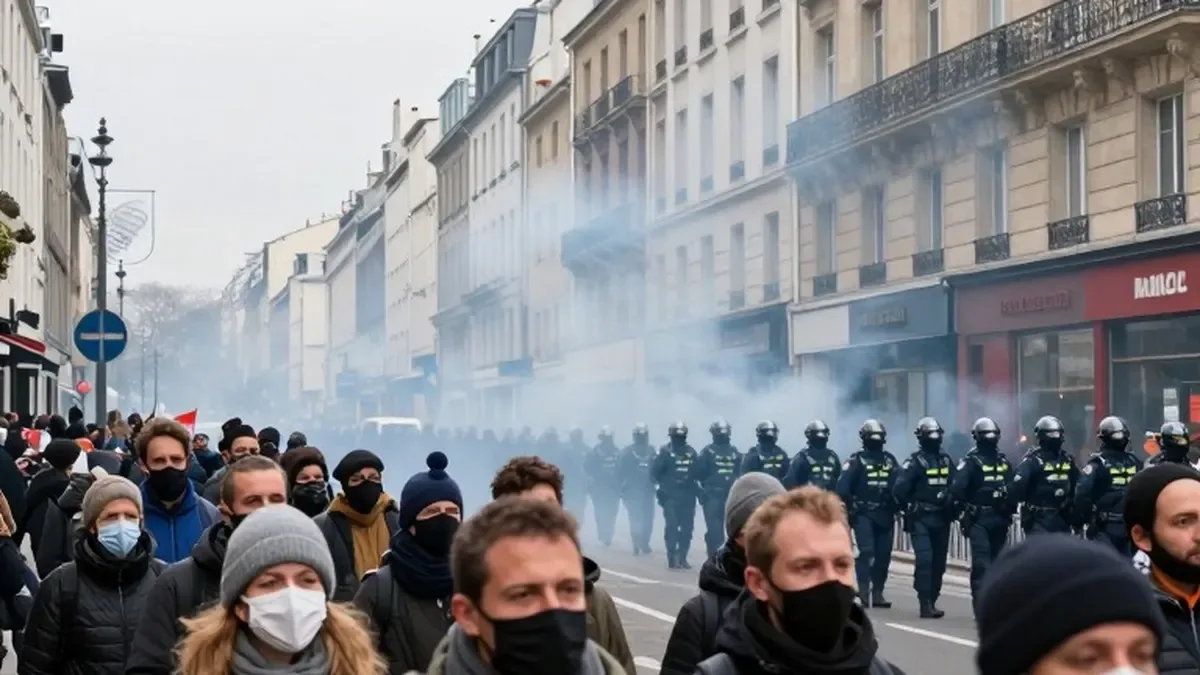
French riot police deployed tear gas and advanced on demonstrators in Lyon on Thursday, marking a significant escalation in ongoing civil unrest across the country. The clashes occurred as part of a nationwide wave of protests and strikes organized by trade unions and student groups, representing a renewed challenge to the administration of President Emmanuel Macron after several weeks of instability.
In various cities, protesters were observed shouting slogans against the police, with many participants dressed in black and wearing face coverings. The major labor union CGT, which is left-wing and leading the action alongside other unions, reported that more than 250,000 people were participating in demonstrations across 73 cities by the afternoon. These actions follow earlier unrest triggered by grievances over living costs, public services, and education, which has been described as the worst civil disturbance France has experienced in years.
The unions are demanding comprehensive wage increases, tax reforms, and improved educational conditions for young people. They have also expressed dissatisfaction with police restrictions placed on certain demonstrations. This social tension is occurring just five months before a presidential election that is expected to feature a second-round contest between far-right candidate Marine Le Pen and hard-left rival Jean-Luc Melenchon. President Macron, who is serving his second term and faces low approval ratings, is ineligible to run for office again.
Disruptions were widespread, with a high school near Toulouse reported to have been set on fire on Thursday morning. In Paris, students and other demonstrators faced off with riot police after blocking a street with rubbish bins. The Eiffel Tower was closed to the public due to the strike. Sophie Binet, the head of the CGT, urged the public to attend the protests in large numbers, noting that demonstrations were planned in 260 towns and cities.
Authorities had prepared for the day by deploying approximately 70,000 police officers nationwide. Domestic intelligence services estimated that between 500,000 and 700,000 people would join demonstrations outside of Paris. The strike action had already led to a reduction in France's electricity output early in the day, although no major issues were reported on the transport network. In Paris, police used tear gas to prevent students from blocking access to the Helene-Boucher high school.
The education sector was significantly affected, with the government reporting blockades at 81 of the country's 3,700 high schools. A student association stated that classes were suspended at 1,000 secondary schools, including those that were blockaded or closed due to strikes. Approximately 16 percent of teachers nationwide were participating in the strike, according to the education ministry. Public and private education unions joined the action, along with unions representing rail workers, public hospitals, and postal services.
Protesters cited deteriorating school conditions and uncertainty about their futures as primary concerns. Irma de Banville, a 19-year-old student in Paris, noted that many people were afraid of police violence but were trying to maintain mobilization. While the government defended its police tactics, it stated that any abuses would be investigated. The unions warned that France is on the brink of recession, with layoff plans increasing across sectors.
In a joint statement, the unions highlighted the rising costs of fuel, food, rent, and utilities, noting that these expenses are climbing while wages and pensions remain stagnant. They described the country's situation as fragile and emphasized the need to address social and environmental challenges immediately. Fabien Villedieu, a national secretary for the SUD-Rail union, told the Associated Press that going on strike is the traditional French response when the government and employers are not reasonable.
The current movement began in September with a protest over staff shortages at a high school southeast of Paris. It subsequently spread nationwide, drawing in students demanding more funding for education and workers seeking better pensions and relief from soaring living costs. Prior to the strike, the government had been engaged in negotiations with unions in an effort to limit the rioting that has characterized the recent period of unrest.