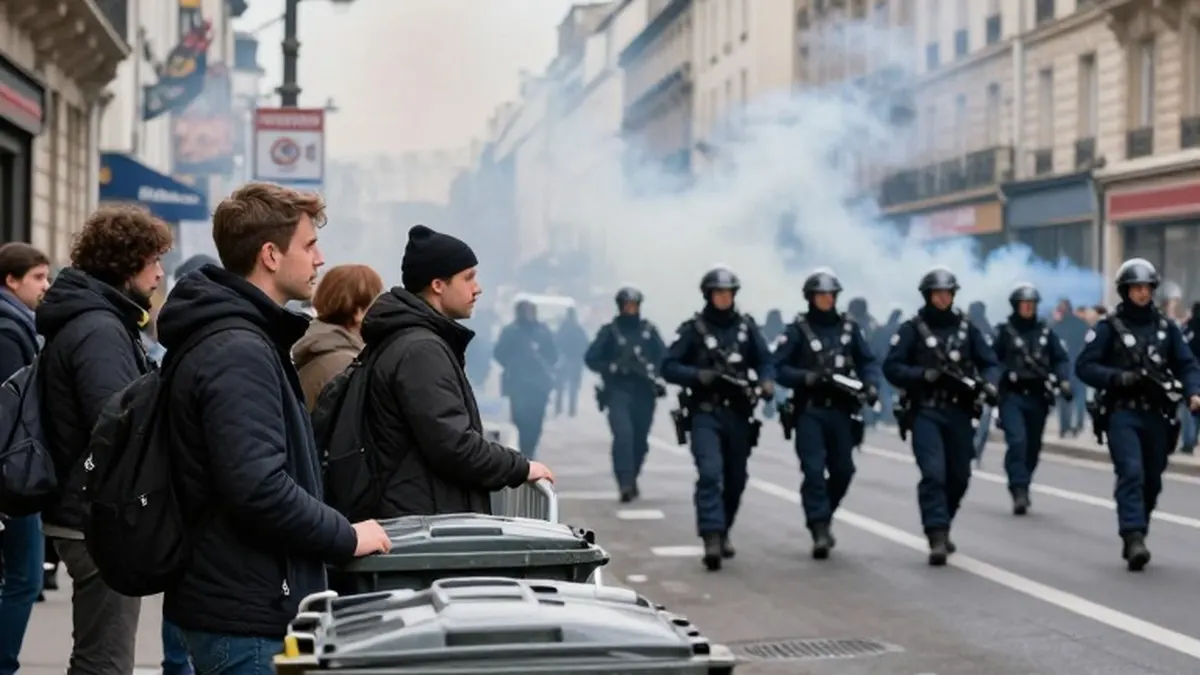
French riot police discharged tear gas and advanced on demonstrators in Lyon on Thursday, marking a significant escalation in the ongoing civil unrest that has gripped the nation. These events occurred as part of a broader wave of nationwide rallies and a coordinated strike by public sector employees, which trade unions organized with the backing of student groups. The renewed mobilization serves as a direct challenge to President Emmanuel Macron during a period of sustained discontent.
In Lyon, several hundred hardcore protesters confronted security forces. Many participants wore black clothing and face coverings while shouting anti-police slogans. The Interior Ministry reported that the violence remained contained, although tensions stayed high throughout the day. A similar scene unfolded in Paris in the morning, where high school students and other demonstrators blocked a street with rubbish bins before facing off with riot police.
The protests were not without incident in other regions. In the southwest, near Toulouse, individuals threw fireworks into a high school, causing a fire that forced pupils and staff to evacuate. Education Minister Edouard Geffray described the incident as an absolute scandal on social media. Meanwhile, in Lyon, a banner at the protest site carried the message that unity among pensioners, students, and workers would prevail.
Sophie Binet, the head of the CGT trade union, told reporters that the government had attempted to block the demonstrations but that the movement was larger than ever. She estimated that approximately 250,000 people were demonstrating across France. The strikes significantly impacted public services, with the Eiffel Tower closing its doors for the day. The Education Ministry noted that just over 15 percent of teaching staff had joined the walkout.
The unrest follows weeks of demonstrations focused on rising living costs, public service quality, and education funding. This current phase of protest comes five months before the presidential election, in which President Macron is constitutionally barred from seeking a third term. The race is expected to be a tight contest, potentially pitting far-right candidate Marine Le Pen against hard-left rival Jean-Luc Melenchon in a second-round runoff.
Mehdi Dumontroty, a 45-year-old firefighter participating in the Paris protests, highlighted the financial strain on public workers. He stated that wages had failed to keep pace with inflation and referenced the wildfires from earlier this year as proof that the sector needed more resources to handle crises. The summer heat waves had caused significant damage, reinforcing the argument for better funding.
Authorities have sought to lower tensions after the riots and looting that occurred on October 17 caught security forces off guard. That previous incident left shops and public buildings damaged across the country and intensified criticism of Macron's management of the crisis. In response to the current demonstrations, around 70,000 police officers were deployed nationwide, a figure comparable to recent weekends. The government has defended its police tactics while stating that any abuses would be investigated.
The movement initially began in September with a protest over staff shortages at a high school southeast of Paris. It quickly spread nationwide, drawing in students demanding more education funding and workers seeking better pensions and assistance with soaring fuel prices. Political parties are now seeking to capitalize on the momentum as the campaign to succeed Macron heats up for the election next May.