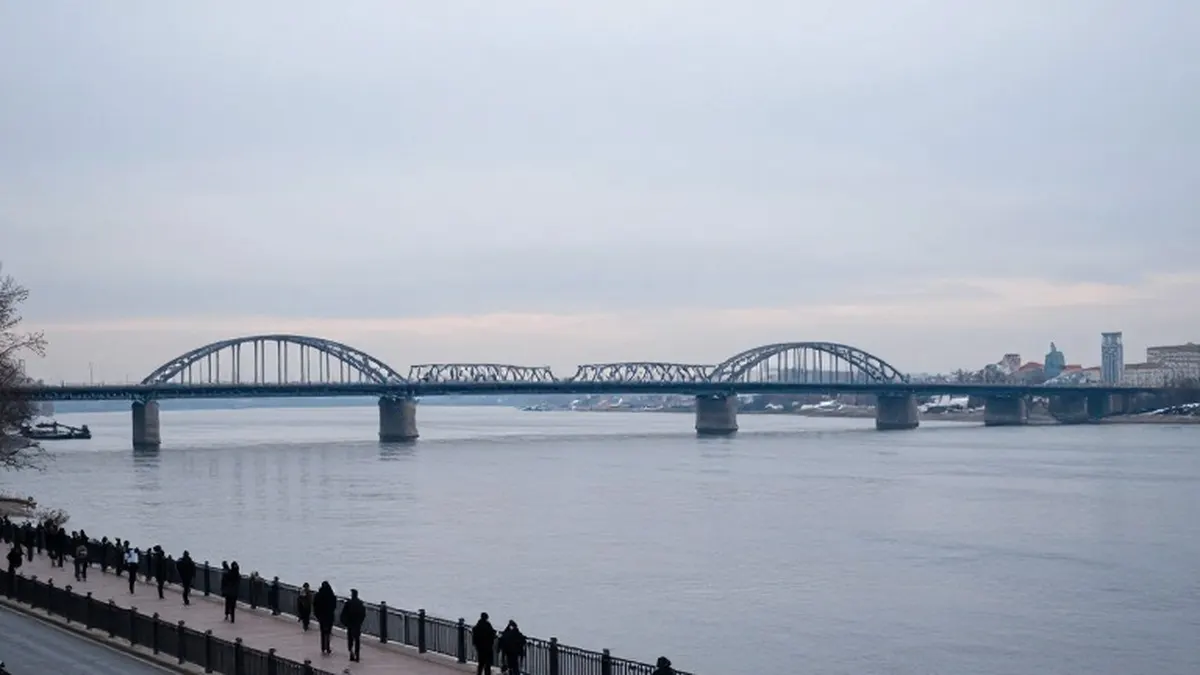
The capital of Ukraine, Kyiv, depends on seven road and rail bridges to connect its 3 million residents who live on opposite banks of the Dnieper River. Since early October, Russian forces have intensified attacks on these vital links, adding significant stress to a city already preparing for a difficult winter due to targeted strikes on power and heating facilities.
The situation escalated sharply this week when a new barrage damaged two of the bridges. On November 20, Mayor Vitali Klitschko ordered the complete closure of one bridge after it sustained heavy damage. The incident resulted in at least eight fatalities and has led to traffic restrictions, with some crossings now reserved exclusively for buses and subway trains.
City and national leaders are urgently developing backup plans to ensure mobility for residents, emergency services, and defense operations in case further bridges are destroyed. Mykola Kalashnyk, the national transport and infrastructure minister, announced on Telegram on October 30 that 21 combined water crossings are being planned. He confirmed that work has already started in the capital to establish these alternative routes.
One proposed solution involves constructing floating pontoon bridges. However, engineers note that these structures require stable embankments on the riverbanks to anchor them safely. Anna Minyukova, a bridge and transport tunnel engineer, pointed out that river currents have already washed away some of the initial sand and rockwork. She attributed this to the work being carried out under a simplified procedure to save time, noting that the estimated two to three month timeline is unrealistic, particularly with materials being sourced from abroad.
Officials have also considered deploying high-speed hydrofoils to ferry passengers across the river. While this option avoids the need for a full bridge, it requires the construction of new piers and access roads. Dmytro Bespalov, a transportation mobility expert, highlighted that these Soviet-designed vessels have limited capacity, carrying only about 80 passengers each. He also noted their high fuel consumption, estimating around 120 liters of diesel per hour when operating at speed on their underwater wings.
A longer-term option under consideration is the construction of tunnels beneath the Dnieper. Although the city's subway system has lines that cross to the eastern bank, the trains currently travel over the river via bridges. Five potential locations for new tunnels have been identified, and an American company has expressed interest in the project. However, Vitaliy Selyk, co-founder of the charitable organization Smilyvi Vidnovlyuvaty, warned that construction could take three to six years under ideal conditions, assuming stable funding and security.
Selyk emphasized the logistical challenges of building two massive construction sites on both banks while the city remains under fire. He questioned whether civilian workers would be willing to operate at such sites. Bespalov added that while tunnels are a standard solution in Central Europe, they typically require five to 10 years to complete, making them less effective for immediate needs.
Many residents are frustrated by the congestion and delays, with some walking across the bridges to save time. One commuter named Serhiy said he is considering finding new employment on the eastern bank to avoid the daily struggle of crossing the river. Another resident humorously suggested that if the winter becomes cold enough, he might use huskies and a sled to cross the frozen Dnieper.
The ongoing disruption has prompted criticism from locals who feel the city did not anticipate such a crisis. One woman, who declined to give her name, stated that the focus should be on infrastructure rather than new parks during wartime. She described the morning and evening commutes as a daily quest, highlighting the growing anxiety among Kyiv's population as they navigate the changing landscape of their city's transit network.