Prominent Hong Kong activist Joshua Wong was sentenced to 10 years in prison on Thursday, his second conviction under the national security law imposed by Beijing, in a case critics say reflects the sustained crackdown on the city's once-thriving pro-democracy movement.
Wong was charged in 2025 with conspiracy to collude with foreign forces to endanger national security, and he pleaded guilty to the offence in September, a step that usually results in a lighter sentence. The 30-year-old is already serving a term of four years and eight months for the city's biggest national security case, also following a guilty plea. Before the collusion prosecution, he had been expected to be freed in January 2027.
Judge William Tam said during the sentencing hearing that Wong's offence was of a grave nature, and he rejected the claim that Wong's role was limited. Tam said he had considered a 13-year sentence as a starting point but reduced it because of the guilty plea. He also ruled that Wong can serve his two sentences concurrently, noting that only about two months remain on the earlier term.
Wong looked calm and thanked his supporters before leaving the courtroom. Supporters waved back, and Tiffany Chin, a former member of the now-disbanded group Scholarism, which Wong once led, was in tears.
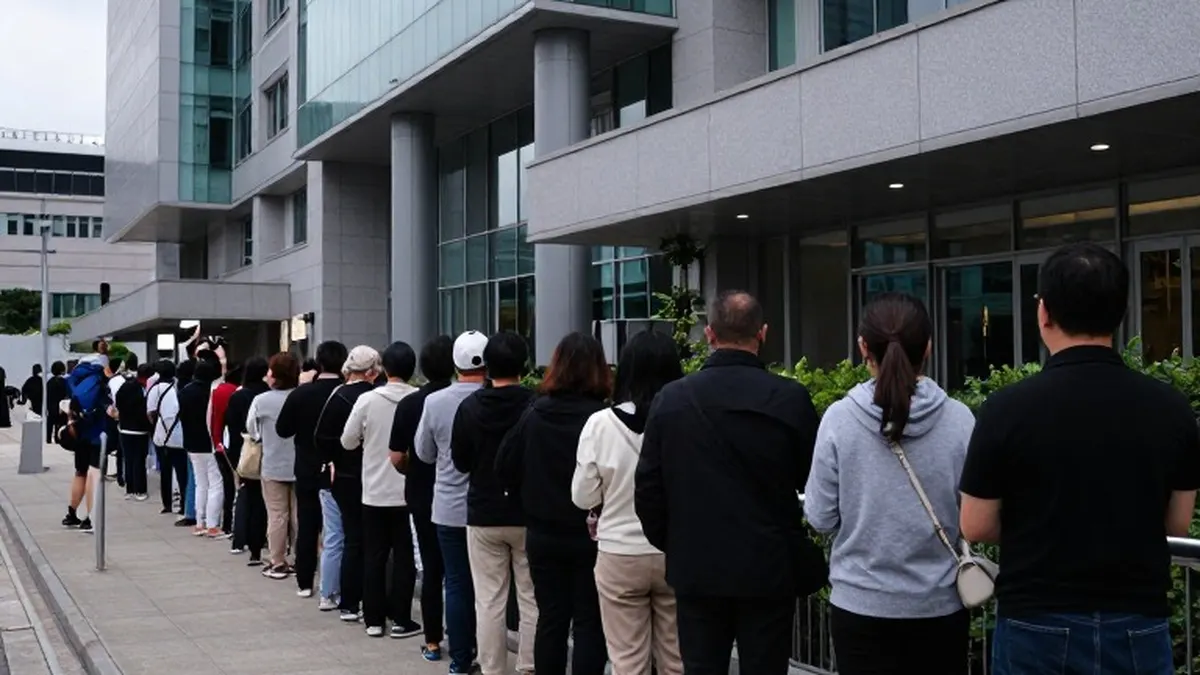
Some members of the public began queuing outside the court building as early as Tuesday to secure a seat in the public gallery, and activist Lui Yuk-lin held a piece of paper carrying Wong's name while waiting in line on Thursday. Resident ET Wong said the activist possessed "big-picture thinking" as a teenager that some adults might not even have, and walked a difficult path for Hong Kong's future, human rights and the student movement. "At least in my heart, he should not have spent a single day in wrongful imprisonment," she said.
Hong Kong once had a freewheeling civil society marked by vibrant protest and media scenes, but after an anti-government movement rocked the city in 2019, authorities reduced public choice in elections and arrested many leading activists. News outlets known for reports critical of the government shut down, and dozens of civil society groups dissolved. Observers say Wong's sentencing shows official determination to keep prominent activists in prison as long as possible, further chilling civic activism.
"NSL charges can be repeatedly weaponized to keep a specific political prisoner in jail, if the government deems necessary," said Eric Lai, a research fellow at Georgetown Center for Asian Law, referring to the national security law. Beijing, however, views Wong as an anti-China figure supporting Hong Kong independence, a stance that crosses its red line, and Hong Kong authorities say the security law is crucial for the city's stability following the 2019 protests, maintaining that law enforcement actions are evidence-based.
The prosecution alleged that Wong and fellow activist Nathan Law agreed in or around 2016 to lobby internationally for democratic self-determination, and that the pair had called for sanctions and other adverse measures against Hong Kong and China before the law was introduced, citing Wong's meetings with U.S. politicians Nancy Pelosi and Marco Rubio in 2016 and 2019. After the law took effect, Law and others advanced their work abroad, while Wong supported the effort from Hong Kong through foreign media and social media, prosecutors said.
Wong's lawyer, Derek Chan, earlier urged the court to impose a sentence that would give his client hope, saying Wong wishes to take care of his parents after his release. Friends said Wong has spent nearly six years in prison reading, exercising and teaching himself guitar. In September, a pro-Beijing newspaper criticized a 2017 Netflix documentary about Wong for "beautifying" his crimes, and the city's security bureau said the government was taking follow-up action. The documentary then shot to the top of Netflix's popular chart in Hong Kong.