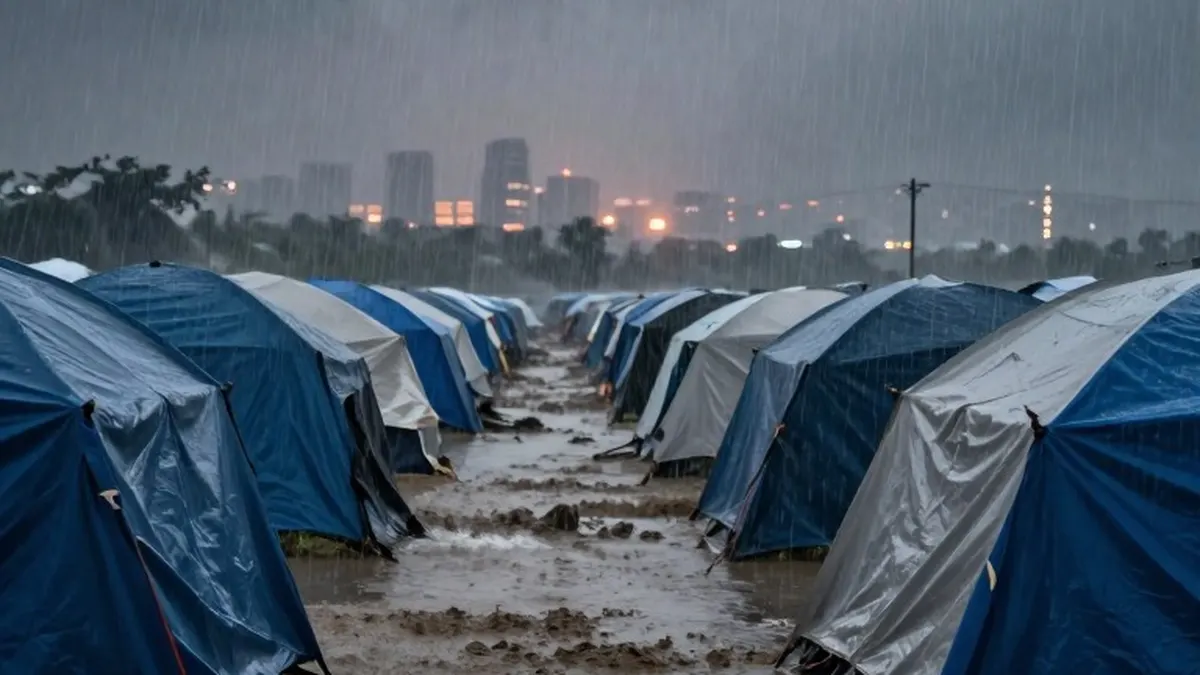
Winter storms struck the Eastern Mediterranean coast on Friday night and into Saturday, bringing heavy rainfall that significantly impacted the region. In the Gaza Strip, the downpour flooded numerous tent camps, leaving tens of thousands of displaced families without adequate shelter. The weather system also affected coastal Israel, where officials reported blackouts and road closures in several cities while issuing warnings for residents to avoid areas prone to flash floods.
Residents in the war-torn Gaza Strip described feeling overwhelmed as the rain flooded more than 70,000 tents. While no fatalities were reported, the storm caused injuries among the displaced population. The Hamas-run civil defense agency stated that it received 1,500 distress calls from residents. The agency also noted that three abandoned houses collapsed during the storm, though no injuries resulted from those specific incidents.
At a tent encampment in Gaza City, residents attempted to mitigate the damage by repairing structures or using sand to reinforce them against incoming water. Many families worked to move their children out of flooded shelters. Olfat Magdoub, a local resident, noted that the flooding occurred on the very first day of rain, raising concerns about the severity of future downpours. She expressed frustration at the rapid onset of the crisis.
Um Muhammad al-Hersh, 45, described the recurring nature of the winter suffering for displaced families. She recounted spending four days sleeping on blankets on the floor during a previous rain event because her bedding was soaked. She explained that her family could not save their mattresses or clothes, forcing them to sleep on the ground again. She emphasized that this cycle of hardship repeats every winter for many in the enclave.
In Deir al-Balah, Maryam Odeh, 34, shared the anxiety of not knowing where her children would sleep safely. Khaled al-Najjar, 41, added that families fear not only the flooding but also the cold and the potential spread of widespread diseases. A coalition of Palestinian civil society organizations issued a statement warning of a catastrophe threatening hundreds of thousands of residents. The group called for increased pressure on Israel to allow the unrestricted entry of humanitarian aid.
Hamas municipal and civil defense officials stated that fuel shortages and damaged equipment hindered their ability to cope with the storm. They claimed that Israel had destroyed hundreds of vehicles, including bulldozers and water pumps, during the conflict and has since restricted the entry of construction equipment. Israel has indicated that reconstruction work will not begin until Hamas agrees to disarm and relinquish control of the enclave.
Mustafa Qazzaat, a member of the Hamas-run Gaza City council, said that prefabricated homes have not been allowed into Gaza since the truce was announced. He stated that the territory urgently needs 200,000 such homes, along with heavy machinery to clear rubble, open roads, and provide electricity and heating. COGAT, the Israeli Defense Ministry agency coordinating aid, stated on Friday that it had stepped up efforts to improve sanitary conditions in coordination with international organizations ahead of the expected heavy rain.
In Israel, the Meteorological Service reported heavy rains across the coastal region and parts of the interior plains. The northern town of Binyamina received approximately 50 millimeters of rainfall within an hour on Saturday morning, leading to local floods. Residents in and near Gan Yavne experienced power outages for most of Saturday after the electric grid was damaged late Friday night. Tel Aviv recorded 40 millimeters of rain, while Haifa received 31 millimeters and Jerusalem 28 millimeters.
Authorities warned of a heightened risk of flooding in central and coastal Israel, particularly in flash flood zones near rivers. Police briefly closed Route 90 near the Dead Sea on Saturday morning due to flood concerns but reopened it after the storm passed. The Health Ministry advised Israelis to avoid swimming in the Mediterranean on Saturday due to potential sewage runoff from the heavy rainfall. The rain was expected to continue into Saturday evening before lightening, with sporadic light rain predicted for the coming week and slightly lower temperatures.