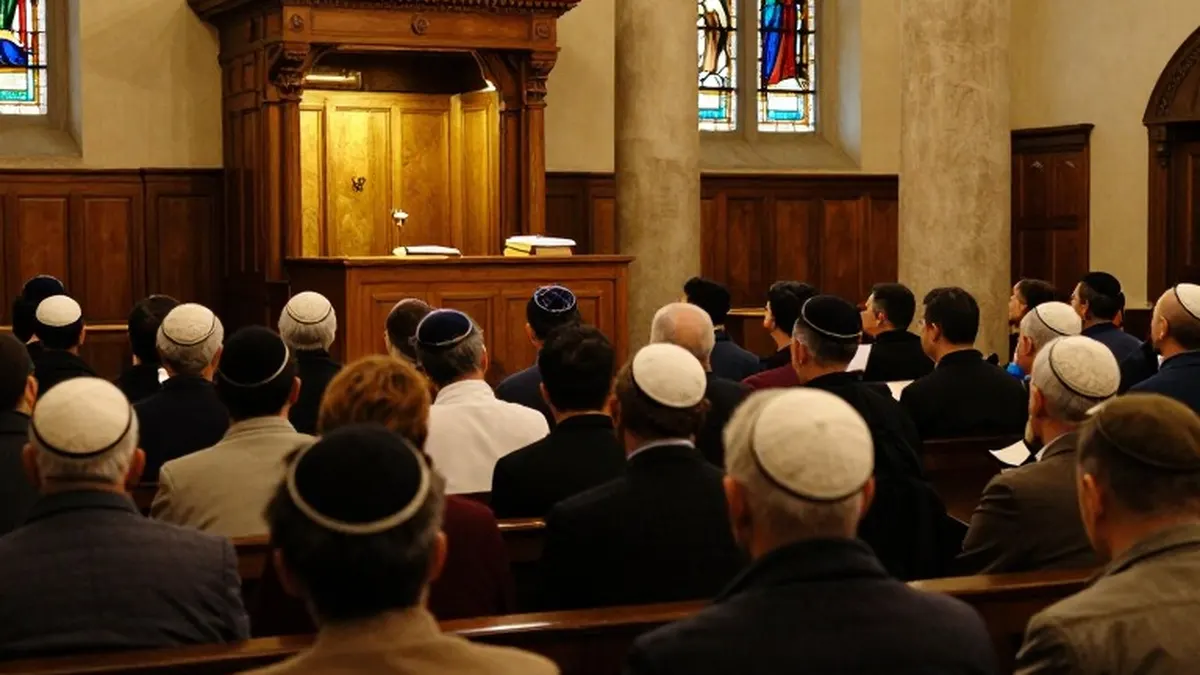
More than 150 rabbis, scholars, and communal leaders from over a dozen countries gathered in August in the sanctuary of Manhattan's Congregation Shearith Israel, the oldest Jewish congregation in the United States, for the second Sephardic Rabbinic Conference, titled The Art of Leadership. Over two days, the program ran from halachic decision-making and pastoral care to AI and Israel advocacy, and included an evening concert of Sephardic liturgy.
Those addressing the gathering, in person or on video, included Rabbi Haim Sabato, rosh yeshiva of Birkat Moshe in Ma'ale Adumim and a recipient of this year's Presidential Medal of Honor; Kiryat Ono Chief Rabbi Ratzon Arussi, the leading disciple of Rabbi Yosef Qafi; Rabbi Benzion Algazi, rosh yeshiva of the Ramat Gan hesder yeshiva and founder of the Tzurba M'rabanan Institute; Consul General in New York Ofir Akunis; and World Zionist Organization chairman Yaakov Hagoel.
The inaugural conference last year drew some 50 rabbis from six countries. This time, delegates arrived from Turkey, the United Arab Emirates, Mexico, Spain, the United Kingdom, Israel, and Argentina, serving Syrian, Persian, Moroccan, Greek, Bukharian, and Spanish and Portuguese communities.
At the heart of the effort is an idea the movement's own literature calls worldliness: a posture toward knowledge developed by the geonim, the spiritual and legal leaders of Babylonian Jewry from the late sixth century to the 11th century, and carried to its height in medieval Spain and Provence, where grammar, logic, medicine, astronomy, and philosophy were treated as instruments of Torah study. The Habura, the study community at the center of the movement, compresses the reasoning into one line on its website: the author of the Torah is the author of the world.
How that mainstream tradition became a minority position is a story of numbers and institutions. In the 11th century, nearly all Jews were Sephardic. By the 1930s, more than nine in 10 were Ashkenazi, and the Ashkenazi world had spent two centuries building modern religious institutions, above all the yeshiva. Political scientist Daniel Elazar judged a generation ago that the Sephardic rabbinate was well on the way to Ashkenazification by 1953, the year Rabbi Ben-Zion Uziel, the Sephardi chief rabbi of Mandatory Palestine, died.
The result, critics within the movement say, is a leadership class formed almost entirely in one educational world. "A method that is never taught as a whole cannot compete as a whole," said Sina Kahen, co-founder of The Habura and founder of Da'at Press, whose book The Battle for the Jewish Mind was published this year and revisits the 13th-century quarrel over Maimonides. "Nobody planned that. It is what happens when you have no institutions of your own."
The response has come in three parts. The Habura, founded by Kahen and Avi Garson, teaches more than 2,000 students in English, Hebrew, and Spanish in more than 20 countries, with in-person groups in Britain, the United States, Mexico, Brazil, and Israel, and records over 1,000 hours of Torah study a month. Its rosh bet midrash is Rabbi Joseph Dweck, who served as senior rabbi of the Spanish and Portuguese Sephardi community of the United Kingdom from 2013 to 2025.
Da'at Press serves as the movement's library, returning works by Sadiya Gaon, the Meiri, Elia Benamozegh, and others to print, sold worldwide through Amazon and daat.press and in Israel through Jerusalem's Pomeranz bookstore, with free copies sent to yeshivot and schools. The conference itself was co-founded by Garson, the COO of the Jewish Wisdom Society, and Ethan Marcus of the Sephardic Brotherhood of America, and was co-hosted by The Habura, the Sephardic Jewish Brotherhood of America, and the UJA-Federation of New York, with support from the Orthodox Union, Rabbinical Council of America, World Zionist Organization, and KKL-JNF.
Organizers are adamant that the project is not ethnic. "Sepharad and Ashkenaz, as we use them, are modes of thinking," Kahen said. "The name tells you where the method was kept safest. It does not tell you who owns it." Garson struck a similar note about the gathering's purpose: "This is not a nostalgic reunion, and not a call to go back to Aleppo. The classical tradition is neither. It is rooted, and it is not rigid."
A century ago, Rabbi Henry Pereira Mendes called from a London pulpit for a renewal of Sephardic energy. The people behind The Habura, Da'at Press, and the conference describe their work as a wager on the Jewish future rather than an exercise in preservation. Dweck summarized the task before the next conference in four words: "The center must hold."