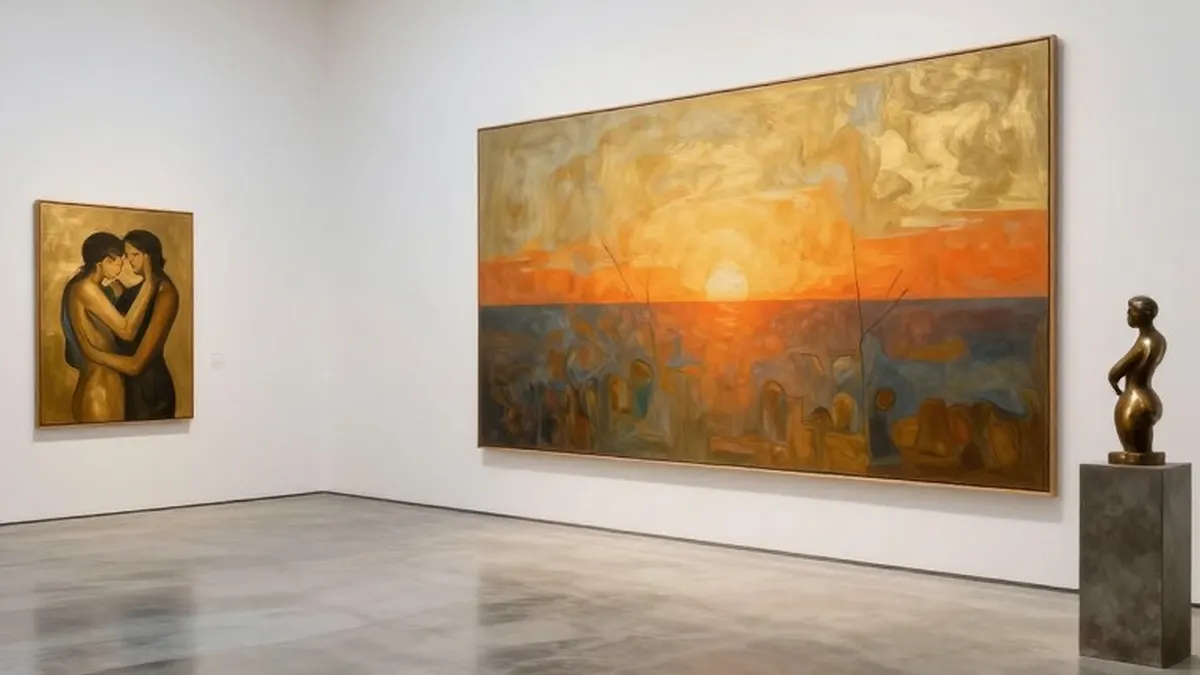
London-born artist David Breuer-Weil has opened his first solo exhibition in Israel, bringing paintings and sculptures shaped by the Hamas-led massacres of October 7, 2023 to the Sheetrit & Wolf Gallery in Tel Aviv's Neveh Tzedek neighborhood. The show, titled Achdut (Unity), opened recently at the gallery on Shabazi Street.
The exhibition arrives as many British Jews are asking whether the refuge Britain once offered their families still holds. Breuer-Weil's father, a Jewish boy from Vienna who was named George after the king to ease his entry into England, fled in 1938 ahead of the Nazis and found shelter first in London and then in Letchworth. "England saved his life, basically," the artist said. "So there's a certain love for England, because they actually saved our family."
The figure of the outsider runs through his work, from the Alien and Visitor series, in which giant bodies appear to have crash-landed headfirst, to Visitor V on London's Park Lane, a pair of monumental feet sticking upside down out of the ground. His father and grandfather were officially classed as aliens when they reached Britain. "A lot of my work has a sort of Monty Python double edge," he said. "At first, it may be quite amusing, but there's a deeper thing behind it."
Raised in a religiously observant home with a strong grounding in Talmud, Breuer-Weil studied at Central Saint Martins under Shelley Fausset, one of Henry Moore's main assistants, and visited Moore's studio while the sculptor was still alive. He describes the result as the English sculptural tradition merged with a Jewish sensibility. Israelis have lived with that mixture for years, often without knowing his name: his globe Jerusalem, Centre of the World, commissioned by the Jerusalem Foundation as a tribute to map collector Aaron Laor, stands in the capital's Teddy Kollek Park, and his sculpture Soul, built on the Talmudic teaching that saving one person saves the whole world, stands at Shaare Zedek Medical Center.
That same teaching drove Morning, the painting he began immediately after October 7 and completed on October 25, 2023. He made it to the exact dimensions of Picasso's Guernica, 3.76 by 6.88 meters, working day and night. Where Guernica holds nine figures, Morning holds hundreds, perhaps thousands, each rendered as a world. "There were so many people, 1,200. That's 1,200 worlds," he said.
In London, Morning was shown only at a private event with British Friends of the Art Museums of Israel, as part of a larger exhibition in Cavendish Square, and never reached the press. "We didn't hide it. It was a security thing," he said. The works that followed turned toward Britain itself, including vast canvases of burning newspapers, a response to what he sees as media distortion of what happened, and paintings of books that recall the book burnings of earlier times.
In Where Will I Go, on view in Tel Aviv, he draws on a Renaissance prototype to confront the question many British Jews now ask about their future in the country. He is also creating Britain's memorial to October 7 for the Jewish community, a project endorsed by the Israeli Embassy and Chief Rabbi Sir Ephraim Mirvis. It will stand in Brighton, home to a new Jewish community center and to families who lost relatives on October 7, among them the family of Adam Ma'anit, a prominent advocate for Israel in Britain.
During the months the hostages were held captive, Breuer-Weil painted the yellow ribbons that London's Jewish community tied to trees across the city, describing them as little acts of support or rebellion. When the released hostages came home, the photographs of families holding one another led to Home, a series of 18 gold paintings and four sculptures of people embracing. "These are the good stories," he said. "Not in all cases, but in some cases, the story ended with being reunited."
Gallery co-owner Ruth Sheetrit proposed the exhibition's title after seeing the embracing figures, though Breuer-Weil said he would add a question mark. "What does it mean to us as Jewish people nowadays? Is it possible?" he asked. He now wants to donate Morning, which comes in four parts and needs a very large wall, to Israel as a statement of support, and Sheetrit is looking for a permanent home for it. The artist also dreams of a sculpture park, perhaps in the Negev. "I need the patron," he said.