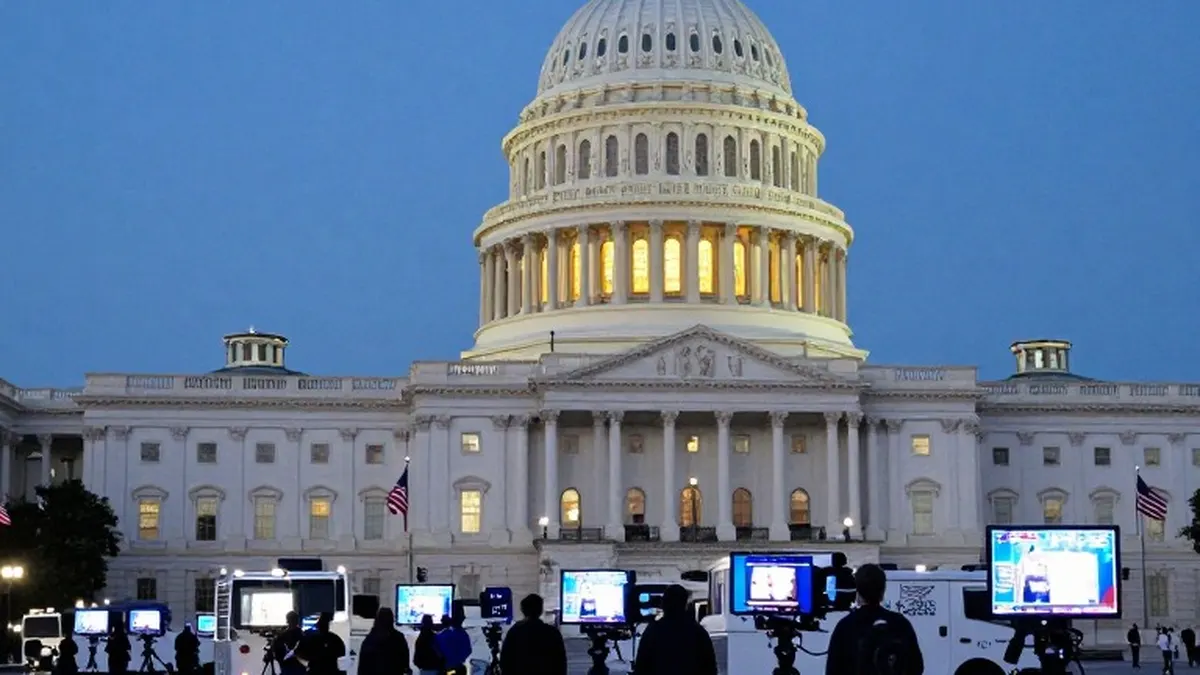
Control of the Senate is at stake as voters cast their ballots Tuesday, capping a midterm election cycle defined by betrayal, alleged ballot shenanigans and President Donald Trump's repeated public praise for the backside of one Republican candidate.
Close contests are expected in familiar battlegrounds such as Georgia, Michigan and North Carolina, but also in states that have grown more reliably Republican during Trump's rise in politics, including Ohio and Iowa. Races in even deeper red states such as Alaska, Kansas and Texas have also proved tighter than expected. Underscoring the stakes, more than $3.4 billion has been spent on television and digital advertising in Senate races nationwide, according to tracking firm AdImpact.
Republicans currently hold a 53-47 majority in the chamber, meaning Democrats would need a net gain of four seats to win control.
The consequences for Trump are significant. For the past two years, Republicans have controlled both chambers of Congress, allowing him to pursue his agenda largely unchecked. If the GOP loses the Senate, he would need Democratic cooperation to advance legislation and appointments, while Democrats would gain expanded power to investigate his administration.
Alaska has emerged late as a closely watched contest. Democrat Mary Peltola is under scrutiny after a New York Times report that her campaign and other Democrats recruited a candidate, Dan J. Sullivan, who shares a name with Republican Sen. Dan Sullivan. The tactic, described as ballot-stacking, is seen as a way to sow confusion among voters in a state that uses ranked choice voting and has four Senate candidates on the ballot. Peltola and her campaign have repeatedly denied recruiting the lesser-known Sullivan. Polls close in Alaska at 1 a.m. ET.
Clarity on the battle for the Senate will arrive much earlier in states such as Ohio, where polls close at 7:30 p.m. ET, and Michigan, where the last polls close at 9 p.m. ET.
In Ohio, Republican Sen. Jon Husted faces a tough challenge from Democratic former Sen. Sherrod Brown in the race to serve the remaining two years of JD Vance's unexpired Senate term. Husted was appointed to fill the seat temporarily last year after Vance was elected vice president. Polls have shown a close race, and Trump held three rallies in the state in recent weeks, along with one in the Cincinnati media market in neighboring Kentucky, to boost Husted. At those events, Trump promoted Husted's work as a senator while also repeatedly complimenting his physique in blunt terms.
Michigan's race is ending on an explosive note. Republican nominee and former Rep. Mike Rogers received a surprise last-minute endorsement Sunday from Rep. Haley Stevens, who lost the Democratic nomination in August to Abdul El-Sayed. Stevens had vowed as late as Saturday, publicly and privately, to keep her promise to vote for El-Sayed. The two Democrats had long clashed over his criticism of Israel, and her criticism intensified in recent days, prompting the El-Sayed campaign to signal she was no longer welcome at his events. Stevens cited that in her decision to defect to Rogers, sparking outrage and accusations of betrayal from House Democratic colleagues.
Other key races include Maine, where polls close at 8 p.m. and Republican Sen. Susan Collins is up against Democratic former state Senate President Troy Jackson. In Texas, where the last polls close at 9 p.m. ET and no Democrat has won a Senate seat in 33 years, state Rep. James Talarico has maintained steady polling leads, though within the margin of error. He faces state Attorney General Ken Paxton, who ousted incumbent Sen. John Cornyn in a primary runoff after a heavy push by Trump, while Trump ally and tech billionaire Elon Musk has spent at least $150 million to back Paxton.