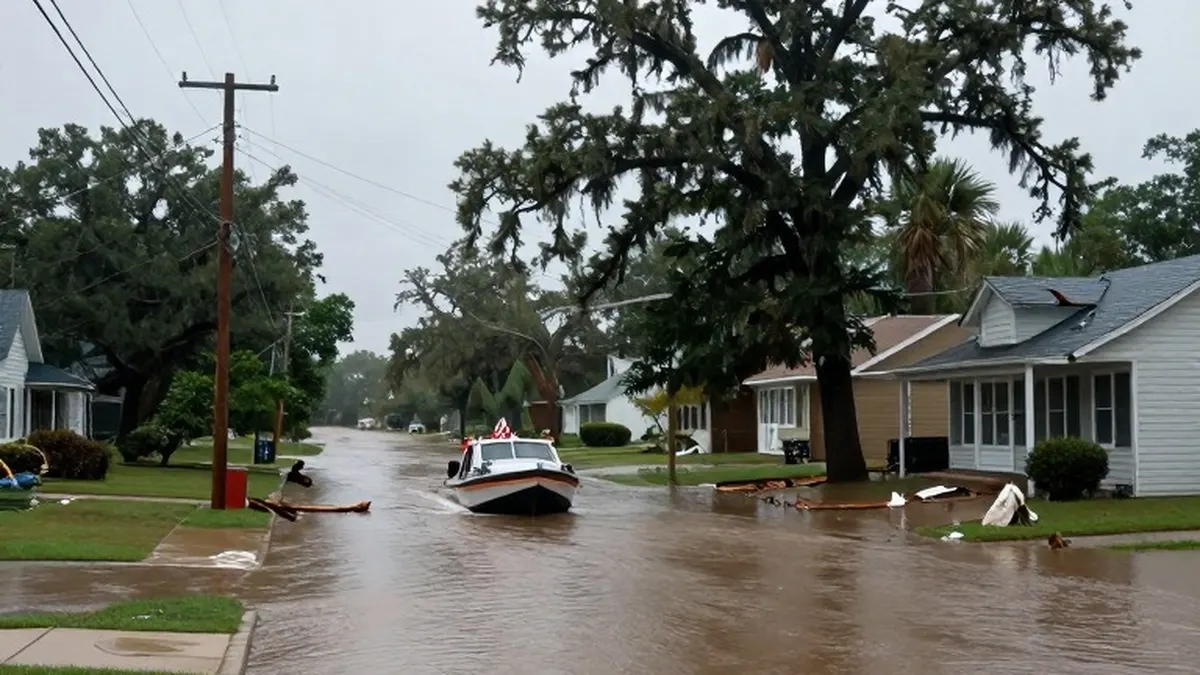
Hurricane Helene carved a vast path of destruction through Florida and much of the southeastern United States, leaving at least 40 people dead in four states as of Friday. The storm snapped large oak trees, ripped apart homes and forced rescue crews into urgent operations to pull people from floodwaters.
Helene made landfall late Thursday as a Category 4 hurricane with maximum sustained winds of 140 mph (225 kph). It came ashore in the thinly populated Big Bend region of Florida, where fishing villages and vacation retreats sit at the meeting point of the Panhandle and the peninsula. Moody's Analytics said it expects between $15 billion and $26 billion in property damage.
The effects reached hundreds of miles inland. In northeast Tennessee, 54 people were moved to the roof of Unicoi County Hospital as water rapidly flooded the building, prompting a dangerous helicopter rescue. Ballad Health said all staff and patients were rescued and no one remained at the hospital by late Friday afternoon. In Georgia, some hospitals in the south lost power, and Gov. Brian Kemp said chainsaws were needed to clear debris and reopen roads.
Atlanta recorded 11.12 inches (28.24 centimeters) of rain in 48 hours, according to Georgia's Office of the State Climatologist. That is the most the city has received in a two-day span since records began in 1878, surpassing a 9.59-inch mark set in 1886. In North Carolina, a lake featured in the film "Dirty Dancing" overtopped a dam, and nearby residents were evacuated. Newport, Tennessee, was also evacuated over dam concerns, though officials later said the structure had not failed. A tornado in Nash County, North Carolina, critically injured four people.
Pinellas County Sheriff Bob Gualtieri said all five people who died in his county were in areas under evacuation orders. Some residents who stayed because they doubted the warnings ended up hiding in attics from rising water. "We tried to launch boats, we tried to use high-water vehicles and we just met with too many obstacles," he said, adding that the toll could climb as crews search flooded neighborhoods. Two South Carolina firefighters were killed when a tree hit their firetruck.
Survivors described frightening scenes. Laurie Lilliott found her home in Dekle Beach, Florida, collapsed by storm surge, with one corner held up by a piling. "It took me a long time to breathe," she said. In Hudson, Florida, Kera O'Neil and her sister waded through chest-deep water carrying their two cats after water reached her knees indoors.
President Joe Biden said he was praying for survivors. The Federal Emergency Management Agency deployed more than 1,500 workers, who assisted with 400 rescues by late morning. Officials cautioned that floodwater may hide live wires, sewage and sharp debris, and the Citrus County sheriff's office urged trapped residents to call for help rather than wade out.
Nearly 4 million homes and businesses in Florida, Georgia and South Carolina had no power Friday afternoon, according to poweroutage.us. A Georgia utility group warned of "catastrophic" damage, with more than 100 high voltage transmission lines hurt. Florida Gov. Ron DeSantis said Helene's damage appeared greater than that of Hurricane Idalia and Hurricane Debby combined. "We also understand that this is a resilient state," he said.
In North Carolina, forecasters warned of flooding possibly worse than any in the past century, and about 300 roads were closed. A mudslide washed out part of an interstate at the North Carolina-Tennessee line. Buncombe County's 911 center took more than 3,300 calls in eight hours, and Ryan Cole, the county's assistant emergency services director, said recovery would take "many days and weeks." Helene was the eighth named storm of the Atlantic season, which NOAA had predicted would be above average because of record-warm ocean temperatures.