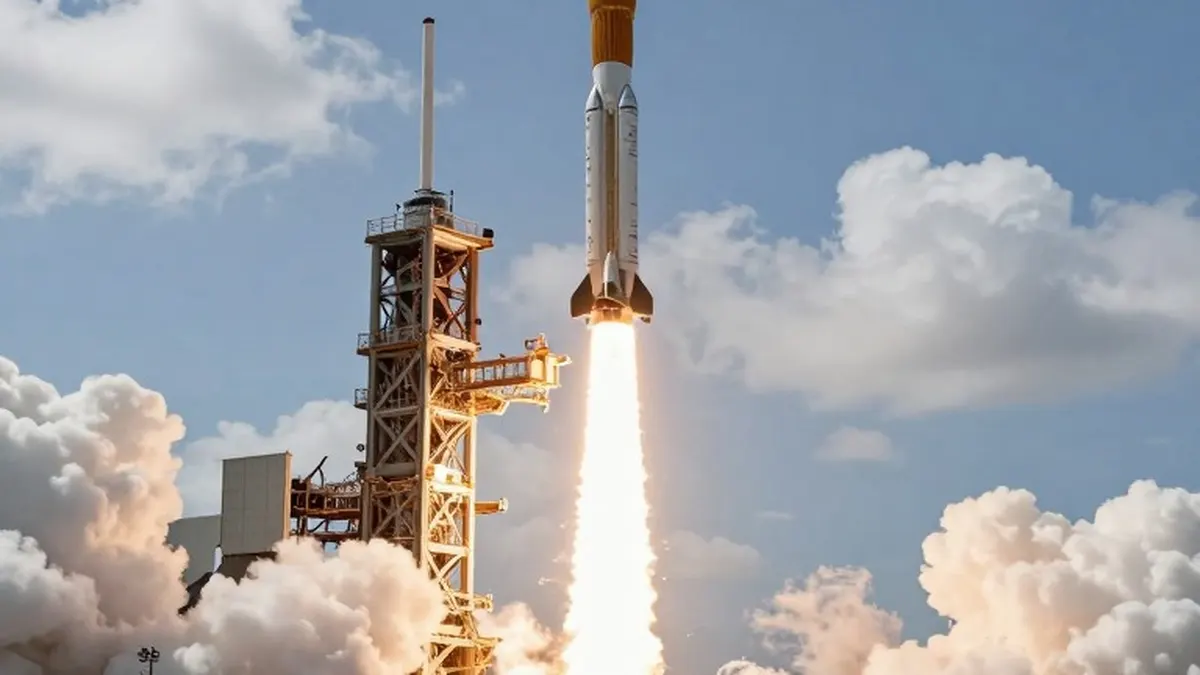
A SpaceX Falcon 9 rocket lifted off from Florida at 1:17 p.m. on Saturday, sending the Dragon spacecraft toward the International Space Station on NASA's ninth commercial crew rotation mission. The flight, known as Crew-9, had been pushed back earlier in the week because of the weather from what was by then post-tropical cyclone Helene.
On board are NASA astronaut Nick Hague and Roscosmos cosmonaut Aleksandr Gorbunov, who are headed for a five-month stay at the orbiting laboratory. Hague is expected to dock at the station on Sunday at about 5:30 p.m. EST. After the launch, he described the trip on NASA's livestream: "It was a sweet ride."
The capsule left Earth with two seats unoccupied. They are meant for NASA astronauts Sunita "Suni" Williams and Barry "Butch" Wilmore, who have been in space since early June and will return aboard the Dragon in February.
Williams and Wilmore reached the station on June 6, a day after launching from Cape Canaveral aboard Boeing's Starliner. They had been expected to head home about a week later. That plan fell apart when NASA and Boeing officials found helium leaks and problems with the spacecraft's reaction control thrusters as the Starliner neared the station.
After weeks of testing and data analysis, NASA decided late last month that it would be too risky for the two experienced astronauts to fly home on the Starliner. The Boeing-built spacecraft instead returned to Earth without a crew on Sept. 7, leaving Williams and Wilmore to wait several more months for a ride.
The solution required changes to the Crew-9 roster. Astronauts Zena Cardman and Stephanie Wilson had to give up their seats to make room for the returning pair. NASA Deputy Administrator Pam Melroy told a post-launch news conference that a crew change "is not a small thing," and said the reshuffling was "hard" for the two. She added that it reflects how complicated and dynamic human space flight is. "We need to be agile and focus on the mission," she said.
NASA Administrator Bill Nelson congratulated "the entire team on a successful launch" and noted that the mission demanded "a lot of operational and planning flexibility." He credited NASA staff along with commercial and international partners for adapting to changing circumstances "without sacrificing the safe and professional operations of the International Space Station."
NASA said the Dragon separated from the rocket and is flying freely. Crew-9 is scheduled to arrive at the station on Sunday, Sept. 29, at 5:30 p.m. ET, with coverage beginning on NASA+ at 3:30 p.m. ET.